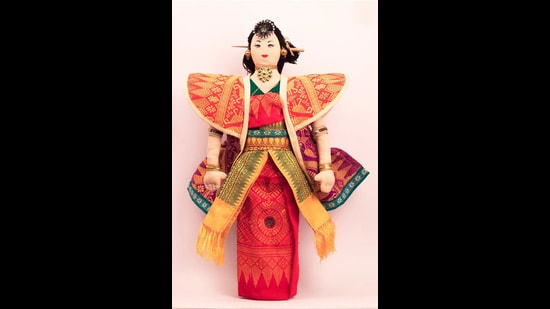
Kirat Brahma began making dolls when he was six. His first one was a papier-mâché bird, he says.
He made the figurines because he loved crafts as a child, but also because the blonde dolls and plastic toys around him didn’t seem to have anything in common with the tales his grandmother told: of magical birds, Bodo farmers who turned warriors overnight, and powerful queens reflected in the moon.
Bridging this gap, between the stories of his people and the
Kirat Brahma began making dolls when he was six. His first one was a papier-mâché bird, he says.
He made the figurines because he loved crafts as a child, but also because the blonde dolls and plastic toys around him didn’t seem to have anything in common with the tales his grandmother told: of magical birds, Bodo farmers who turned warriors overnight, and powerful queens reflected in the moon.
Bridging this gap, between the stories of his people and the toys their children play with, has been his mission ever since.
As a young man, he enrolled at the National Institute of Design, Ahmedabad, graduated in 2015, worked for years in animation. But I think I was always going to find my way back to toys, says Brahma, 35, smiling.
He wanted children from Assam — a region often so isolated and underrepresented that few of us have contributed even to the massive flood relief efforts needed there this year — to have something in which they could see themselves reflected. Something that would also remind them, he says, that their stories mattered, “even though they don’t show up in comic books and movies”.
In 2021, he returned home after a decade in Ahmedabad and started Zankla Studio with his mother, Bharti Brahma, 58, a homemaker, weaver, tailor and embroiderer.
Today, he heads a company, a non-profit foundation, and a team of 34 local artisans, all focused on heritage handmade, biodegradable toys made by local craftspeople. Each one comes with a story on a card, and a link to the Zankla Studio website for more.
So who are these characters, and what’s next for Zankla?
* Gowdang Rani: A popular Zankla Studio doll, Gowdang Rani draws from stories of a Bodo / Bhutanese queen. Legends tell of how she fought to protect her people’s land. “She represents female power,” Brahma says. “When I talk about her, people in my community can visualise her. The glowing full moon is a metaphor for her; a source of light in the darkness.”
* Mimi: This mythical songbird loses her song after she is captured and caged. “She eventually realises that her captor is also trapped in a relationship with the ones he captures,” Brahma says. The folktale is open-ended, meant to provoke thought and introspection. The bird’s captivity becomes a reflection on the things that weigh us down. Rather than offering a conventional escape or resolution, the story follows her gradual realisation that she can move beyond the bars that confines her.
* Boro Jwhwlao: A traditional Bodo fighter, this is an ordinary man who carries within him the spirit of a warrior. He is a patriot, protector, defender of his community and land. He has no rank or title. He looks like just about any young man. The doll is dressed like a farmer, bandanna around his head, setting out to cut grass with a scythe. Yet the card tells the buyer he is capable of great things, as many ordinary people tend to be. (It also tells them he dislikes laziness, and likes to eat rice and chilli.)
* Zara Fagla: With his mop of hair, sunglasses, dreadlocks and modern attire, this doll draws on the Bodo folk dance tradition, but reimagines the folk artist as a contemporary musical figure who encourages wisdom and unity through songs with which people of all ages can identify.
* Gambari Sikla or Thengphakhri: This legendary Bodo woman is known in folk lore as the region’s first female tax collector in the British era. She is remembered for resisting British authority after seeing the hardships her people suffered, because of the taxes she was ordered to collect. Her story survives in the Bodo oral tradition and folk songs.
* There are animals, birds and butterflies too. Some are endangered, such as the red panda, rhinoceros and elephant. Others are beloved local species, such as the peacock and water buffalo.
Brahma says the studio’s approach to all its figurines is to take a key aspect of local lore and give it shape, allowing children and adults alike to dig deeper and discover more, embellish tales or retell them with stories of their own woven in.
“The idea is to have these toys make people curious about what they stand for,” he says.
The dolls are currently available via the Zankla Studio website and Instagram page.
“Right now, we are also selling at the Eco Shop in Kaziranga National Park. We will soon be at the Pakke Tiger Reserve in Arunachal Pradesh, and Manas National Park in Assam.”
Prices range from ₹200 to ₹3,000. Brahma says he is working to cut these in half, so that more locals can engage with the toys. Right now, he is trying to balance the needs of his team, he adds, with the fact that the cheapest dolls available to villagers can cost as little as ₹40 (albeit made from scratchy plastic, with hair of yellow nylon thread).
Meanwhile, Zankla Foundation, the company’s non-profit arm, is now in the process of using corporate social responsibility funding to launch a 12-month training programme to help people in neighbouring states make eco-friendly toys based on their lore.
The aim is to look beyond Assam, Brahma says, and develop dolls based on stories from across north-east India. “The big challenge is connecting with buyers,” he says. “We are trying to bridge that gap.”
One Subscription.
Get 360° coverage—from daily headlines
to 100 year archives.
Archives
HT App & Website