Some have compared it to the crackling of a campfire, or the sizzling of bacon in a pan. The music of a healthy reef consists of squeaks, grunts and gurgles of snapping shrimp, scurrying crabs and fish darting through coral thickets.
As of last month, those sounds have quieted further. More than two-thirds of the world’s coral reef areas experienced bleaching-level heat stress over the past year, according to data from the US National Oceanic and Atmospheric Administration (NOAA).
In
It was like a massacre. In the summer of 2023, the Sombrero Reef was almost obliterated, when sea surface temperatures — which usually hover between 23 and 29 degrees Celsius in the string of islands that make up the Florida Keys — shot up to 32.5 degrees Celsius.
The non-profit Coral Restoration Foundation (CRF) watched as the protected site they had been working to restore for a decade, was lost.
Desperate, they began to rescue still-living corals from the nearby waters of the Upper and Lower Keys. Working with the US National Oceanic and Atmospheric Administration (NOAA) and with other non-profit groups, thousands of survivor colonies were lifted out of the warming ocean and moved to temperature-controlled tanks, where they stayed until their home was habitable again.
When temperatures dropped in October, the evacuated corals were relocated to the sea. This helped preserve at least some of the region’s genetic diversity.
This was the first such rescue effort, but CRF has successfully rehabilitated corals over and over within the ocean, over the past decade. Small bits nurtured in “nurseries” are reattached to parent reefs, to keep the latter from fading.
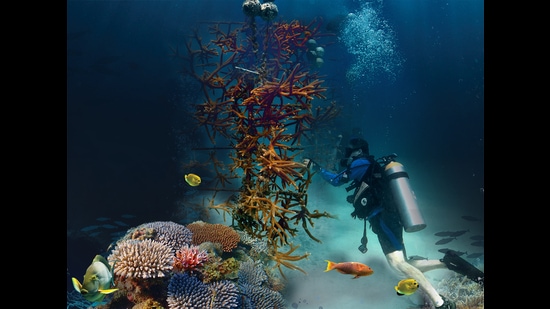
The “nurseries” are made up of vertical structures called coral trees that stand in the sea. Here, fragments are exposed to 360-degree sunlight and high nutrient loads. In six months, a fragment the size of a finger can grow to the size of a football.
Each attempt at rehabilitation gives the scientists more metrics to test: Can they make the corals more resistant to heat; boost their immunity to certain diseases?
But all the “sciencing” is merely a stopgap, says Alexander Neufeld, science programme manager at CRF. “What we need is for pollution and climate changes to be curbed, for long-lasting impact.” That said, Neufeld adds, “there are more corals on the reefs in Florida today than there would have been if we had spent the last 20 years doing nothing.”
Inner piece: Lab-evolved algae
One of the ways to make reefs more heat-resistant is to breed more heat-resistant algae.
After all, it is the algae that respond to the temperature, releasing toxic chemicals that cause the polyps to expel them. Without the algae, the corals then lose their colour, and their source of nutrition (like all animals, they cannot make their own food).
Previous attempts to breed heat-resistant algae have failed. But, in 2012, researchers at the Australian Institute of Marine Science decided to give it a fresh shot.
They evolved 10 clonal strains of a common coral microalgae, over four years, in a laboratory, with the key focus being resilience to high temperatures. Findings published in journals such as Science Advances in 2020 showed some of these species proved beneficial to keeping corals alive in temperatures as high as 31 degrees Celsius (most corals begin to bleach if sea surface temperatures stay at 31 degrees Celsius for more than three to four weeks).
“This is really promising, and could be combined with other interventions,” says lead researcher Patrick Buerger, who now heads an applied-biosciences lab at Macquarie University.
There’s still a lot to learn about the survival of these experimental strains in the wild, he adds. Will there be trade-offs in terms of nutrient production, coral growth, reproductive output or disease susceptibility? Can the process of experimental evolution be sped up further? For now, though, he repeats, it is a step in the right direction.
Breeding super coral
It was a mesmerising sight at Australia’s Great Barrier Reef that spurred marine biologist Peter Harrison into action, in 1981. During a night excursion there, he saw trillions of microscopic eggs and sperm being released by multiple coral species in a mass spawning event.
Most of the eggs and sperm would become fish food, he knew. And that gave him an idea: Could spawn from one healthy, hardy reef be collected, saved and used to rejuvenate it and others?
The procedure has since come to be called coral in-vitro fertilisation (IVF) or larval restoration. The spawn of heat-tolerant specimens that have survived bleaching are captured and used to rear larvae in special floating reef pools on the surface of the ocean. The larvae are then transplanted onto degraded sections of a reef, so they can replenish them.
Since 2012, this method has been successfully used in areas where reefs have been degraded by blast fishing (where explosives are used to stun or kill fish) in the Philippines. More recently, it was used on the Great Barrier Reef and in the Maldives.
“The restored populations have a higher chance of surviving future changes,” says Harrison, founding director of the Marine Ecology Research Centre at Southern Cross University, Australia. This method is also expected to prove helpful as populations dwindle, leaving fewer of a species to reproduce.
Workouts in a ‘gym’
At the Experimental Reef Lab (ERL) at the University of Miami, corals are on a unique fitness journey.
Researchers have built 16 large tanks that mirror certain projected ocean conditions, such as changes in acidity levels, temperature and light. Within these tanks, they then conduct experiments on different species, with the aim of monitoring their response and finding ways to boost immunity and resilience.
Working on autopilot, a suite of open-source robotic arms, built in-house by scientists at NOAA’s Atlantic Oceanographic and Meteorological Laboratory (AOML), injects specific doses of diseases and of nutrients such as nitrogen and phosphorus into each tank.
The simpler workouts involve being exposed to frequent pulses of warm sea water twice a day. “Think of this like going to the gym and working out really hard, then going home to relax and recover. Do that every day and it tends to make us stronger, more capable of dealing with stress,” says Ian Enochs, head of the coral programme at AOML.
Findings published last year show that resistance to heat is growing. “This ‘training’ regimen is akin to an athlete preparing for a race,” the study’s lead author, Allyson DeMerlis of the University of Miami’s Rosenstiel School, said in a statement.
Hypoxia (or low oxygen levels), ocean acidification and diseases such as Stony Coral Tissue Loss Disease (SCTLD) are the major threats that scientists are now working on.
“We can eventually identify particularly strong species and individuals that are more resilient and target them for restoration in the ocean, just like we might target more hardy crop strains for agriculture,” says Enochs. The challenge is scaling up fast enough, he adds. “We have a lot of work to do before we perfect this, and unfortunately not a lot of time to do it in.”
One Subscription.
Get 360° coverage—from daily headlines
to 100 year archives.
Archives
HT App & Website