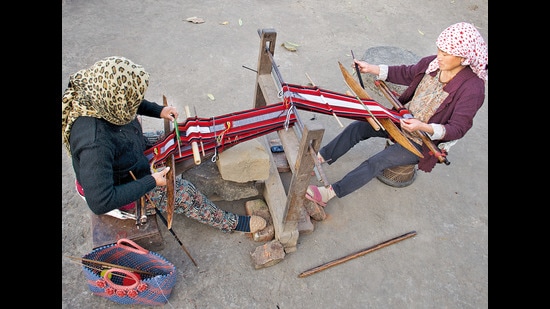
Did you know that the jawbone of a fish is used to clean raw cotton in Andhra Pradesh? This extraordinary tool, an ingenious use of dinner’s leftovers, is still in use in villages across the state. In Ponduru and the surrounding villages, where the entire process of cotton production, from cultivation to weaving, is done by hand, the bones of the valuga fish provide an important tool. Here some of the finest cotton khadi in India is produced through the use of environmentally sound and energy-efficient technologies that have been developed over centuries.
Did you know that indigo, that ubiquitous colour of our blue jeans, is a natural dye that was used to dye cloth over 4,000 years ago in ancient India? Archaeologists have discovered remnants of indigo fabric in the ruins of Mohenjo-Daro. People back then had acquired the knowledge needed to extract that magical shade of blue from the leaves of a plant that grew in the vicinity. Through the dyeing process, fabric goes through a transformation. It initially emerges a pale shade of yellow from the dyeing vat. Then, on further exposure to air, oxidation causes the colour to change first to a shade of muddy green, before it begins to transform into the indigo blue that we all know and love.
Repository of skills
{{/usCountry}}Repository of skills
{{/usCountry}}These fascinating facts are chronicled by designer Archana Shah in her second book, Crafting a Future, a moving and informative tribute to Indian handlooms and the artisans who create them. In truth, India is the last repository of some of the most complex handmade textiles in the world. This legacy of human innovation and skill is responsible for one of the most diverse expressions of a material culture that has been practised unbroken for centuries.
Textiles have played a pivotal role in every sphere of human activity. From the rich and complex textiles developed for the elite, to the humblest fabrics worn by the common person, the design language of every textile articulated the cultural framework that defined every individual in society.
What makes this book a particularly interesting read is that the writer is herself a textile designer. Archana founded the successful clothing company, Bandhej, in 1985, where she sought to sustain and preserve the inherent knowledge of traditional artisans by creating clothing collections that utilised their skills for a contemporary consumer market.
Rediscovery of India
While Archana’s observations are respectful of the ingenuity of the artisans and their skills, they are balanced with a down-to-earth understanding of the dynamics that exist between the need to sustain our cultural heritage, and the creative and economic challenges of hand-crafted products.
Far from a dry academic report, this is a story of travels and discoveries. We read about the pashmina that is obtained from the highlands of Ladakh, and the story of Malkha cotton from Hyderabad—an inspiring project that created a unique resource of field-to-fabric cotton that is collectively owned and managed by the primary producers themselves: the farmers, ginners, spinners, dyers and weavers, empowering an entire community. We also learn the fascinating story of how a weaving community in Rajkot challenged the monopoly of the fabled double ikat Patola weavers of Patan by successfully learning the complicated techniques and creating new business opportunities for the entire community. What once was a craft with a highly limited reach is now a story of entrepreneurship and expansion.
These stories of human ingenuity and innovation are of particular relevance today. Besides being a vital part of our heritage, the handloom sector is an important source of sustainable textile production, a serious factor for consumers, as well as for policy makers, to consider as we confront the deterioration of our environment.
David Abraham is one half of the duo behind the eponymous label Abraham and Thakore, and a pioneer in the modern Indian design movement
From HT Brunch, December 5, 2021
Follow us on twitter.com/HTBrunch
Connect with us on facebook.com/hindustantimesbrunch