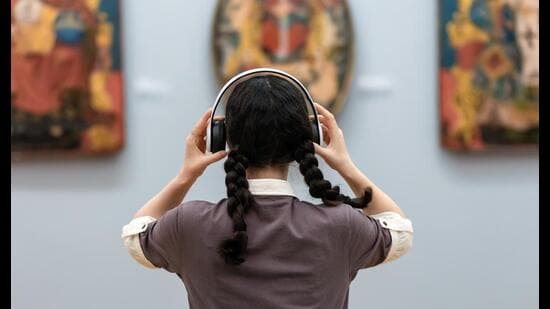
It’s not that deep. Humans have been making art before we even invented the wheel. What we’ve been doing, all these thousands of years, via cave paintings, oils-on-canvas, classroom doodles, chromolithographs, Bayeux Tapestries, graphic T-shirts and bananas taped to a wall is essentially the same thing. We’ve been trying to make sense of the human condition.
Sometimes, we get it. Ravi Varma’s elegant ladies tell us the whole story. For everything else? There’s new kinds of help.
The Louvre recently introduced jargon-free trails such as their My First Louvre tour. London’s Tate Modern and New York’s Museum of Modern Art have trained staff to be Roaming Art Explainers who pop in to galleries all day and address visitor queries — no question is too silly. The Rijksmuseum in Amsterdam and the National Gallery of Victoria in Melbourne use location-tracking apps to deliver bite-sized trivia the moment a visitor stands before a painting. Every major museum in India has audio guides and docents, many now have QR codes that lead to music, additional photos or just information about the artist.
In Delhi, Shaleen Wadhwana is one of a tireless group of educators filling in all the gaps in public art knowledge via guided museum tours, gallery walkthroughs, educational workshops, and training programmes. “A painting in a white cube gallery, without any explanation can feel daunting,” she acknowledges. “But put that same painting in a public space — under a tree, in a garden workshop, or on the ceiling of a café — and it becomes many things, but no longer intimidating.”
{{/usCountry}}In Delhi, Shaleen Wadhwana is one of a tireless group of educators filling in all the gaps in public art knowledge via guided museum tours, gallery walkthroughs, educational workshops, and training programmes. “A painting in a white cube gallery, without any explanation can feel daunting,” she acknowledges. “But put that same painting in a public space — under a tree, in a garden workshop, or on the ceiling of a café — and it becomes many things, but no longer intimidating.”
{{/usCountry}}In Mumbai, Jasmine Shah Varma, an art curator and founder of the art-education platform Indian Colours, says that curiosity emerges only once unfamiliar ideas become approachable. “Visitors don’t immediately ask what a painting means,” Varma finds. “More often, they begin with the tangible: What is it made of? Who is the artist? What inspired the work? Why did they make it?” If this is you, relax. You’re doing fine.
Historian Anirudh Kanisetti, who conducts heritage walks and art-history lectures across Bengaluru and the Deccan, has practical cues for exploring regional heritage. When strolling through Hampi’s temples or the caves in Badami, soapstone indicates a medieval North Karnataka origin; domes and cusped arches signal Persianate influence; flat ochre backgrounds featuring figures in block-printed textiles, suggest the Vijayanagara or Nayaka period. “Once people leave with practical tools, they start seeing art differently wherever they go.” Which means you’ll always be more confident the second time around.
At Delhi’s Kiran Nadar Museum of Art, India’s first private modern art museum, tech is stepping in. They’ve partnered with the studio Ask Mona on a conversational AI companion that lets visitors type or speak everyday questions about works and shows in English and Hindi. So, if you were at the Tyeb Mehta retrospective earlier this year, it was possible to input “I don’t understand what it means,” “Is that a hand and a leg together?” or “Why is there a line through the painting?” without feeling like a human was judging your level of ignorance.
But you don’t even have to visit a museum to understand its treasures. YouTube and Insta are filled with dummies’ guides to famous works and movements (We’re loving the British Museum’s Bayeux Tapestry series!). Desi Art Mag, a print-only magazine, two issues old, focuses on demystifying South Asian contemporary art through explainers titled Why Does Art Feel Intimidating? Why Collect Art? and How To Enjoy Art 101. “We write for people who are new to art, but not new to thinking. Intellectually curious, culturally rooted, ready to engage, just never given a way in”, they say on their website.
Not all visitors have questions: Kanisetti recalls a moment when he was guiding visitors through the Royal Palace Museum in Thanjavur. He was all in, commenting on the technical details of the famous Chola bronze of Shiva Vrishabhavahana, when a nearby visitor remarked, “Arre, what style he has!” In those five words, the first-time viewer had captured what every art-history book was trying to explain: The sculpture’s extraordinary elegance. Kanisetti says that even after a thousand years, the sculpture was so chic that “if you dressed him in modern clothes, he wouldn’t look out of place in a hipster café.” Rizz is part of the human condition too, and art keeps reminding us of it, if we only care to look.
From HT Brunch, September 26, 2026
Follow us on www.instagram.com/htbrunch