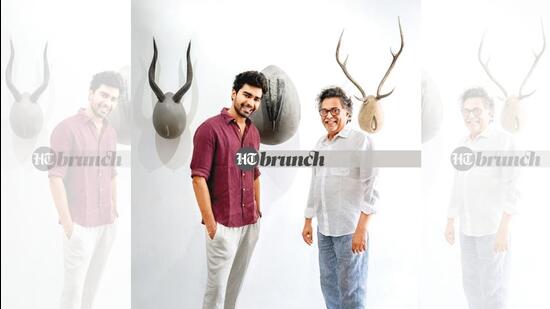
Between 2016 and 2018, Siddharth Kerkar worked on a series of 50-60 paintings meant to be exhibited at the Museum of Goa.
“Barely anything sold,” the 25-year-old Goan artist says dejectedly. “I had put in so much effort for two years and I had no success at all.”
Today however, the demand for the young artist’s work has exploded. And he has only one explanation for this. Social media.
“What I realised from that episode in 2018 is that I had never documented the process of my painting until then; that I had barely even spoken about my exhibition on my social media,” says Siddharth. “Then, I started creating videos of myself at work and during the lockdown in 2020, one of these art videos got about four lakh views, whereas my videos usually got around 40-50k views.”
Social st(art)
The son of acclaimed artist Subodh Kerkar, 62, who runs the Museum of Goa, Siddharth has been exposed to art since his childhood, having visited the Venice Biennale four times, and been the youngest artist at the age of 19 at an artist residency programme in Portugal.
It was while he was studying in Europe that he came across a new trend.
{{/usCountry}}It was while he was studying in Europe that he came across a new trend.
{{/usCountry}}“There was this craze in 2015-16 to vlog everything,” he explains. “So while creating work, I also shot stuff on my GoPro. I loved creating videos, so that’s how it all began.”
Today, he has 79.9k followers on his personal Instagram account. His art account is much smaller, with 11k followers, but he prefers it that way. This is his “niche audience”.
“Within days of my video getting higher views during the lockdown, I started getting enquiries for my work, and I realised that there probably is no one right now making the kind of content I do,” says Siddharth. “Setting up a separate account for my art was also about the fact that if a million people are following me, but really don’t connect with my art, it doesn’t make sense. It is the 50,000 who connect with my work who matter, because they are genuinely interested in what I create. The two accounts also help me grow my network the way I like it.”
Siddharth learnt the tricks of the influencer game early on from a social media influencer he had been dating. With his GoPro, he tried creating content on fashion and travel. Art then took a backseat for a year and a half.
“I did collaborations with British government and I was in London, so travel was easier,” he says about that time. “But when the lockdown hit and I came back home, I got back to my art and, over the past two years, I have had the inspiration to create in my studio.”
Even a brand collaboration on Siddharth’s handle are done artistically, where he can be seen sipping on beer while working on canvas.
“I’m finally getting to work with brands that I resonate with, and it has taken a long time to reach this place where I can associate with the brands I want to work with,” he says. This allows him creative freedom; the presence of the brands does not come at the cost of the art he creates whether in the videos or on canvas.
Friend zone
Balancing that thin line between his art and the demands of the brands that contribute to his earnings is extremely important to Siddharth. That’s because most of his commissioned work and enquiries come directly from Instagram. Has that changed the rules of how artists exhibit and sell their work?
“My art is not just for buying but also about recreating,” says Siddharth. “I use things like sawdust and household materials to create textures. During the lockdown, I made a lot of art and documented it much more, and I had about 50-100 projects with even galleries approaching me to exhibit,” he smiles.
Art is not the only thing that Siddharth creates on social media. Some of his most important friendships are also the product of online interaction. “Instagram has made everything so accessible, including friendships, you know?” he sighs happily. “I post a lot about places to explore in Goa or to eat and often I find people asking me for recommendations when they are in town. That’s one way I’ve made friendships. And then there are clients who have turned into best friends, like Kresha (Bajaj, the fashion designer) and her husband, Vanraj Zaveri.”
He adds, “I’m also a very chatty person. If I’ve had an interesting chat with someone at a party, I invite them to my place for drinks, and I think I get that nature from my dad who always has guests because we love conversations.”
Siddharth’s conversations with his guests keep his inspiration flowing, making him far more invested in his art than ever before.
“Art is all I have known anyway. It’s like a religion in our house,” he says. “I see my social media journey as a means to reach more people. To make my art more accessible. And I find that my environment always finds a way into my art. I’ve been very experimental, something again I picked from my dad.”
Father on son
Siddharth’s father, the acclaimed artist Subodh Kerkar, was a doctor before he quit to make art.
“We should not just be doing one thing in our lives. I was interested in several things. Though I started as a landscape artist, I’ve found my voice in installations. But I started painting again during the lockdown. I experiment and I play,” he says.
Subodh’s experiments have also found him on Instagram, thanks to a little coaxing from his children, Siddharth and Sharada, 29. His Instagram Reels are raw and diverse, from short clips of people visiting the Museum of Goa to the artist himself working in his studio.
“Siddharth has hired a team of photographers and videographers. My Reels are either a product of my interns or research assistants shooting as I work or when I see something to make a video of,” says Subodh. “Siddharth is also better looking, so he should be on camera more than me!”
Has social media changed how artists reach their audience? “If used correctly, social media reaches the kind of audience that not even the best gallery in the world can reach—beyond geographical borders,” says the senior Kerkar. “I want my work to be seen by more people and I think social media has democratised art. Art should become a religion because it humanises us.”
Subodh will soon start an art education programme in local languages so as to reach more people. Art exposure, he says, is extremely important.
“Siddharth has had tremendous exposure to art since he was young. He has visited art fairs and galleries, imbibed the right skills and put them to the right use,” Subodh explains. “That’s the point of making art accessible, whether it is through education programmes like I want to do, or via Instagram the way Siddharth does it. That’s what makes Siddharth a successful artist.”
From HT Brunch, January 23, 2022
Follow us on twitter.com/HTBrunch
Connect with us on facebook.com/hindustantimesbrunch