Listicle: 10 artworks that might never go on display
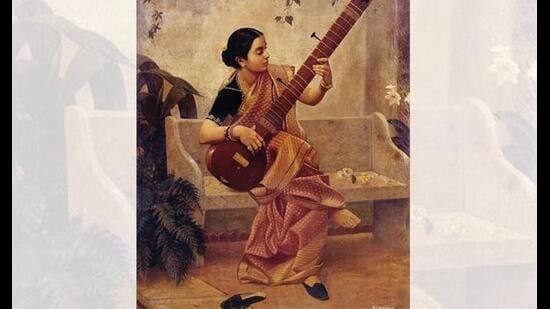
- Raja Ravi Varma’s Kadambari (1906)OK, Ravi Varma made anywhere between 2,000 to 7,000 works before he died in 1906. His final oil-on-canvas won’t be on view any time soon. It’s trapped in a ₹100-crore ownership lawsuit and fraud dispute before the Delhi High Court and is chilling at the Kiran Nadar Museum of Art. The OG owner, Mohinder Varma, approached the HC after discovering that his associates had tried to smuggle the treasure to Australia behind his back.
- Damien Hirst’s For the Love of God (2007)This human skull, cast in platinum and studded with 8,601 diamond crystals, is owned by a consortium that includes Hirst himself. Some public museums have been wary of displaying it, because of its precious materials and the ethical debate over using 18th-century human skull fragments as art. It’s hiding out in a London vault. Who knew a £50 million sculpture would be a security nightmare?
- Subodh Gupta’s Very Hungry God (2006)Gupta morphed around 3,000 sparkling stainless-steel utensils into a 3.6m high heavy duty skull sculpture in 2006. Critics have called it a statement on mortality and consumerism. It’s in the famed Pinault Collection (as in Francois Pinault, as in Salma Hayek’s FIL). But it hasn’t travelled anywhere since 2017. Weighing over one tonne, displaying it is a logistical nightmare.
- Nicholas Roerich’s Himalayas Kanchenjunga (1933)The legendary Russian painter visited India in 1923 and stayed until his death in 1947. Two of his works (the other is Kashmir. Sunset, from 1944) hung in the library of Delhi’s Indian Agricultural Research Institute until in 2009. Then, in 2011, they were sold at an auction in London. The IARI didn’t even know they’d been stolen. The sellers said they’d got the works from Roerich’s daughter-in-law, the actress Devika Rani. What a shady claim!
- Leonardo Da Vinci’s Salvator Mundi (1500)Discovered at a small auction in the US, thought to be a copy, found to be the OG of OGs. Sold for a wild $450 million in 2017 and never seen since. Initially, people speculated that it was ‘sailing’ on the Saudi Crown Prince’s superyacht, but no. It’s actually chilling in an ultra-secure Swiss freeport. Meanwhile, Vinci’s charcoal and chalk drawing, The Virgin and Child with St Anne and St John is permanently bolted in a dark, climate-controlled room at London’s National Gallery to prevent sun-damage.
- Abanindranath Tagore’s Aurangzib Examining the Head of Dara (1911)The painting of the emperor examining his slain brother Dara Shikoh’s dismembered head sounds gruesome. But that’s not why it’s locked in the permanent archive of Kolkata’s Rabindra Bharati Society. The fragile watercolour was boxed because of preservation concerns. Also, the RBS lacks a dedicated museum wing for its safe display.
- Paul Cézanne’s The Card Players (1890s)The French painter dropped five versions of The Card Players – all are showcased at top global museums, except one. The two-player version never hit museums or exhibition circuits despite fetching an insane $250 million in 2011. Why? Greek tycoon George Embiricos sold it to the royal family of Qatar, who like to keep it on the downlow.
- Pablo Picasso’s The Man with a Moustache (discovered in 1989)Pablo Picasso’s The Man with a Moustache (discovered in 1989). The Man… remains invisible despite being displayed. It was not until 1989 that art renovators, using infrared tech and X-ray machines, realised it was hiding in plain sight, underneath Picasso’s 1904 painting of Woman Ironing. Picasso had reused his canvas. In 2008, similar tech was used to scan his The Blue Room (1901), and a painting of a bearded man in bow-tie surfaced. Reduce, reuse, recycle. But not like this!
- Amrita Sher-Gil’s Self-Portrait and Portrait of Denyse (1931, 1932)The celebrated Indo-Hungarian artist’s self-portrait was auctioned in 2015 for £1.7 million. It did a pop-up tour in New York and London just before the sale. In 2021, another major moment dropped. Her oil painting, Portrait of Denyse (1932), featuring her French art-critic bestie came up for sale, after remaining hidden in private collections in France for almost nine decades. Both masterpieces are privately housed, hidden again.
- Vincent van Gogh’s Portrait of Dr Gachet (1890)For nearly a century, the first version of this work, featuring his doctor, toured galleries and private collections. In the 1990s, it was sold for $82.5 million to Japanese businessman Ryoei Saito, and went off-grid. Saito didn’t want to share. When he passed away, the work was sold in 1998 to Austrian businessman Wolfgang Flöttl. He didn’t share either. It’s believed to be sitting in a private collection in Lugano, Switzerland, owned by the family of a secretive Italian collector.
{{^usCountry}}{{/usCountry}}
Catch your daily dose of Fashion, Taylor Swift, Health, Festivals, Travel, Relationship, Recipe and all the other Latest Lifestyle News on Hindustan Times Website and APPs.
Catch your daily dose of Fashion, Taylor Swift, Health, Festivals, Travel, Relationship, Recipe and all the other Latest Lifestyle News on Hindustan Times Website and APPs.
Advertisement
{{/htLoading}}{{#usCountry}}