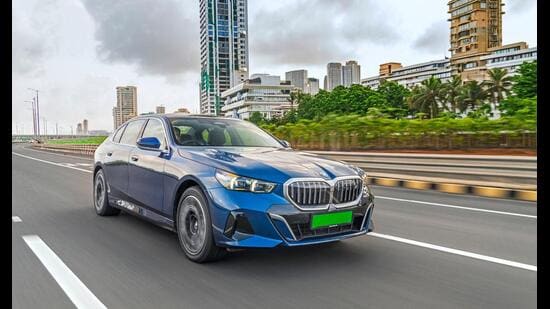
Luxury sedans are alive and well in India. Petrol or diesel, regular or long wheelbase, there’s plenty to choose from. Go electric, though, and the choice dwindles. Every luxury maker is bringing in electric SUVs, which leaves the BMW i5 in a class of one. Like the i7, it has no competition, and at ₹79.60 lakh it neatly fills the gap between the iX1 and the flagship.
It’s a big car. The wheelbase has been stretched 110mm to 3,105mm and the length is 5,175mm, which makes it larger than the E-Class in every dimension. Only an ‘I’ on the grille, 20-inch alloys and the green number plate give it away. Those wheels suit it better than the 18s on the 530Li, but the styling remains polarising, with more cuts and creases than some eyes can take.
Inside, it’s classic modern BMW. Twin curved screens, open-pore wood, a crystal drive selector and the rotary controller add a sense of occasion. The 17-speaker Bowers & Wilkins system is a treat. The menus and sub-menus, however, will test your patience.
The back seat is roomy but not indulgent. The raised floor pushes your knees up, the seat doesn’t recline and the middle passenger gets a firm backrest and a tall tunnel. There are no soft-close doors and no rear sunshades, which a car this expensive should have. Boot space is 500 litres on paper, but the spare wheel eats into it.
On the move, the i5 is about calm, not drama. The single motor makes 272hp and 410Nm, almost identical to the 530Li, but delivered with EV smoothness. It isn’t neck-snapping. I clocked 6.99 seconds to 100kph, while the petrol car did it in 6.45, and the i5 runs out of breath beyond 100kph.
{{/usCountry}}On the move, the i5 is about calm, not drama. The single motor makes 272hp and 410Nm, almost identical to the 530Li, but delivered with EV smoothness. It isn’t neck-snapping. I clocked 6.99 seconds to 100kph, while the petrol car did it in 6.45, and the i5 runs out of breath beyond 100kph.
{{/usCountry}}The Adaptive regeneration mode is beautifully calibrated, and there’s a proper one-pedal mode too. The brake pedal, though, feels a bit numb as it blends regen with the regular brakes.
The ride is where the i5 shines. Rear air suspension and the extra ground clearance make it plush and absorbent even on those big wheels, and dare I say better than the E-Class. The clearance is why the car arrived over a year late. It clears speed breakers easily, even with four on board. The trade-off is that there’s less of the sharp, precise feel of older 5 Series.
Range is the weak spot. BMW claims 669km from the 81.6kWh battery, but the real-world figure is 386km, at 5.06km/kWh, and that was in Efficient mode. A 60kW DC charger takes 47 minutes to go from 20% to 80%. BMW does throw in a free wallbox charger, and the battery has an eight-year warranty.
So is it worth the ₹3 lakh premium over the 530Li? That depends on how you use it. If the car is registered to a company, the higher depreciation benefit on EVs makes sense. If you cover big distances every month, lower running costs help too. This i5 is a good alternative to a petrol-powered luxury car.
From HT Brunch, September 26, 2026
Follow us on www.instagram.com/htbrunch