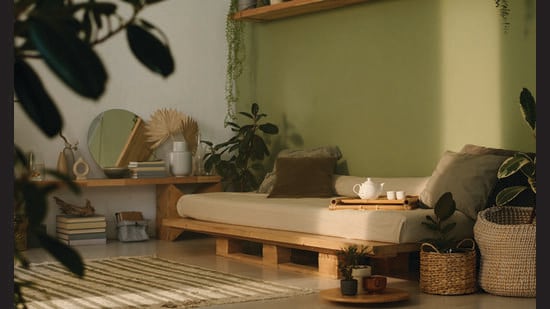
Japanese decor has won the internet. Our Instagram saves are full of wabi-sabi corners, shoji screens and impossibly beige and serene living rooms. We’ve pinned the Japandi aesthetic, double-tapped tatami mats and saved a photo of a very expensive-looking branch in a very empty vase. But before you turn your Mumbai living room into a corner of Kyoto, a word of caution. Some ideas translate beautifully to Indian homes; others don’t make any sense once you factor in humidity, dust and, you know, actual living. Three designers tell us what to steal, what to adapt, and what to leave in Japan.
Steal: Shin-soe-tai. “Ikebana’s classical structure, shin-soe-tai, is built around three stems of different heights,” explains Ridhi Khosla Jalan, interior stylist, RKJ Design Studio. “The tallest represents ‘heaven’, the middle one ‘human’, and the shortest ‘earth’. The idea is to create balance without making everything look perfectly symmetrical.”
This makes arranging your decor so much easier. “In an Indian home, this could shape how a console, shelf, or side table is styled. A tall brass urli or sculpture can be the “heaven” piece, a mid-height stack of books or a bowl “human”, and a low, wide object like a flat platter or small plant can be “earth”,” she says.
Skip: Minimalism. We’ve got minimalism all wrong. It’s not about placing a white sofa in a white living room and calling it a day. Or throwing away perfectly functional items, only to replace them with new, neutral-toned versions of the same thing. You don’t need to chuck all your family portraits, crochet paraphernalia and art collection to live among empty walls and shelves.
{{/usCountry}}Skip: Minimalism. We’ve got minimalism all wrong. It’s not about placing a white sofa in a white living room and calling it a day. Or throwing away perfectly functional items, only to replace them with new, neutral-toned versions of the same thing. You don’t need to chuck all your family portraits, crochet paraphernalia and art collection to live among empty walls and shelves.
{{/usCountry}}Think of minimalism as a philosophy, rather than a look. Ashiesh Shah, architect and interior designer, says, “Minimalism works when it grows out of a way of living, not when it’s reduced to white walls and empty shelves. Indian homes are naturally layered with memory, ritual and everyday life. That’s not something to edit out.”
Steal: Wabi-sabi. The aesthetic embraces everything “imperfect, impermanent, and incomplete”. That doesn’t necessarily mean choosing defective items for your home. “It’s about selecting natural materials such as various Indian stones or handloom textiles for how they age and behave over time over materials that are designed to look artificially ‘new’ forever,” says Sarah Sham, principal designer, Essajees Atelier. “Try handloom or khadi in neutral tones as cushion covers, throws or curtains. A solid timber dining table – with its grain, its marks, the way its colour deepens over years – is worth keeping, not sanding away.” You will need to research how a material will weather in Indian humidity and monsoons, but when done right, it gives a home a sense of warmth and permanence.
Skip: Tatami floors and shoji screens. Tatami floors and shoji screens belong to a particular culture and climate,” says Shah. Traditionally, Japanese rooms were designed around tatami mats. The number and arrangement of mats helped determine the room’s proportions and use. “Shoji, too, was part of a larger architectural system: Translucent screens were set within sliding frames and used along the edges of rooms to filter daylight. They could be moved to open up, close off or reconfigure the space,” Shah adds. This is not as useful for India’s extreme heat or humidity. Here, shoji screens end up being decorative, at best, while tatami can’t survive the dust, spills and wet mopping.
Steal: The tokonoma. This is a small alcove in Japanese homes kept free of clutter and reserved for a single display, such as a scroll or a flower. The object switches with the seasons, says Jalan. “The tokonoma is framed by the tokobashira, a simple wooden post usually left in its natural finish. Together, they turn one corner into a focal point, rather than another space to fill with things, and make the whole room feel calmer by contrast.”
In an Indian home, this translates easily into a wall niche near the entrance or living room, where the display can be swapped for Diwali, Holi, monsoon or summer.
Skip: Low furniture. Yes, it keeps the visual field uncluttered, makes ceilings feel higher and makes the room feel more open. But it’s more practical to a culture where floor-level living is normal, rather than a place such as India.
A traditional zataku or low tea / coffee table is typically just 28 to 38 cm high. Low sofas tend to sit around 38 to 42 cm from the ground, while platform beds keep the mattress close to the floor. That works for a room with ceilings averaging around 2.4 metres. But that isn’t the case in India. “Here, grandparents may need a chair they can get out of without negotiating with their knees, and guests are unlikely to be impressed by a cushion on the floor. Then comes the dust, the sweeping, the mopping and the daily traffic of an Indian household,” says Shah.
From HT Brunch, September 5, 2026
Follow us on www.instagram.com/htbrunch