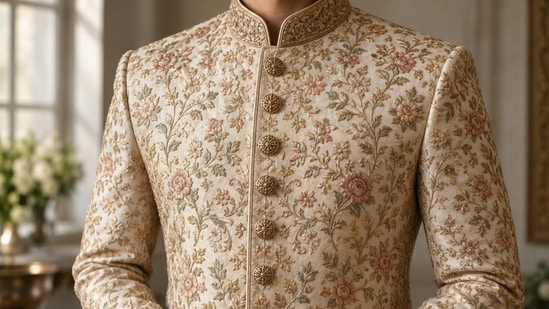
Wedding season is around the corner, and shopping is in full swing. While much of the attention goes to what the bride will wear for each function, the groom's wedding wardrobe deserves just as much consideration. The groom's wedding wardrobe deserves just as much consideration. The sherwani takes the centre stage, but choosing the right one involves paying attention to its colour, fit, and silhouette. Finding the right match calls for a little homework, taking measurements and trying different styles to know which one fits and looks good on you the best.
An expert commented on the non-negotiable essentials for choosing the right sherwani for the groom. Saggar Mehra, designer and founder of Saggar Mehra Couture, a luxury bespoke menswear designer brand, said that choosing a sherwani needs to be a personalised approach rather than trend-driven, as a sherwani's style depends on body type too .
“In Indian menswear, a sherwani can significantly influence how the overall body proportions appear. Its shoulder line, length, fabric, embroidery, and relationship with the lower garment all contribute to the final silhouette. Rather than following fixed rules for different body types, the better approach is to understand how these elements can be used to create balance,” the designer highlighted the essentials.
When you pick any sherwani, make sure to check for these basic parameters too, rather than selecting on the basis of a ‘catchy colour’ or ‘aesthetic embroidery work.’
{{/usCountry}}When you pick any sherwani, make sure to check for these basic parameters too, rather than selecting on the basis of a ‘catchy colour’ or ‘aesthetic embroidery work.’
{{/usCountry}}Here are the tips:
1. Start with the silhouette
- For broader or fuller frames, cleaner silhouettes with controlled shoulder structure and minimal bulk generally create a more balanced appearance.
- Men with slimmer builds can experiment with slightly more structure, layering, and texture to add dimension.
- Taller frames can carry longer proportions and fuller lower garments.
- Shorter or more compact frames often benefit from streamlined silhouettes and fewer visual breaks.
2. Pay attention to length and proportion
- The length of the sherwani should work in relation to the wearer's height and torso.
- A very long silhouette can overwhelm a shorter frame, while a slightly longer, well-balanced cut can work beautifully on a taller build.
- The relationship between the sherwani hem and the lower garment is equally important; a narrow churidar, fuller trouser or contrasting bottom can completely change the way the same sherwani reads on the body.
3. Let embroidery work stand out
- Embroidery should be considered part of the silhouette rather than simply decoration.
- Concentrated detailing around the shoulders and chest adds visual weight to the upper body,
- Vertical motifs can create a sense of length.
- Larger-scale patterns can complement taller or broader frames, whereas finer, more controlled embroidery can work particularly well on more compact proportions.
4. Choose fabric and structure together
- Fabric determines how much visual and physical volume a sherwani carries.
- Heavier brocades, textured fabrics, and dense embellishment create a more substantial silhouette.
- Softer fabrics offer a cleaner fall.
- If the embroidery is already elaborate, a more streamlined construction can prevent the overall look from becoming overwhelming.
- Simpler surfaces can, in contrast, support stronger structure.
5. Look at the complete look, not just the sherwani
- The sherwani, inner kurta, lower garment, and footwear should be considered as one composition.
- Tonal dressing creates a more continuous visual line, while strong contrast creates defined breaks between the upper and lower body.
- The collar, buttons, cuffs, and even the amount of kurta visible can further influence the final proportions.
In the end, the designer's final advice is that there is no standard sherwani silhouette that acts as the benchmark. This is because there is no one single body type. The best approach, as per the expert, is to understand where the garment creates structure, where it adds visual weight, and how its individual elements connect. When you follow this instruction, the result naturally turns out to be a standout instead of being formulaic.
Catch your daily dose of Fashion, Taylor Swift, Health, Festivals, Travel, Relationship, Recipe and all the other Latest Lifestyle News on Hindustan Times Website and APPs.
Catch your daily dose of Fashion, Taylor Swift, Health, Festivals, Travel, Relationship, Recipe and all the other Latest Lifestyle News on Hindustan Times Website and APPs.