When it comes to hair care, natural oils often become the first thing we reach for when our hair starts looking thin, dry or weak. Two ingredients that have become especially popular in hair care are rosemary oil and onion oil. Both are widely used in hair-care routines, but they work in slightly different ways.
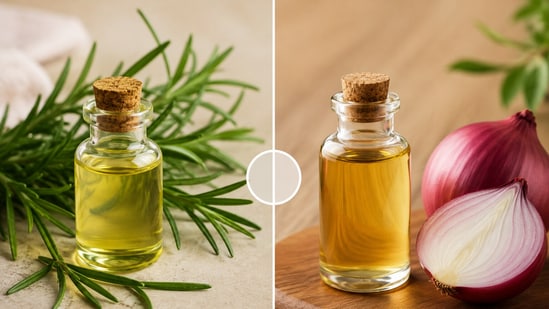
So, if you are wondering whether rosemary oil or onion oil is better for your hair, here is a simple comparison to help you understand their benefits and how to use them.
Rosemary oil: A popular choice for scalp care
Rosemary oil is an essential oil obtained from the rosemary plant. It has become popular in hair-care routines because of its potential to support scalp health and hair growth.
One of its biggest benefits is that it may help improve the appearance of hair density when used consistently. Some research has also explored rosemary oil for androgenetic hair loss, although more evidence is needed before considering it a proven replacement for medical hair-loss treatments.
Benefits of rosemary oil
May support hair growth: Regular scalp massage with diluted rosemary oil may help support healthier-looking hair and improve the appearance of hair density over time.
Supports scalp health: Its antioxidant properties can help protect the scalp from oxidative stress. A healthy scalp provides a better environment for hair growth.
May help with hair fall: By supporting scalp care and circulation through massage, rosemary oil may be useful as part of a broader hair-care routine.
Can make hair feel healthier: When used in a suitable carrier oil, it can add softness and shine to the hair.
It is important to remember that rosemary essential oil should not generally be applied directly to the scalp because it is highly concentrated. Always dilute it appropriately and stop using it if you experience irritation.
Onion oil: A traditional option for stronger-looking hair
Onion oil has also gained attention, particularly among people dealing with brittle hair and excessive breakage. Onion contains sulphur compounds and antioxidants, which are among the reasons onion-based hair products are often marketed for scalp and hair care.
Onion juice has been studied in a small clinical study involving patchy alopecia areata, but this should not be taken as proof that onion oil can treat every type of hair loss. The evidence for onion oil itself is much more limited.
Benefits of onion oil
May support stronger-looking hair: Onion-based products are often used to condition the scalp and hair, which may help reduce the appearance of dryness and breakage.
Contains sulphur compounds: Sulphur is associated with keratin, the protein that makes up much of the hair shaft. However, applying onion oil does not automatically mean more keratin production.
May support scalp care: Onion-based formulations can be incorporated into a regular scalp massage routine.
Can improve hair texture: Depending on the formulation, onion oil can help make dry hair feel softer and smoother.
Useful for dry, brittle hair: Regular oiling may reduce friction and make hair easier to manage, potentially helping minimise breakage caused by combing and styling.
One downside is the smell. Pure onion-based products can have a strong odour, although many commercial formulations add fragrances or other ingredients to make them easier to use.
Rosemary oil vs onion oil: Comparison
| Feature | Rosemary Oil | Onion Oil |
| Main use | Scalp care and supporting hair growth | Hair nourishment and scalp care |
| Hair growth evidence | Has some research supporting its potential role in hair growth | Limited evidence for onion oil itself; onion juice has some research |
| Best suited for | Hair thinning and scalp-focused routines | Dry, brittle and breakage-prone hair |
| Key properties | Antioxidant and aromatic plant compounds | Sulphur-containing compounds and antioxidants |
| Odour | Fresh, herbal scent | Strong onion-like smell, depending on formulation |
| How to use | Essential oil should be diluted with a carrier oil before scalp application | Usually used as a ready-to-use hair oil or formulation |
| For hair fall | Potentially useful as part of a consistent hair-care routine | Better considered a supportive hair-care product rather than a hair-loss treatment |
Which one should you choose?
Choose rosemary oil if your primary concern is hair thinning or you want to focus on scalp health. It has comparatively better research behind its potential role in supporting hair growth.
Choose onion oil if your main concern is dryness, roughness or breakage and you want a nourishing oil for your hair-care routine.
Neither should be considered a guaranteed treatment for hair loss. Persistent or sudden hair fall can have several underlying causes, so it is worth consulting a dermatologist if the problem continues.
Can you use both?
Yes, but there is no need to layer several oils simply because they are trending. I would rather choose one based on my main hair concern and use it consistently.
If using rosemary essential oil, dilute it in a carrier oil and massage a small amount into the scalp. Leave it on for a suitable period depending on your product instructions and then wash your hair. For onion oil, follow the directions on the product because formulations can vary considerably.
A patch test is also a sensible step before using either product regularly, particularly if you have a sensitive scalp.
The bottom line
For me, the rosemary oil vs onion oil debate comes down to what I want from my hair-care routine. Rosemary oil has comparatively more promising evidence for supporting hair growth, while onion oil is better viewed as a traditional scalp and hair-conditioning option with limited direct evidence for hair growth.
Most importantly, consistency matters more than constantly switching between trending ingredients. If hair fall is persistent, severe or accompanied by scalp changes, I would speak to a dermatologist rather than depending on oils alone.
Similar stories for you
These 6 beard shampoos that keep your beard clean and hygienic during monsoon
₹1500, and you can too">I bought my entire skincare range under ₹1500, and you can too
I switched from lipstick to lip tints, and since then, there has been no going back
At Hindustan Times, we help you stay up-to-date with the latest trends and products. Hindustan Times has an affiliate partnership, so we may get a part of the revenue when you make a purchase. We shall not be liable for any claim under applicable laws, including but not limited to the Consumer Protection Act, 2019, with respect to the products. The products listed in this article are in no particular order of priority.
Catch your daily dose of Fashion, Taylor Swift, Health, Festivals, Travel, Relationship, Recipe and all the other Latest Lifestyle News on Hindustan Times Website and APPs.
Catch your daily dose of Fashion, Taylor Swift, Health, Festivals, Travel, Relationship, Recipe and all the other Latest Lifestyle News on Hindustan Times Website and APPs.