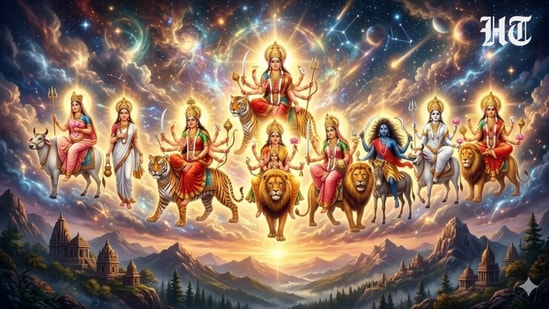
If you have ever wondered why Navratri is associated with nine forms of Durga while Shakta traditions also speak of the ten Mahavidyas, you are not alone. For many, Navratri is a time of nine nights of devotion to the Goddess. Yet behind the familiar celebrations lies a much larger Shakta tradition, with different forms of the Divine Mother representing different spiritual ideas and practices.
The Navadurga and the Das Mahavidyas are both connected to Shakti, but they are not simply two names for the same set of goddesses. They come from different theological and ritual traditions and offer different ways of understanding the Divine Feminine. Dr Manmit Kumarr, spiritual guru and founder of the Academy of Tantra, explains the distinction and what these traditions can reveal about your own inner journey.
Navadurga: Nine expressions of Durga
The Navadurga are the nine forms of Goddess Durga traditionally associated with the nine nights of Navratri. They are Shailaputri, Brahmacharini, Chandraghanta, Kushmanda, Skandamata, Katyayani, Kalaratri, Mahagauri and Siddhidatri.
For you, the journey through these nine forms can be understood as more than a sequence of daily prayers. Each form can represent a different quality or stage of inner growth.
{{/usCountry}}For you, the journey through these nine forms can be understood as more than a sequence of daily prayers. Each form can represent a different quality or stage of inner growth.
{{/usCountry}}This makes Navratri an opportunity to look inward as well as worship outwardly. Instead of asking only which Goddess you are worshipping on a particular day, you can ask what within you needs to awaken, strengthen, purify or transform.
What are the Das Mahavidyas?
The Das Mahavidyas, or Ten Great Wisdom Goddesses, belong to a distinctly Tantric framework within Shakta traditions. They are traditionally known as Kali, Tara, Tripura Sundari (also known as Shodashi), Bhuvaneshwari, Bhairavi, Chhinnamasta, Dhumavati, Bagalamukhi, Matangi, and Kamala.
Unlike the Navadurga, the Mahavidyas are not simply another nine or ten forms associated with the Navratri cycle. They are connected with different dimensions of Shakti, including wisdom, consciousness, transformation and liberation. Their imagery can also be far more challenging than the familiar devotional representations of the Goddess.
Kali challenges conventional ideas about time, identity and death. Chhinnamasta raises difficult questions about life, death, desire and the nature of the self. Dhumavati is associated with emptiness, loss, old age and what remains when familiar forms of security fall away. Bagalamukhi is traditionally linked with the power to still or arrest, while Matangi challenges conventional ideas about purity and exclusion. Kamala reflects the sacred dimensions of abundance and prosperity.
Taken together, these forms show why the Mahavidyas cannot easily be reduced to a list of powerful goddesses associated with particular wishes. They can instead be understood as invitations to encounter forms of wisdom that may be uncomfortable or challenging.
The question, therefore, shifts from, “What can the Goddess give me?” to, “What is this form of the Goddess asking me to see?”
One Shakti, different doors
This is where the relationship between the Navadurga and the Das Mahavidyas becomes clearer. Both can be understood within the broader universe of Shakti, but they arise from different theological and ritual frameworks.
The Navadurga are closely associated with the devotional cycle of Navratri and the many expressions of Durga. The Mahavidya tradition, meanwhile, is deeply connected with Shakta Tantra and its exploration of different dimensions of reality, including those that people may naturally find difficult to face.
So while both traditions point toward Shakti, they do not ask you to approach the Goddess in exactly the same way.
One can think of them as different doors into a much larger spiritual tradition. They may lead toward a shared understanding of the Divine Feminine, but the experience, symbolism and practices associated with each door can be very different.
ALSO READ: Pitru Paksha 2026: What each zodiac sign should donate to honor ancestors and invite abundance
Why the distinction matters during Navratri
Understanding that difference can also change the way you approach Navratri.
Spiritual practice can become limited when every sacred form is reduced to a transaction. You may come across the idea that a particular puja will bring wealth, remove problems or guarantee a specific outcome. Such devotional intentions have their place in religious practice, but Tantra invites a deeper inquiry into what worship means.
The Goddess is not simply a means of getting what you want. Shakti refers to divine power and the dynamic force through which existence manifests, changes, continues and dissolves.
Once you look at worship this way, the focus can shift. Instead of searching only for an external solution, you can begin to ask what the practice reveals about your own fears, attachments, strengths, and patterns.
What each tradition can teach you
The Navadurga can be understood as a way of walking with Shakti through different stages of inner development. The nine nights can give you an opportunity to cultivate discipline, build courage, recognise your strength, face difficult emotions, release what no longer serves you and become more receptive to grace.
The Goddess, in this understanding, is not only outside you. Her worship can also become a mirror for qualities that may already exist within you but have not yet been fully recognised or developed.
The Mahavidyas take that inner exploration into more challenging territory. Tantric traditions do not always draw a simple line between what is spiritual and what is not. Life contains birth and death, pleasure and pain, abundance and deprivation, desire and detachment, beauty and decay, creation and destruction.
The Mahavidya tradition places even these difficult dimensions within the larger field of Shakti. This does not mean glorifying suffering. Instead, it encourages you to develop the wisdom to face reality without constantly trying to deny or escape it.
That is also why the Mahavidyas can feel intense. They do not always present the seeker with the Goddess they expect. At times, they point toward something the seeker may need to confront.
Are the Navadurga and Das Mahavidyas the same?
The answer is no, although they are connected through the larger understanding of Shakti.
The Navadurga are nine forms of Durga associated particularly with the Navratri tradition, while the Das Mahavidyas belong to a Tantric tradition centred on ten forms of divine wisdom. Their stories, symbolism, rituals and spiritual emphasis are not identical.
At the same time, Hindu traditions often allow a single form of the Goddess to hold different meanings across different contexts. Kali, for example, has an important place in multiple Shakta traditions. Her significance can therefore change depending on the theological and ritual setting in which she is being understood.
This is part of what makes Hindu spirituality so diverse. Unity does not always require uniformity. Different traditions can recognise the same underlying Shakti while preserving their own practices, symbols and ways of understanding the Divine.
A different question to ask this Navratri
This Navratri, you can take that understanding a step further. Instead of asking only, “Which Goddess should I worship to solve my problem?”, ask yourself, “Which aspect of Shakti am I being invited to embody?”
Perhaps you need greater courage to face uncertainty. You may need discipline, compassion, clarity or detachment. You may need the strength to let something end, the wisdom to stop trying to control what cannot be controlled or the courage to begin again.
This is where Devi worship can become more than a ritual. It can become a sadhana, a spiritual practice through which you engage more deeply with yourself and with the sacred.
When worship becomes sadhana, the Goddess is not merely someone you pray to for an outcome. She can also become a way to understand your relationship with life, your inner patterns, and the changes you are being called to make.
Shakti, then, is not merely something to worship. It is something to awaken, honor and embody.
ALSO READ: Pitru Paksha 2026: What each zodiac sign needs to heal
Disclaimer: The interpretations of Shakti, Navadurga and the Das Mahavidyas presented here are rooted in Hindu spiritual and Tantric traditions and may vary across texts, teachers and communities. This article is intended for cultural and spiritual understanding and should not be treated as a substitute for guidance from a qualified religious or spiritual teacher.