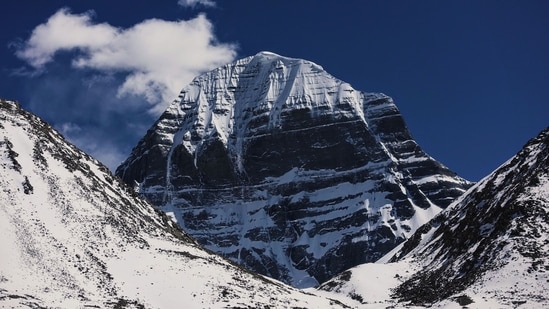
Mount Kailash has been regarded as a sacred mountain for centuries, drawing pilgrims and spiritual seekers from across Asia. Sadhguru, the founder of Isha Foundation, is once again travelling towards Kailash, sharing reflections from the journey with his followers online.
In a recent Instagram post, Sadhguru asked, "What Makes Kailash a Space of Grace?” He spoke about what he describes as the mountain's immense spiritual significance and suggested that experiencing its presence can open a different dimension within a person. These are Sadhguru's spiritual interpretations and are not scientific claims about the mountain.
His latest journey offers a chance to look at why Kailash has remained such a powerful symbol in spiritual traditions.
Why is Kailash considered sacred?
Mount Kailash is located in Tibet and is revered in Hinduism, Buddhism, Jainism, and the Bon tradition.
{{/usCountry}}Mount Kailash is located in Tibet and is revered in Hinduism, Buddhism, Jainism, and the Bon tradition.
{{/usCountry}}In Hindu tradition, the mountain is associated with Lord Shiva and is traditionally regarded as his abode. For Tibetan Buddhists, Kailash is associated with Mount Meru, the sacred centre of the Buddhist cosmos. Jain traditions connect the mountain with spiritual liberation.
The mountain's importance, therefore, goes beyond its physical appearance. For pilgrims, reaching the region can be a journey of faith, devotion and spiritual reflection.
Also Read Sadhguru says breaking one limitation each day can lead to freedom. What does it mean spiritually?
What does Sadhguru mean by “grace”?
Sadhguru frequently uses the idea of grace when speaking about spiritual growth. In his recent Kailash post, he describes the mountain as a place where a person can experience something beyond ordinary perception.
He has also previously referred to Kailash as a "mystical library”, describing his belief that generations of yogis and mystics have left their spiritual knowledge there.
This should be understood as part of Sadhguru's yogic and spiritual worldview rather than as an objectively verified property of the mountain.
Also Read Sadhguru calls Mount Kailash the ‘greatest mystical library’. What does it mean in spirituality?
Why do people undertake a Kailash pilgrimage?
A pilgrimage is different from ordinary travel.
You may visit a mountain for its scenery, adventure or remoteness. A pilgrimage usually carries a deeper intention. The journey itself becomes part of the experience, with physical effort, prayer, rituals and contemplation playing an important role.
Kailash is also associated with the practice of parikrama, or circumambulation, in which pilgrims traditionally walk around the mountain as an act of devotion.
The journey can be physically demanding because of the high-altitude environment. For devotees, however, the difficulty is part of what makes the pilgrimage meaningful.
Can a visit to Kailash transform you?
Sadhguru believes that Kailash can have a profound influence on a person's inner experience. His recent post suggests that coming into contact with what he calls the mountain's grace can open a new dimension of experience.
Yet the enduring appeal of Kailash does not necessarily depend on proving such claims.
For many pilgrims, the significance lies in stepping away from ordinary life, undertaking a difficult journey and spending time in a place that carries centuries of religious meaning.
That may also explain why Sadhguru continues to return to Kailash. For him, the mountain represents not simply somewhere to travel, but a spiritual setting in which faith, experience and inner reflection come together.