Sign in

Opposition unity unlikely to translate into national alliance

In Uttar Pradesh, the Bahujan Samaj Party (BSP) and Samajwadi Party (SP) have announced a pact for Lok Sabha polls keeping the Congress out— thereby making the contest triangular.

Published on: Jan 20, 2019, 07:36:08 IST
New Delhi | By
Share
Share via
  • facebook
  • twitter
  • linkedin
  • whatsapp
Copy link
  • copy link

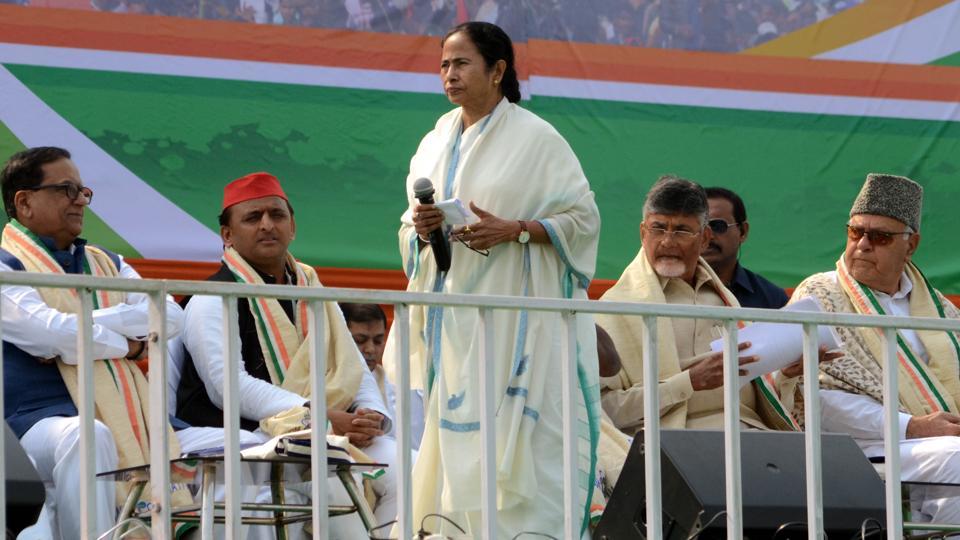
The battle-lines for the 2019 Lok Sabha elections became clearer on Saturday with 18 opposition parties coming together for a rally in Kolkata with one unifying goal: defeating the Narendra Modi-led Bharatiya Janata Party (BJP) at the Centre in 2019 Lok Sabha elections. But, this may not translate into a national pre-poll alliance, even though some state-level opposition coalitions are taking shape.

West Bengal Chief Minister Mamata Banerjee with Opposition leaders at TMC led 'United India' rally in Kolkata on Saturday. (ANI)

In Uttar Pradesh, the Bahujan Samaj Party (BSP) and Samajwadi Party (SP) have announced a pact for Lok Sabha polls keeping the Congress out— thereby making the contest triangular.

BSP chief Mayawati made it clear she was a proponent of an anti-BJP, anti-Congress alliance, an idea also floated by Telangana chief minister K Chandrashekar Rao who skipped Saturday’s rally. In Telangana, the so-called grand alliance of the Congress, Telugu Desam Party, Community Party of India and Telangana Jana Samiti may not fructify for the Lok Sabha polls after their poor performance in the recently assembly polls.

Also Read | ‘Bachao, bachao, bachao’: Modi mimics Opposition unity rally in Kolkata

In West Bengal too, the chances of an alliance of all anti-BJP parties appears bleak. The Congress is keen to contest the Lok Sabha polls with the CPI(M) led Left Front — Trinamool’s arch-rivals who made their position clear by skipping Banerjee’s meeting. “If the Congress allies with the TMC in Bengal, we will be politically finished,” said a senior Congress leader on Saturday, asking not to be named.

In Bihar, the grand alliance led by Rashtriya Janata Dal (RJD) and the Congress is likely to keep out SP and the BSP -- though most opposition parties have an in-principle understanding, a pact similar to what they have in Jharkhand.

In Maharashtra, the opposition alliance is only between the Nationalist Congress Party and the Congress. The Congress is likely to contest Madhya Pradesh, Rajasthan and Chhattisgarh, the three states it won from the BJP in 2018 assembly polls, alone.

Also Read | Mamata uses rhetoric, hyperbole to underscore Opposition unity, attack Modi regime

Political analysts termed the opposition’s rally as a landmark show of unity but were unsure whether it will translate into a larger coalition. Most of them said the opposition needs a common manifesto, as suggested by former prime minister H D Deve Gowda at the rally, to convince voters.

Former Presidency College principal Amal Mukhopadhyay said as of now the opposition does not have an acceptable “cohesive” leader who can keep all of them together.

(With inputs from bureaus in Kolkata, Ranchi, Patna and Hyderabad)

  • Chetan Chauhan
    ABOUT THE AUTHOR
    Chetan Chauhan

    Chetan Chauhan is the National Affairs Editor looking into all aspects of news and features from across India. A Chevening scholar with over three decades of experience in reporting and news management, Chetan has extensively covered all important aspects of the social sector, political economy, environment and climate change nationally and internationally. He did a journalism course at the Reuters Institute of Journalism in Oxford and Digital Media training at Nanyang Technological University in Singapore. He started as a reporter with The Statesman in 1996 and joined the Hindustan Times in 2000 in the metro bureau covering environment, crime and Delhi politics. He covered hot local news, from the Jessica Lal murder case to the rebellion of Delhi Congress MLAs against then Chief Minister Sheila Dikshit, to the replacement of toxic vehicle fuel with cleaner compressed natural gas (CNG) in the national capital. Some of his stories on air pollution became part of the Supreme Court’s landmark MC Mehta versus Government of India case in the National Capital Region (NCR), forcing the government to take corrective measures. As part of the national political bureau since 2004, he covered important central sectors such as environment, education, social justice, labour, rural development, water resources, renewable energy, agriculture, broadcasting and the Planning Commission for more than a decade producing several exclusive and investigative breaking stories. His specialisation is the environment, having covered at least a dozen United Nations global conferences on climate change, biodiversity and wildlife including climate summits in Paris, Copenhagen and Bali. He also covered India’s two five-year plans ---11th and 12th and reported on drafting and execution of right based laws such as Right to Education, Right to Information and rural job guarantee law, MG-NREGA, now being introduced in new format as VG-RAM-G Act. He has in-depth knowledge of social sector issues. He was one of the first to report on tigers vanishing from Sariska and Panna wildlife reserves in 2004 and 2008, respectively, leading to the setting up of the National Tiger Conservation Authority (NTCA) and the introduction of stringent penal provisions for poaching. He has written extensively on the rising human-animal conflict in India and the degradation of India’s biodiversity hotspots because of mining and other activities. Since 2004, Chetan has covered Parliament comprehensively and participated in training on the nuanced coverage of Parliament proceedings. He has travelled extensively across India to cover national and provincial elections since 1998, especially in the Hindi heartland states, considered India’s road to power. He writes a regular column for Hindustan Times, Ecostani, on important national politics, economy, Himalayan ecology and environmental issues. His other responsibilities include providing inputs for edits and edit page articles for the publication, apart from managing news flow from across India.Read More