Credited with developing innumerable technological wonders, including world’s smallest satellite, the Indian Institute of Technology, Kanpur (IIT-K) is synonymous with science.
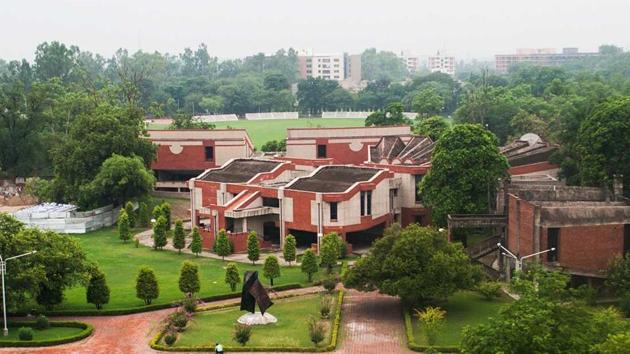
So much so that when the idea of using artificial rain to check pollution came up last week, the option that chief minister Yogi Adityanath bet on was IIT-K.
However, only a few would know that India’s premier institute, contrary to its reputation, is also working for the advancement of traditional Indian wisdom stored in scriptures like the Vedas, Purans, Upanishads, Ramayan and Gita.
The institute has been decoding a number of such scriptures for the common man in different languages.
In fact, Gita Supersite, an exhaustive website decoding ancient Hindu scriptures, was developed 20 years back by the premier institute.
The website offers the facility of instant transliteration in a preferred language along with Sri Sankara’s commentary.
Interestingly, while the website has been there for long, it became an instant hit recently when a WhatsApp message containing details of it went viral.
“When earlier we had about 600 users a day, more than 2,000 people are visiting the site now,” said TV Prabhakar, professor, computer science and engineering, IIT-K.
“The site was famous among serious students of Gita and other philosophical texts but now the common man is also accessing it,” he said.
{{/usCountry}}“The site was famous among serious students of Gita and other philosophical texts but now the common man is also accessing it,” he said.
{{/usCountry}}Vedas, Puranas, Upanishads Srimad Bhagwat Gita, other Gitas, Ram Charit Manas, Valmiki Ramayan, Brahma Sutra, Yog Sutra, Vedanta concept map, Narada Bhakti Sutra concept map — anything and everything spiritual is available on this repository of Indian philosophical texts.
Originally all these texts are in Sankrit but can be viewed in any of 11 language scripts—Assamese, Bengali, Devnagari, Gujarati, Kannada, Malayam, Oriya, Punjabi, Roman, Tamil and Telugu.
“We hope to put up English translations of Sutras as well as Sankara’s commentary very soon,” Prabhakar tells HT.
Not only this, audio clips of various ‘shlokas’ has also been made available on this site.
The seeds of this project, according to Prabhakar, were planted in the pre-Internet era with a project undertaken by him at IIT-K and funded by the Chinmaya International Foundation in 1989.
“When Internet became popular, the department of electronics in the Central government assigned us a project on technology development in Indian languages,” Prabhakar said.
“And we demonstrated this by developing the Gita Supersite, a first of its kind website,” he added.
“The fact that such a website has been in oblivion for so long reflects on IIT-K’s inhibition to ensure its due publicity. Gita Supersite deserves more and should be updated regularly,” said Rajnish Sharma, a regular visitor.