A five-member expert committee set up by the University Grants Commission (UGC) has submitted a very critical report of the functioning of Allahabad University (AU) to the centre. The report has now been sent to AU for its comments on the findings.
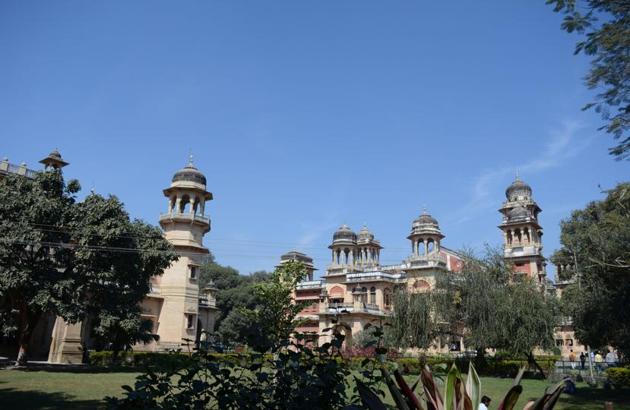
In its report, submitted by the panel after a three-day visit to AU campus between November 13 and 15, 2017, the committee has summarised that the state of the university as deplorable in all academic, financial and administrative matters. It has maintained that the university carries the baggage of its history and most of the problems are intractable.
The committee was set up to conduct an academic, research, financial and infrastructural audit of the university by the UGC on October 10, 2017 and later was reconstituted in November 2017.
“If the present state of affairs continues, this university is bound to become inviable and unworkable. The state of affairs may be then too far gone. MHRD may need to consider suitable action,” the report says.
The panel comprising Gautam R Desiraju, IISc-Bangalore, Prof Soibam Ibotombi, Manipur University, Prof Pinakpani Chakrabarti, Bose Institute- Kolkata, Amita Singh, JNU-New Dellhi, Prof Mahadeo Jaiswal, IIM, Sambalpur and KP Pandian, former JS, DST, in the report has observed that this once noble institution has been quite unlucky in the persons who were selected to lead it since 2005 when it became a central university.
{{/usCountry}}The panel comprising Gautam R Desiraju, IISc-Bangalore, Prof Soibam Ibotombi, Manipur University, Prof Pinakpani Chakrabarti, Bose Institute- Kolkata, Amita Singh, JNU-New Dellhi, Prof Mahadeo Jaiswal, IIM, Sambalpur and KP Pandian, former JS, DST, in the report has observed that this once noble institution has been quite unlucky in the persons who were selected to lead it since 2005 when it became a central university.
{{/usCountry}}“Management is an all-important but little recognized component of university administration in India. There is no management in AU; just a hopping from one crisis to the next. In such a scenario, there is no room for long range vision,” the report says.
Commenting on teaching-learning and evaluation, the panel has observed that a university is built on the strength of its faculty. “The University has 317 teachers compared to the sanctioned strength of 820. The student: teacher ratio is 79:1, which cannot sustain the optimum teaching quality. Many departments have no new appointment for the last 20 years or more. The average faculty age is 58 years,” it says.
The report also says that the students mentioned that in many subjects the regular faculty never teaches and the JRFs substitute for them and that too only for 4-5 classes during the whole course.
“This inadequacy of teachers also makes the university retain the retired professors, and this corrupts the whole teaching system. There is also excessive dependence on 'guest lecturers’. The immediate need of the hour is recruitment of new faculty members, following the recommendation from MHRD, not getting trapped into any litigation. An assessment of teachers by students at the end of the semester would make the faculty members more responsive to the need of the students,” it adds.
On research, consultancy and extension, the report points out that university website has list of research publications which has not been updated since 2014. “This is not acceptable,” it says.
AU vice-chancellor Prof RL Hangloo was not available for comments. AU’s dean student’s welfare (DSW) and PRO Prof Harsh Kumar said that the varsity would submit its reply to MHRD on point to point basis within the stipulated time as required.