The government agricultural mandi in Gunnour Assembly Constituency (AC) in Panna district in Madhya Pradesh has two large sheds. One can see from a distance that one is more crowded with both people and grain than the other. The reason becomes clear when one goes closer.
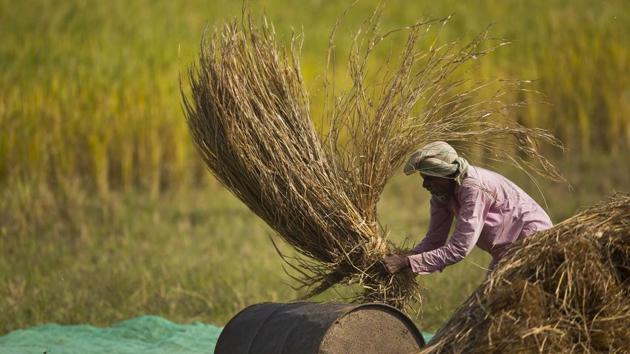
The emptier shed has two groups of farmers with the same product: black urad. They have come to sell it under the Bhavantar scheme of the state government. However, there is a vast difference in their fortunes now. One group’s product has passed the quality control test of the procuring officials, while the others’ hasn’t.
It has slightly higher soil content per unit weight. It cannot be filtered out, because soil particles are often the same size as the dal. The latter group is devastated. Bhavantar gives Rs 5,600 per quintal while the mandi prices are as low as Rs 3,500 per quintal. A farmer who came with a fully loaded tractor is potentially staring at a loss of more than Rs 50,000. That’s a lot of money.
The crowded shed is full of farmers who now await private buyers to sell their crop at much lower prices. Even farmers whose crops are accepted will have to wait for some time (sometimes weeks, and some say even months) before they get the payment directly in their bank accounts. This delay matters a lot for small farmers, who have very little capital and need to pay for other expenses including the cost of transportation to the mandi immediately.
{{/usCountry}}The crowded shed is full of farmers who now await private buyers to sell their crop at much lower prices. Even farmers whose crops are accepted will have to wait for some time (sometimes weeks, and some say even months) before they get the payment directly in their bank accounts. This delay matters a lot for small farmers, who have very little capital and need to pay for other expenses including the cost of transportation to the mandi immediately.
{{/usCountry}}Travelling across Madhya Pradesh, HT hears other complaints from farmers. There are problems with the registration process for Bhavantar and rich farmers are favoured, says one. Private traders have artificially lowered prices in the market as they know that the small farmer has no other option but to sell to them, says another.
This is not to say that Bhavantar or government procurement has not benefitted farmers. Things could have been a lot worse without the scheme. What is also a fact however, is that for each beneficiary, there are several rejected aspirants. That could work against the government politically.
The average farmer in Madhya Pradesh is used to better times. That Madhya Pradesh has been one of India’s better performers in agricultural growth (in terms of the rate) under Shivraj Singh Chauhan is well known. One of the biggest reasons for this was Chauhan’s focus on irrigation. Data from the Centre for Monitoring Indian Economy (CMIE) shows that Madhya Pradesh doubled its net irrigated area between 2002-03 and 2014-15 (latest available data).
This also led to a sharp increase in productivity. Madhya Pradesh has significantly closed its yield gap in food grains vis-à-vis the all-India average under the current state government. (See Chart 1)

In almost all the villages HT visited, farmers were unanimous that irrigation infrastructure, including power supply, has improved significantly under the Chouhan government. Yet, they are not happy with the Bharatiya Janata Party this time.
The price crash is to blame. Farmers recount how the prices they are getting today are only a small fraction of what they used to get earlier.
This shows up in the data as well. CMIE statistics show that the average prices of soyabean, gram, garlic etc., all important crops in Madhya Pradesh, fell significantly in the post-demonetisation period. Cost of cultivation did not go down though. Labour, fertilizer, diesel etc. all of them have become more expensive. (See Chart 2)

To be sure, the BJP supporters discount the hit due to demonetisation. But the perception on demonetisation is more uniform in Madhya Pradesh than it was in Karnataka, when this author visited the state before the assembly elections. Sitting in his small shop in the Jabera AC of Damoh District, Arun Singhai openly proclaims his loyalty to the BJP. His brother is a local leader of the party, he says. “I have always voted for the BJP and will do so again, but it is also true that I used to earn more when the Congress was in power,” Singhai told HT.
In India, whether the farmer votes as a farmer, or as part of a larger caste group has always been a much debated question. The answer to this question will matter a lot in Madhya Pradesh this time.
Elections are scheduled on November 28 and the results will be declared on December 11. A counter-question is warranted. Did farmers vote as farmers or caste groups when they rewarded Shivraj Singh Chauhan for his focus on agriculture?
For full coverage on MP elections, click here.