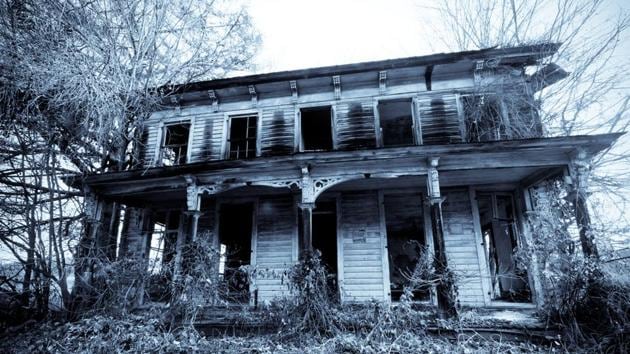
Haunted houses tell us a lot of stories. But those stories are not just about ghosts. Colin Dickey , the author of Ghostland: An American History in Haunted Places, went around the country visiting haunted houses to see if they “could tell us something about who we are as a people, or how we understand the past.”
In an interview for the AP Travel podcast “Get Outta Here,” Dickey said ghost stories help us “talk about things in the past we might not otherwise have confronted.” It might be a place with a violent or brutal history like a prison or asylum, or a just an old building with creaky stairs and dark hallways where someone’s life took a tragic turn due to the death of a child or an unrequited love.
Examples of places with a disturbing past that bill themselves as haunted attractions include the LaLaurie Mansion in New Orleans, where slaves were treated with extraordinary brutality, or Philadelphia’s Eastern State Penitentiary , an abandoned prison. Dickey describes Eastern State as “a broken-down castle with stone crenellated towers” where “it’s easy to imagine” a history of “atrocities and violence.” “Ghost stories in many ways are a way for us to approach our own history,” Dickey said, “and our own history is complicated.”
Dickey also noticed that haunted stories sometimes revolve around women who never married or who were widowed young. Sometimes these women were viewed as having been frozen in time, living out their lives in a decaying house. But he says the facts often tell a different story, suggesting that these individuals may have been viewed as odd or even spooky because their lives as single women didn’t fit cultural norms for marriage and childrearing.
{{/usCountry}}Dickey also noticed that haunted stories sometimes revolve around women who never married or who were widowed young. Sometimes these women were viewed as having been frozen in time, living out their lives in a decaying house. But he says the facts often tell a different story, suggesting that these individuals may have been viewed as odd or even spooky because their lives as single women didn’t fit cultural norms for marriage and childrearing.
{{/usCountry}}The Winchester Mystery House , a 161-room mansion in San Jose, California, which Dickey visited often growing up, is a good example. Sarah Winchester’s father-in-law developed the Winchester rifle, so she and her husband were wealthy heirs. Their only child died in infancy, and Sarah’s husband died soon after. Dickey says stories often paint her as having lived out her life in perpetual grief, haunted by the ghosts of everyone who’d ever been killed by a Winchester rifle, and “building this labyrinth to keep them at bay,” Dickey said. But Dickey says the truth differs from the legend. “She got on with her life as a widow, but all things considered, a relatively happy widow,” he said. The ghost stories came about, he speculates, because “a woman living alone happily just doesn’t fit in our culture.”
Dickey also points out that the haunted house industry has become important as a way to raise money to preserve old buildings. Many historic sites have embraced haunted tours as a fun way to engage visitors who will gladly pay for a ghost tour, but who might not sign up to learn about 19th century customs or antiques. Take for example the Merchant’s House Museum on East Fourth Street in Manhattan. The 1830s row house was home to the family of Seabury Tredwell. Five of the eight Tredwell children never married. Seven people died in the house, the last of them Gertrude Tredwell in the 1930s. Regular tours of the Merchant’s House carefully stick to the facts, telling visitors only what is known from Census records and other research about who lived in the house and when, or what can be gleaned from physical evidence, like dents left in the floor by furniture routinely laden with heavy plates of food.
But the Merchant’s House also advertises haunted tours. The theme is especially popular during the Halloween season. Through Oct. 30, the site hosts an exhibition called “Truly We Live in a Dying World: A 19th Century Home in Mourning” with displays of mourning clothes, a coffin covered with lilies and a mannequin of Seabury Tredwell laid out on his deathbed. You can even take a selfie in a coffin. For decades, Merchant’s House staff members were warned against repeating ghost stories, according to spokeswoman Emily Hill-Wright. But in the last 10 or 15 years, the museum has embraced the opportunity to use ghost stories as “a wonderful way to bring in new audiences. People will come in because they hear that we’re haunted. Once we get them inside, they realise what a special place this is.”
She said the museum has no qualms about using “the interest in ghosts and morbid things in order to educate the public. It’s not just that we’re raising money because of ghosts and having fun with that. There is an educational component. We do feel we’re fulfilling our mission.”
Follow @htlifeandstyle for more