The city on Sunday recorded its cleanest Diwali air in five years, since real-time air quality monitoring began in Mumbai. However, researchers have predicted a marginal spike in pollution levels on Monday.
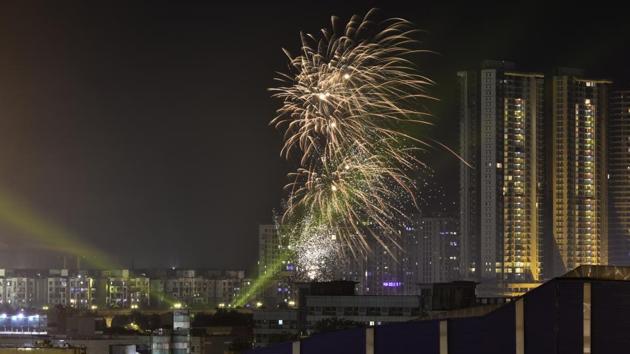
The air quality index (AQI) on Sunday for PM2.5 (fine particulate matter that can enter deep into the lungs and cause health ailments) was 30 (good) during the day, which increased to 87 (satisfactory) by evening. An AQI of 118 (moderate) has been predicted for Monday, 70 (satisfactory) for Tuesday, and 76 (satisfactory) for Wednesday, according to the System of Air Quality Weather Forecasting and Research (SAFAR).
“Cyclone Kyarr has managed to keep air pollution levels to its lowest for the west coast, and of the four cities where SAFAR records air quality, Pune followed by Mumbai were the cleanest, while ‘moderate’ pollution was witnessed in Ahmedabad, and ‘very poor’ levels in Delhi during Diwali,” said Gufran Beig, project director, SAFAR.
Bandra-Kurla Complex (BKC) was the most polluted location on Sunday, with an AQI for PM2.5 at 217 (poor), followed by Malad at 120 (moderate). While Worli recorded maximum nitrogen dioxide (NO2) levels (125) (moderate) owing to heavy vehicular traffic, maximum carbon monoxide (CO) levels were recorded at Mazagaon 105 (moderate) owing to the increase in the use of firecrackers and vehicular pollution.
{{/usCountry}}Bandra-Kurla Complex (BKC) was the most polluted location on Sunday, with an AQI for PM2.5 at 217 (poor), followed by Malad at 120 (moderate). While Worli recorded maximum nitrogen dioxide (NO2) levels (125) (moderate) owing to heavy vehicular traffic, maximum carbon monoxide (CO) levels were recorded at Mazagaon 105 (moderate) owing to the increase in the use of firecrackers and vehicular pollution.
{{/usCountry}}BKC and Malad have been predicted to be the most polluted locations in the city on Monday.
SAFAR categorises AQI levels from 0-50 as good, 51-100 satisfactory, 101-200 as moderate, 201-300 is poor, 301-400 is very poor, and above 401 is severe.
“Maximum pollution levels are expected between 1am and 6am on Monday, on account of external emissions such as firecrackers being burst across the city, which will lead to a temporary increase in air pollution with the formation of a boundary layer of pollutants close to the surface,” said Beig. “However, high moisture and calm winds under the influence of Cyclone Kyarr, which moved away from the Indian coastline on Friday, has helped keep pollution at its lowest levels in five years during Diwali for Mumbai and Pune.”
Last year, Mumbai recorded an AQI of 221 (poor) on Diwali (November 7, 2018), and 305 (very poor) AQI, a day after Diwali. Mumbai recorded high pollution levels during Diwali 2017, when the AQI was 204 (poor) on Diwali (October 19, 2017), and 319 (very poor), a day after Diwali. In 2016, an AQI of 278 (poor) was recorded on Diwali day (October 30, 2016), and 315 (very poor) the day after. In 2015, the city recorded an AQI of 279 (poor) on Diwali day (November 11), and 313 (very poor) the day after.
SAFAR also predicted the concentration of PM2.5 this Diwali is likely to surpass the safe limit of 60µg/m3 (microgrammes per cubic metre) on Monday. PM2.5 concentration on Sunday was 43µg/m3, while the forecast for Monday is 66µg/m3, and 42µg/m3 on Tuesday. .
Stay updated with all the Breaking News and Latest News from Mumbai. Click here for comprehensive coverage of top Cities including Bengaluru, Delhi, Hyderabad, and more across India along with Stay informed on the latest happenings in World News.
Stay updated with all the Breaking News and Latest News from Mumbai. Click here for comprehensive coverage of top Cities including Bengaluru, Delhi, Hyderabad, and more across India along with Stay informed on the latest happenings in World News.