Indian scientists have uncovered remains of an ancient ocean floor, located to the east of Kolkata and under a large part of Bangladesh, increasing the opportunity to tap into more natural resources in the region.
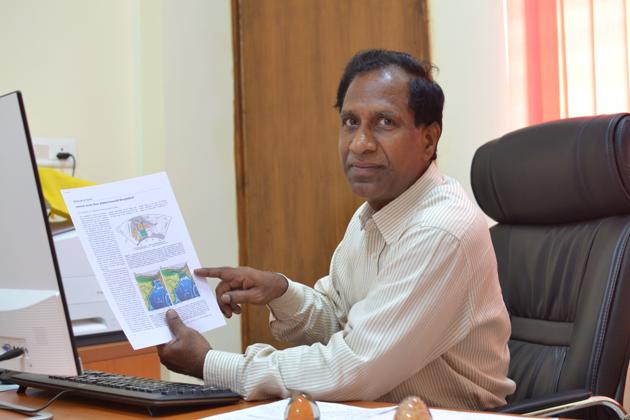
A study led by a team from the University of Hyderabad (UoH) said the ocean floor pushed the area where Kolkata currently stands inside the landmass but also led to the formation of the land which forms 75% of present day Bangladesh.
Researchers said the finding is significant because it is contrary to the general belief that all seven continents are underlined by continental rocks or granite that are billion years old. Beneath the oceans, on the other hand, are basalt rocks not more than 200 million years old.
“There is also a general understanding that most continents are older than the oceans. So if Bangladesh is part of the Indian subcontinent, it should have granitic rocks. But we found the scenario here is different,” said KS Krishna, lead author and professor, Centre for Earth, Ocean and Atmospheric Sciences (CEOAS), UoH.
Using different kinds of geophysical methods in the Bay of Bengal and other published results from Bangladesh, the team found that the area has 120-million year-old oceanic rocks buried underneath thick river sediments, while the west part of Kolkata has continental rocks like the rest of the country.
{{/usCountry}}Using different kinds of geophysical methods in the Bay of Bengal and other published results from Bangladesh, the team found that the area has 120-million year-old oceanic rocks buried underneath thick river sediments, while the west part of Kolkata has continental rocks like the rest of the country.
{{/usCountry}}“This means ancient Bay of Bengal was different 23 million years ago from what we see today, extending far into the landmass to almost 75% of the Bangladesh and Kolkata regions,” said Krishna. “This is a unique case on the Earth as a result of interconnected and unified geological processes”.
With many Indian petrochemical companies exploring natural gas/ gas hydrates/hydrocarbons owing to the thickness of sediments, the study findings will help look for fossil fuels from both ancient and younger sediment. In this work, researchers from CSIR-National Institute of Oceanography (CSIR-NIO) and Oil and Natural Gas Corporation said the processes took place after 23 million years that led to the formation of Bangladesh.
“After the Indian plate collided with the stationary Asian plate, there was rapid rise in the already existing Himalayan mountain range reaching nearly present day height,” said M Ismaiel, co-author and faculty, CEOAS. “These mountain ranges as a result started interacting with the atmosphere which led to the establishment of the Asian monsoon and soil erosion owing to the rains.” The eroded sediments flowed into the two major river systems of Ganges and Brahmaputra and finally into the northern part of the ancient Bay of Bengal. This process continued from 23 million years onwards and sediments kept getting deposited in the Bangladesh region, and reached above sea level. This sedimentation filled the coastal region which today is east part of Kolkata.
“Continental rocks cannot support 18km thick sediments because the continent cannot go down for sediment depositions, therefore it will lead to the formation of a mountain against the gravity. On the other hand, oceanic rocks will sink the moment sediments begin settling on them,” said K Srinivas, CSIR-NIO.
The study was published in Current Science, peer-reviewed journal of Indian Academy of Sciences, on Wednesday.
Stay updated with all the Breaking News and Latest News from Mumbai. Click here for comprehensive coverage of top Cities including Bengaluru, Delhi, Hyderabad, and more across India along with Stay informed on the latest happenings in World News.
Stay updated with all the Breaking News and Latest News from Mumbai. Click here for comprehensive coverage of top Cities including Bengaluru, Delhi, Hyderabad, and more across India along with Stay informed on the latest happenings in World News.