This May, China will hold a forum on the “One Belt, One Road” strategy advocated by Premier Xi Jinping, one which around 20 national leaders and cabinet members are already scheduled to attend. Premier Xi is preparing for a major reshuffle in the autumn, and we can surmise that he would like to stress the foreign policy achievements of his administration since its inception in 2012.
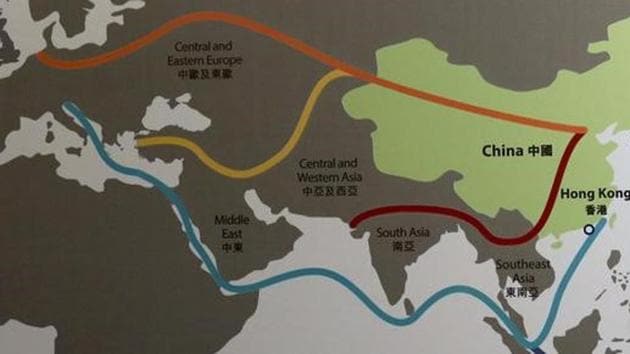
But what is the One Belt, One Road strategy? That is not an easy question to answer, but here is an outline below.
First, since this strategy is part of the peripheral diplomacy inherited from Hu Jintao’s administration, we can say that it consists of land and maritime Silk Roads. Second, although it has been unclear what area this strategy covers and there is more than one version of the map in existence, it appears to include East Africa and the South West Pacific Ocean, as well as the entire Eurasian continent. Third, within the Chinese government, the state council, the ministry of foreign affairs, and the ministry of commerce have jurisdiction over the strategy, while various local governments have also been given roles. Fourth, one function of the strategy is to dispose of surplus production from domestic state-owned enterprises and other businesses. Also, as the domestic opportunities for infrastructure construction are now fewer, China has a surplus of infrastructure-building capacity.
Although this concept is an extension of Hu Jintao’s peripheral diplomacy, it can also be understood as a policy opposed to American rebalancing such as the Trans-Pacific Partnership (TPP), or geopolitically as an attempt by China to form its own sphere of influence. Nevertheless, the strategy has always been vague in many respects. In particular, will One Belt, One Road be an international organisation with members or not? It seems that the countries invited to the upcoming forum have been given membership, but that is not definite. Even researchers in China sometimes point out that there is no meaning to the One Belt, One Road strategy without a clear organisation backed by geopolitical thinking and strategy. China is presenting its own new image of Asia via such things as Asian security guarantees, and it is offering international public goods such as the Asian Infrastructure Investment Bank. But even within China, it is not clear what role this One Belt, One Road strategy has to play.
{{/usCountry}}Although this concept is an extension of Hu Jintao’s peripheral diplomacy, it can also be understood as a policy opposed to American rebalancing such as the Trans-Pacific Partnership (TPP), or geopolitically as an attempt by China to form its own sphere of influence. Nevertheless, the strategy has always been vague in many respects. In particular, will One Belt, One Road be an international organisation with members or not? It seems that the countries invited to the upcoming forum have been given membership, but that is not definite. Even researchers in China sometimes point out that there is no meaning to the One Belt, One Road strategy without a clear organisation backed by geopolitical thinking and strategy. China is presenting its own new image of Asia via such things as Asian security guarantees, and it is offering international public goods such as the Asian Infrastructure Investment Bank. But even within China, it is not clear what role this One Belt, One Road strategy has to play.
{{/usCountry}}Regarding this One Belt, One Road strategy, I’d like to focus on two specific points. The first point is the formation of domestic consensus. Doubts over this strategy have been raised within China. It is well-known that this strategy is centred on infrastructure investment, and while it serves the purposes of dealing with domestic production surpluses and making effective use of surplus capital, since the Chinese domestic economy is somewhat weak, it has been criticized as prioritizing foreign investment over domestic investment.
The second point is infrastructure building; in other words, this strategy’s meaning in terms of its economic aims. There is also a view that the One Belt, One Road should be clearly separated into land and sea policy, and that we should pay more attention to the sea (one road) policy than the land (one belt). In actuality, on land Russia is watchful of China’s actions, and there is no ordinary economic rationale for building in the desert. For that reason, it does seem China has decided that the land policy should emphasise economics. On the other hand, as we can see from China’s construction of harbors in Brunei and Sri Lanka, as well as naval bases from the South China Sea to the Strait of Malacca, in the Indian Ocean, and in Djibouti in South Africa, China is establishing sites for the expansion of its naval forces. In other words, the rationale for the sea Silk Road policy is not just an economic one, but has political and military elements too. In particular, we should pay attention to China’s One Belt, One Road policy in the Indian Ocean. And we also need to pay particular attention to whether economic and political aspects are truly separate from military aspects or not.
Shin Kawashima is professor at the University of Tokyo
The views expressed are personal