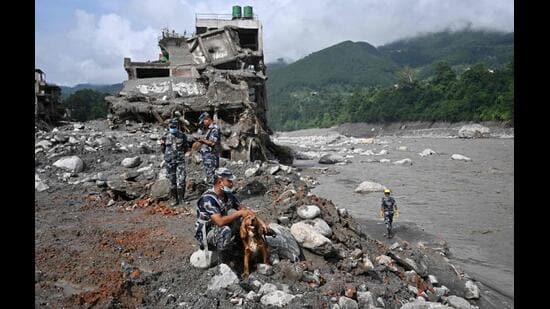
On the Nepal–Tibet border, the same river produced two destructive floods 14 months apart; August’s killed over 1,450 people and left a $4.78 billion rebuilding bill. Last year, Hong Kong raised a typhoon warning 14 times; a normal year brings about six. Nepal is a landlocked least developed country; Hong Kong’s per capita income is above $60,000. Vastly different economies, yet climate shocks are rising in both.
For anyone pricing risk for a living, the lesson is plain: The past is no longer a reliable guide. How can we better insure against rising climate shocks?
In September, the UN Environment Programme’s report said the 1.5°C Paris limit will be crossed on a sustained basis within a decade on every central estimate. Today’s policies point to about 2.6°C by 2100, and even full delivery of pledges peaks near 1.8°C. There are, UNEP says, “no benign scenarios” above 1.5°C, and “insurance and financial system stress” is among the risks.
In an overshoot world, risks, once complicated are now compounding: The next shock lands before the last is paid for. Disasters drain budgets and starve prevention. When insurers withdraw from the riskiest places, costs shift to households and stretched governments, eroding the property values and tax base on which local adaptation depends.
Cover is thin. Insured losses from extreme weather have exceeded $100 billion every year since 2020, yet reach only about 30% of economic losses. Asia suffers about 30% of the world’s disaster-related losses but accounts for only about 5% of insured losses. Of roughly $65 billion lost in 2025, 92% was uninsured, with the burden falling on families, small firms and public budgets.
{{/usCountry}}Cover is thin. Insured losses from extreme weather have exceeded $100 billion every year since 2020, yet reach only about 30% of economic losses. Asia suffers about 30% of the world’s disaster-related losses but accounts for only about 5% of insured losses. Of roughly $65 billion lost in 2025, 92% was uninsured, with the burden falling on families, small firms and public budgets.
{{/usCountry}}Disaster losses average 0.3% of GDP worldwide, but about 1.2% in landlocked developing countries and 2.1% in small island States. One storm cost Vanuatu about 59% of its GDP; Hurricane Maria cost Dominica 226%. Insurance is thinnest where public balance sheets are weakest. Nepal has asked the global loss-and-damage fund for $20 million, just 0.4% of reconstruction costs.
As COP31 negotiations begin, any asks for post-disaster funds are unlikely to be met as aid budgets fall. The vast insurance protection gap is a market failure; a systemic response is needed from insurers, regulators and governments.
First, risk-based pricing needs honest models. In October, an anonymous catastrophe modeller at a major insurer wrote in The Guardian that the industry was “collectively fudging the numbers” to keep premiums down. Governments and regulators lean on premiums too. Whoever applies the pressure, communities face worse losses than estimated. Insurers must resist it; regulators must make resisting it possible.
Second, insurers must invest for 2050. The assets behind their promises (sovereign bonds, grids, ports, hospitals) sit in the same path as their customers — when one event hits infrastructure, policyholders and governments together, diversification fails. Insurers should ask of every large asset whether it will still function in 2050. Regulators can go further — no new infrastructure without an insurer’s climate risk assessment based on scenarios, not past averages. Bring risk engineers in at site selection, not after the design is fixed, and insurability becomes part of bankability.
Third, reduce risk. Insurers’ loss data, used early, prevents losses. Alabama’s state-led, insurer-backed Strengthen Alabama Homes programme set a “FORTIFIED” roof standard. When Hurricane Sally struck in 2020, 95% of fortified homes saw little or no damage, premiums fell 35–45%, and home values rose about 7%. India scaled energy-efficient appliances through mandates and public procurement, not individual choice alone. Similar approaches could make housing schemes climate-resilient by insisting on standards to cope with extremes. At scale, this can make resilience more economical, reduce losses and mitigate pressures on insurers and public finances.
Fourth, apply universal service obligation. We expect power and water utilities to serve everyone; insurance plays a comparable role in post-disaster recovery. Insurers could be required to widen coverage steadily to the people and places they don’t typically serve. There are precedents: France requires natural-catastrophe cover in every property policy, and India sets rural and social-sector quotas for insurers. But a mandate alone would only raise premiums, so it needs a public backstop for the tail risks.
Fifth, share data. Governments budget and insurers price risk, but rarely from the same data. India’s 16th Finance Commission allocates 30% of state disaster funds using a Disaster Risk Index. Insurers’ loss data could sharpen such rules, and subsidies should be time-bound and tied to measured risk reduction. A partnership works when the finance ministry sees the avoided loss and the insurer the avoided claim.
Sixth, build partnerships. Gavi pooled public, philanthropic and industry money to vaccinate the poorest. Pooling public, philanthropic and insurer capital could pair risk reduction, starting with multi-hazard early warning, with cover for those who need it most. Existing schemes are too narrow: Global Shield raised €300 million by end-2024 but funds no risk reduction; the Caribbean’s CCRIF paid US$483 million over 2007–2025, far short of losses. Under a 2025 Asian Development Bank agreement, ten global insurers cover part of the credit risk on its sustainable-infrastructure loans, aiming to mobilise up to US$2.75 billion of private capital.
None of this works alone. More underwriting capacity, risk-reduction partnerships, recovery solutions and risk literacy are each necessary but insufficient: Capacity is not enough while risk stays high, and recovery is not enough without capital. Losses also reflect zoning, outdated building codes and urbanisation that ignores climate risk, so reforms must reach property valuations, lending norms, insurance pools and credit ratings.
Insurance is a shock absorber. A car’s suspension does not remove the pothole; it stops the pothole from breaking the car. In an overshoot world, there will be more potholes, and sooner. The question is whether our institutions will act before the losses pile up.
Arunabha Ghosh served as COP30 Special Envoy and is, most recently, co-author of Water, Nature, Progress (HarperCollins). The views expressed are personal