Children and their needs rarely feature in urban planning concerns or policy discourse in India. Talk to any parent in urban India, and they will tell you how difficult it is to raise a child — ironically, being outdoors has become largely detrimental to children’s health. Children are experiencing weakened lung capacity due to exposure to assorted pollutants. Several studies show the high prevalence of asthma, respiratory symptoms, allergic rhinitis, and eczema among adolescents in Delhi due to air pollution. At the same time, the lack of outdoor activities has translated into much longer screen times and childhood obesity. Most parents also worry about reducing children’s screen time because of safety concerns.
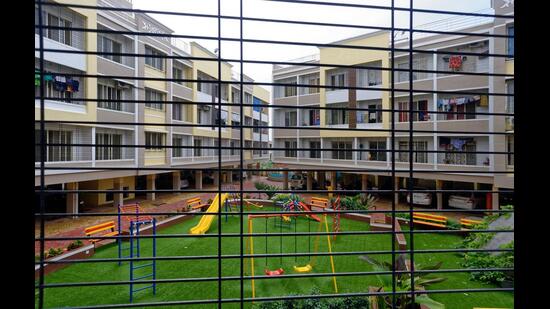
Children’s experiences also vary within the city, reflecting a deep form of inequality. While gated societies may have accessible playgrounds, swimming pools and other facilities, children from lower-income backgrounds often face overcrowding and sanitation issues in their places of dwelling, let alone when such facilities are available with access to the general public. Children from affluent backgrounds may enjoy more comforts, but they lack freedom, remain dependent on their parents for basic activities, including intra-city commutation well into their teens, and live under surveillance cameras because urban planning requirements have tended to ignore their safety and agency. Put simply, our cities are not designed for children, a key demographic.
Indian cities are designed for adult conveniences with limited consideration for children’s safety, independence, or play. Streets are unsafe partially due to fast-moving traffic, missing pavements, few to no play spaces with passive cooling, lack of public infrastructure like toilets, and an absence of community culture. Designing for and with a vulnerable demographic such as children helps incorporate unique perspectives and a gentle playfulness that is missing from formal urban planning in India. When children participate in the design of places, it empowers them as urban residents and future caretakers. Whether by focusing on recreational green spaces or simply designing for safety as pedestrians, this sort of urban and civic engagement also helps reclaim childhood.
Timothy Gill, author of Urban Playground: How Child-Friendly Planning and Design Can Save Cities, argues that a city that is good for children is good for everyone. He suggests children should contribute to urban design by helping shape the vision and brief for streets, public spaces, and neighbourhoods, while adults remain responsible for planning and delivering the solutions. He writes: “Child-friendly urban planning and design means taking children’s needs and wishes seriously when building or changing neighbourhoods, especially their public realm. Drawing on ideas from sustainable urbanism, community participation and public health, the approach is about much more than creating play areas. Streets, sidewalks, traffic levels, parks and other public spaces, and the buildings that border and define them can all influence children’s health, development and quality of life”
{{/usCountry}}Timothy Gill, author of Urban Playground: How Child-Friendly Planning and Design Can Save Cities, argues that a city that is good for children is good for everyone. He suggests children should contribute to urban design by helping shape the vision and brief for streets, public spaces, and neighbourhoods, while adults remain responsible for planning and delivering the solutions. He writes: “Child-friendly urban planning and design means taking children’s needs and wishes seriously when building or changing neighbourhoods, especially their public realm. Drawing on ideas from sustainable urbanism, community participation and public health, the approach is about much more than creating play areas. Streets, sidewalks, traffic levels, parks and other public spaces, and the buildings that border and define them can all influence children’s health, development and quality of life”
{{/usCountry}}Though a handful of India’s elite are shifting abroad or to more pristine locations within the country to raise their children amidst nature, this is not an option available to everyone. Designing urban spaces to ensure children’s rights is in line with UN and Indian constitutional protections. The right to play is recognised under Article 31 of the United Nations Convention on the Rights of the Child (UNCRC), and Article 21 of the Indian Constitution protects the right to life and personal liberty, which includes the right to human dignity, health, and a safe environment. The National Institute of Urban Affairs stresses four service areas to make cities more child-friendly: Built environment, services and facilities, safety and mobility, ambient environment and disaster management. Built environment includes housing, schools, and open spaces. Services and facilities focus on physical and social infrastructure, including special facilities for differently abled children. Safety and mobility relate to aspects of transport, safety of children, and traffic. Ambient environment and disaster management address risks emanating from changing environmental conditions and climate disasters.
To reclaim Indian cities for children, planners, policymakers, and politicians must think from the child’s perspective, and the voices of parents, teachers, and children themselves must be heard in the process of urban planning and design. Designing for children with their input will generate a sense of autonomy and agency and make cities livable for everyone.
Malancha Chakrabarty is senior fellow, Observer Research Foundation, and Shriya Malhotra is an independent researcher and artist. The views expressed are personal