India’s ethanol programme is one of its clearest energy security successes, reaching 20% blending (E20) five years ahead of the 2030 target and cutting the crude import bill. The government has now notified rules allowing flex-fuel vehicles to be certified to run on E85 and E100. The notification enables these fuels rather than mandating them.
Any meaningful uptake would raise demand substantially, as an E100 vehicle runs almost entirely on ethanol and, because ethanol carries less energy, needs more fuel per kilometre than an E20 vehicle. Meeting this demand would depend heavily on sugarcane, rice and maize, which will compete for the land, water, and grain India needs for food and animal feed.
The question is how much the country can afford to divert. Events over the past month suggest the margin is already thin.
Earlier this month, the government directed oil marketing companies to bring sugar diversion for ethanol down to zero for the 2026-27 supply year, amid concerns over sugar output after weak rains.
The same tender, seeking around 11 billion litres, cut the price for maize-based ethanol by ₹3 a litre. Maize was already the largest feedstock in 2024-25, supplying nearly half of India’s ethanol, and with cane juice and B-heavy molasses excluded this year, distilleries will need considerably more of it. The pressure on maize is already reshaping what farmers grow.
The Economic Survey 2025-26 warns that ethanol’s price signals are pulling farmland towards maize and away from pulses and oilseeds, which risks entrenching India’s dependence on edible oil imports. The Survey calls this an emerging tension between Aatmanirbharta in energy and Aatmanirbharta in food.
{{/usCountry}}The Economic Survey 2025-26 warns that ethanol’s price signals are pulling farmland towards maize and away from pulses and oilseeds, which risks entrenching India’s dependence on edible oil imports. The Survey calls this an emerging tension between Aatmanirbharta in energy and Aatmanirbharta in food.
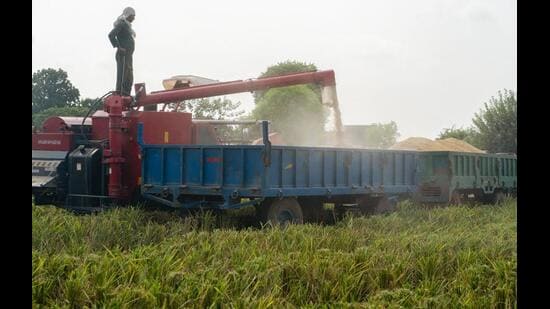
{{/usCountry}}Rice tells a similar story where between June 2025 and June 2026, the Food Corporation of India (FCI) supplied 6.35 million tonnes of rice to distilleries at nearly 40% below its acquisition cost, effectively extending economic support to ethanol through the food system.
A further 7.2 million tonnes has been allocated for 2026-27. With central stocks in July at nearly three times the buffer norm, this is surplus grain for now. But surplus depends on good monsoons and open-ended procurement.
Water is an equally serious constraint, one that ethanol procurement ignores. Distilleries themselves use little water, but the real footprint lies in cultivation. The industry argues, with some merit, that estimates overstate the problem by counting rainfall. Yet much of India’s cane and distillery capacity sits in states where groundwater is already under severe stress.
Brazil is often cited as the model for running transport on ethanol. Its standard petrol carries 30% ethanol but most Brazilian sugarcane is rainfed, and much of its corn ethanol comes from a second crop sown after the soybean harvest.
India’s cane, by contrast, has historically been more than 90% irrigated, and the country’s grain-based ethanol draws on crops that would otherwise feed people and livestock.
India must stop expanding ethanol from first-generation feedstocks (sugarcane, maize and rice) beyond what E20 requires. Rice-based ethanol should be phased out first, while maize and cane allocations should follow feed availability and genuine sugar surpluses. Demand beyond E20 should be met through second-generation (2G) ethanol from non-food biomass such as crop residues and bamboo.
And, 2G ethanol must be run as a national technology mission. Seven years after PM JI-VAN Yojana was launched, only a handful of plants have been commissioned, costs remain well above first-generation ethanol, and even the flagship Panipat plant is not running at design capacity.
Savings from phasing out subsidised rice should fund indigenous conversion technology and a paid biomass collection network. Research institutes should also develop high-yielding, low-water energy crops for degraded land; guaranteed offtake at a premium price would give investors the certainty to build at scale.
Water must be priced into procurement. New cane and grain distilleries should not come up in over-exploited groundwater blocks, procurement prices should reward lower-water feedstocks, and drip irrigation should become a condition for cane supplied to distilleries.
The food-fuel trade-off also must be made transparent. Any support to ethanol routed through the food system should be budgeted and reported annually.
Lastly, ethanol must go where it adds the most value. For cars and two-wheelers, electrification is the more efficient long-term pathway; a parallel E100 retail network risks slowing that shift. Ethanol’s stronger case lies in hybrids and, in time, as a feedstock for sustainable aviation fuel.
Ethanol has a legitimate place in India’s energy mix, but its expansion must be governed by the limits of the country’s land and water.
Amitabh Kant is chancellor, NIIT University, chairman, Fairfax, Centre for Free Enterprise and ex-G20 Sherpa & ex-CEO, NITI Aayog.The views expressed are personal
(This piece is part of the HT debate series. The title of this debate is “Is 100% ethanol the right pivot for India?” The opposing side of the debate can be accessed here)