It has been amply clear over the past couple of years that the Russia-Ukraine war, going on since 2022, has become a laboratory for a form of military adaptation unlike anything seen in recent times. This is a continuous, high-speed contest in which tactical innovations are fielded, countered, and re- countered within weeks rather than years. At the hub of this confrontation is a feedback loop that runs from the frontline to the production-line and back — a loop defining military capability.
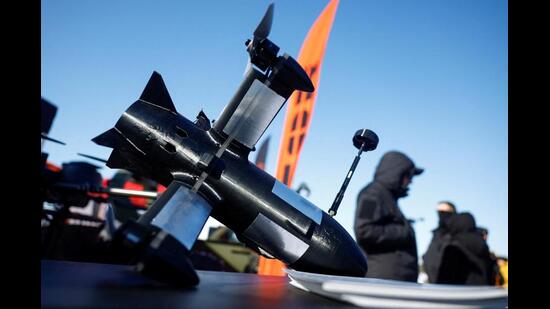
As per a recent analysis of the Carnegie Endowment, “the classical model of defining requirements, issuing a tender, developing a system, testing it, producing it, and then fielding it — is too slow to remain relevant in a rapidly evolving battlefield environment”. This shift is most visible in the deployment of drones on active battlefields and has the repetitive relentlessness as its basis. Ukraine reached an interceptor drone production of roughly 1,500 units per day by January 2026.
Similarly, according to Ukraine’s former commander-in-chief General Oleksandr Syrskyi, Russia plans to manufacture roughly 20,000 units per day. These figures typify today’s wars, where a design not repeated on demand within weeks is already obsolete. Ukraine’s model of a battlefield-to-factory loop is also aided by the Delta platform, a bottom-driven battlefield database that acts as a real-time drone-kill data feedback system.
This enables design iteration on a cycle of weeks rather than years. Every engagement generates data that flows back to the manufacturers.
{{/usCountry}}This enables design iteration on a cycle of weeks rather than years. Every engagement generates data that flows back to the manufacturers.
{{/usCountry}}Mass production and precision deployment are the most crucial prerequisites of an impactful military campaign.
What distinguishes this war is that mass production is strengthened by a tight feedback loop between the user and the manufacturer. In Ukraine, combat units maintain their own repair facilities, small-scale production capabilities, and some even run informal research-and-development cells.
Successful adaptations are spread laterally through information sharing on social media and by civil volunteer communities, instead of strictly through centralised bureaucratic channels. The fusion of civil and military in an all-encompassing manner has been exemplary.
As a corollary, Ukraine’s most competitive drone firms maintain seamless contact with combat units, receive real-time feedback from the front, and iterate designs accordingly. The traditional boundaries between users, developers, and manufacturers have diffused.
This model also consists of mini factories that are geographically distributed and are in proximity of frontlines. For example, the German UAV company, Nordyn, designs networks of mobile, autonomous micro factories that bring assembly and maintenance directly to the frontline. If one unit is hit, there are ten others that keep running.
On the other hand, Russia’s approach to adaptation follows a different rationale — slow to start, but formidable once mobilised. The initial invasion in February 2022 was characteristic of a rigid, top-down structure that discouraged initiative at lower levels. The structure was riddled with a hierarchy-monitored, zero-error syndrome.
Russian innovation was mainly driven by the battlefield needs rather than being based on an established mechanism for doctrinal absorption. The centralised system that inhibited tactical creativity was leveraged to facilitate industrial mobilisation by creating an ‘ecosystem of learning’.
Dara Massicot, senior fellow at the Carnegie Endowment, writes in Foreign Affairs that since 2022, Russia has been studying combat experience. Several specialised commissions have analysed thousands of tactical incidents, leading to over “450 interim changes to combat manuals” for the Russian military.
This has resulted in game changing innovations and tactics. Structurally, the key change was the decentralisation of command. Drawing lessons from Ukraine and to cater for fast developing battle scenarios, defence industryenterprises have established direct communication with the front, promptly implementing feedback-based improvements.
The Russian army today, is a hybrid system: centralised in direction but capable of rapid, large-scale production once a requirement is identified. Russia’s mass production of Geran drones, standardised FPV warheads, and fibre optic drones reflect this pattern of transformation.
The tension between centralised industrial power and decentralised battlefield innovation is the central strategic challenge of the Russia-Ukraine war, which has demonstrated that adaptation has become a vital dimension of combat power. The side that learns faster — not the side that starts with better equipment — gains a temporary edge.
For traditional militaries accustomed to long development cycles and bifurcated users and manufacturers, the implications are discouraging.
Russia bets on mass and the ability to overwhelm; Ukraine bets on speed and the ability to out-adapt. Which bet pays off may depend less on any single technology than on the resilience of the feedback loop that connects the soldier in the trench to the engineer at the factory floor.
The broader lesson for India is that the feedback loop must shift from being merely network-centric to fusion-centric, with data from land, air, space, and cyber domains fused to compress decision cycles. This requires integrated targeting, on-the-spot thinking, and layered protection rather than stand-alone platforms. Through planned theatrisation, this need will, hopefully, be met as battlefield feedback shall have to be institutionalised.
India can establish a real-time drone-kill data feedback loop through a ministry of defence-industry joint programme, on the lines of Ukraine’s Delta platform. Alongside theatrisation, a formation responsible for autonomous operations, under command of the theatre commander could be raised. Last but not the least, a customised procurement policy to accommodate the above dynamics shall be indispensable.
Colonel Shashank Ranjan (retd.) is associate professor of practice and director, Pankaj Kumar Jha Centre for Security Studies, OP Jindal Global University. The views expressed are personal