Concerned parties — whether party cadres or political pundits — are on tenterhooks about the upcoming Uttar Pradesh assembly elections. The resurgence of the Samajwadi Party (SP)-led alliance in the state in the 2024 parliamentary elections means that the results of the 2027 Vidhan Sabha elections are more unpredictable than they have been for a long time. Multiple discourses on caste politics in the state — hitherto considered established — are going to be challenged.
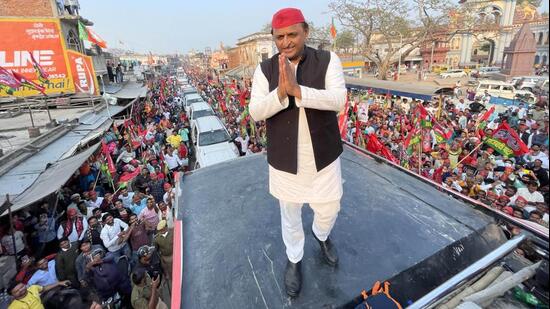
Since 2024, the SP has been gradually building and consolidating its strategy of PDA — Pichhda (backward), Dalit and Alpsankhyak/Aadhi Aabadi (minorities/half of the population). It has also tried to add Pandit (Brahmin) to this mix. The attempt is to constitute a formidable and — from the SP’s point of view — unprecedented social coalition. The SP is taking a leaf out of the BJP’s social engineering book on how to build support at the booth level. The SP recently announced its poll strategy of garnering 27,000 additional votes in each constituency or, to be more precise, 400 additional votes at each booth from diverse caste groups, with a special emphasis on Brahmins.
Some pre-2014 history helps to explain the grounds for the party’s optimism. The SP’s vote share in 2012 was only 29.1%, but it won 224 seats — a clear majority. This was the lowest vote-share to win a majority in the history of UP assembly elections, lower even than the BSP government of 2007 (formed with 30.4% of the vote). The SP hopes to succeed in doing something similar in 2027.
The SP’s share of the Brahmin vote was a tiny 3% in 2002. It jumped to 10% in 2007 and 19% in 2012, enough to help the party to its famous victory. This fell to 7% in 2017 and 6% in 2022. However, in the 2024 election, 19% of Brahmins, and 16% of all so-called upper castes, voted for the SP-Congress alliance. It is by these small margins that elections are won and lost.
{{/usCountry}}The SP’s share of the Brahmin vote was a tiny 3% in 2002. It jumped to 10% in 2007 and 19% in 2012, enough to help the party to its famous victory. This fell to 7% in 2017 and 6% in 2022. However, in the 2024 election, 19% of Brahmins, and 16% of all so-called upper castes, voted for the SP-Congress alliance. It is by these small margins that elections are won and lost.
{{/usCountry}}Thanks to Rajput leaders such as Mohan Singh in eastern UP and the proximity of Amar Singh with Mulayam Singh Yadav in the 1990s and later, Rajputs have not been averse to the SP. During the 2024 LS elections, in certain parts of UP, such as in Allahabad-Varanasi-Gazipur in eastern UP and Meerut-Muzaffarnagar-Saharanpur in western UP, a sizeable number of Rajputs voted against the BJP and backed the SP.
SP strategists and supporters will take encouragement from the fact that in 2012 the SP’s Jatav vote went up by 12% (while the BSP’s Jatav vote fell by 23%). This paved the way for what was called the loose coalition of extremes — of Dalits with Brahmins and Thakurs. Holding such a coalition together in 2012 can be viewed as uncommon political skill on the part of Akhilesh.
Similarly, the SP-led alliance in UP was able to draw support across all non-upper caste social groups during the 2024 LS election, with its campaign pitch of saving reservations and the Constitution. This, combined with local anger at the BJP’s ticket distribution, led to a surprising result, as was seen in 2012. What was fundamentally different this time was that much of the vote-shift was from the BJP to the SP, unlike in 2012 when the SP took votes from the BSP.
Despite being upbeat on the back of the 2024 performance, Akhilesh must be aware that 2027 may not be like 2012. The SP faces a well-oiled election machine in the shape of the RSS-BJP organisation. The BJP is determined not to lose UP in the current fragile political environment.
Several factors could combine to spoil the SP’s plan for 2027. First, the BJP has succeeded in cultivating fear of gunda raj among the upper castes and women. Second, Brahmins, despite their anxieties and grievances, have in the past come out to vote in good numbers for the law-and-order narrative. Third, women, as in Bihar and West Bengal, may decide to vote en bloc for what they perceive as a robust State machinery, one that they think delivers.
Most crucial, the AIMIM factor may lead to a reversal of the negative voting trend among Muslims. In 2024, there was an unprecedented 92% Muslim consolidation behind the SP-Congress coalition in UP. If, as in Bihar, there is positive voting in certain Muslim-dominant constituencies, this will cost the SP dearly.
The 2027 elections in UP are likely to boil down to a contest between the SP-led coalition and the BJP-led NDA. The SP is desperate to shun the label of Muslim-Yadav (MY)-based exclusionary caste politics, which explains the revised acronym and reinterpretation of P for Pandit and the fact that the SP organised a birthday celebration of the late Janeshwar Mishra from eastern UP. The BJP-led NDA, for its part, has put together a formidable social coalition in the last four elections in UP. The BJP’s edifice is erected on the two planks of inclusionary caste politics (sabka saath, sabka vikas) and the share market model in which the labharthi (beneficiaries of welfare) votes for the party that is more likely to benefit them.
Co-authored by David N Gellner, emeritus professor of social anthropology, University of Oxford. Shashank Chaturvedi is a research affiliate of the School of Anthropology, University of Oxford, and Sanjay Kumar Pandey is professor in the School of International Studies, JNU. The views expressed are personal