As India looks towards Viksit Bharat 2047, its eight northeastern states are beginning to occupy an increasingly significant space in the national discourse, for good reason. This region, 98% of whose boundary is international, sits at a point where India’s economic geography is changing. In the course of our work in the region over the past decades, we have come to understand that the North East is not just about its strategic location — it is in fact a powerful engine propelling India’s young population towards long-term development goals. Many of the North East states are demonstrating capacity and innate potential to foster higher economic growth rates than many of the remaining states.
The North East is better understood as a family of states, rather than a single homogenous region. Assam’s river plains, the hill states governed under the Sixth Schedule, Sikkim’s hydropower which accounts for nearly 90% of the state’s installed power generation capacity, and Nagaland’s distinct constitutional arrangements under Article 371A reflect different contexts and institutions. Any argument that spans the region must, therefore, earn its generalisations, and what follows should be read with that in mind.
The region’s natural endowment is a good place to begin. Nearly two-thirds of the North East remains under forest cover, and much of its land is held and cared for by communities. Together, these give the region an asset that few other parts of India can claim — a landscape in which growth can be planned with ecology in view from the start. Sikkim’s journey to fully organic agriculture, the recognition accorded to Meghalaya’s Lakadong turmeric, and the community conservation traditions of villages such as Khonoma in Nagaland show what is possible when livelihoods and stewardship are pursued together. Community ownership also means that the benefits of tourism, agriculture and conservation can remain close to the people who sustain them. The spirit of this model of development could be carried over to other parts of the country, and indeed into national policy.
The region’s human development story is a second source of encouragement. Many northeastern societies, including the matrilineal communities of Meghalaya, have long accorded women a central place in family and economic life, and the region records some of the highest levels of female participation in work in the country. Mizoram’s literacy has for decades stood among the best in India. Young people across the region grow up with English alongside their own languages, which is a considerable advantage especially in a services-led global economy. The region’s athletes, among them Mary Kom, Mirabai Chanu and Lovlina Borgohain, have overcome difficult odds and brought pride to the whole nation. These strengths will matter greatly as India seeks to realise the full potential of its young people and its women.
{{/usCountry}}The region’s human development story is a second source of encouragement. Many northeastern societies, including the matrilineal communities of Meghalaya, have long accorded women a central place in family and economic life, and the region records some of the highest levels of female participation in work in the country. Mizoram’s literacy has for decades stood among the best in India. Young people across the region grow up with English alongside their own languages, which is a considerable advantage especially in a services-led global economy. The region’s athletes, among them Mary Kom, Mirabai Chanu and Lovlina Borgohain, have overcome difficult odds and brought pride to the whole nation. These strengths will matter greatly as India seeks to realise the full potential of its young people and its women.
{{/usCountry}}A third aspect is the region’s cultural and creative wealth, which is an economic and diplomatic asset. Assam’s tea and Muga silk, the handlooms and bamboo crafts of several states, Nagaland’s Hornbill Festival, Shillong’s long musical tradition and a cuisine that is gaining admirers across the country all point to a creative economy waiting to be developed at scale. These traditions also form living bridges to Southeast Asia, from the Tai roots of Assam’s Ahom heritage to the Buddhist heritage of Arunachal Pradesh. As India deepens its engagement with the countries to its east, the region’s cultural affinities can help make that engagement warmer, richer and more lasting.
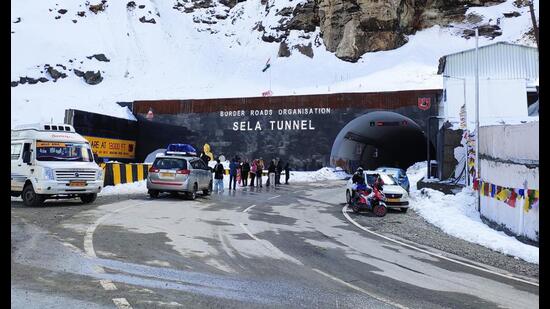
The Union Ggvernment has been a steadfast partner in this journey, starting with the Act East policy of 2014. Bridges at Bogibeel and Dhola-Sadiya and the Sela tunnel have brought the region closer to the rest of the country. The allocation for the ministry of development of north eastern region (DoNER) has grown from about ₹1,000 crore of expenditure in 2022-23 to ₹6,500 crore in the budget for 2026-27. The Rising Northeast Investors Summit, organised by DoNER, attracted investment interest of over ₹4 lakh crore. The task is now to convert these investments into enterprises, jobs and prosperity on the ground.
There are three areas in which the Centre’s continued leadership can be especially valuable. The first is trade and connectivity. The Union government is uniquely placed to build, through diplomacy, stable arrangements for land ports, waterways and corridors that will allow the region to trade with South East and South Asia over the long-term.
The second is fiscal partnership. As the region grows, there is an opportunity to complement support from the Centre with arrangements that recognise performance, so that states are rewarded for results. Credit guarantees and risk-sharing facilities designed with community land systems in mind would enable local entrepreneurs to raise capital while traditional tenure arrangements that communities value remain undisturbed.
The third is recognition of the region’s contribution to the nation’s natural wealth. The Finance Commission has begun to take forest cover into account in its recommendations on devolution. We hope this principle will deepen over time, so that the states that safeguard forests and watersheds for the benefit of the whole country are suitably supported.
Every region in India will have to contribute to the realisation of our Viksit Bharat vision for a developed India. The North East brings to the table a strong natural inheritance, a talented and aspiring population, and a diverse cultural milieu. With the continued support of the Centre and the energy of its people, the region stands poised to make a distinguished contribution to India’s journey to 2047.
Kapil Viswanathan is president, IFMR, and co-founder, Krea University. Conrad K Sangma is chief minister, Meghalaya. The views expressed are personal