Peter Nagy, the American artist and gallerist who founded Nature Morte, died on October 13 after a long illness. He was 67, and had lived in Delhi for over three decades.
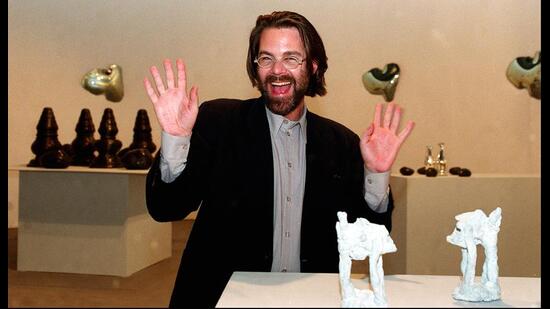
I met Peter somewhere in the late 1980s in New York. I was in my 20s, assisting photographers in studios in the days of film, and doing the rounds of the city. The East Village was still a little dangerous after sundown, but it had St Marks Place and the music, and further east Alphabet City, where they said Avenues A, B, C, and D stood for adventurous, brave, crazy, and dead. It was where anyone young and curious about art, or about the underbelly of the city, wanted to be. For many of us, the West Village was Disneyland, with its fancy bars, overpriced galleries and shoe shops. The graffiti on the subway trains was the signature of the city, and it moved through every borough. When I came back in the 1990s, the subways were clean, Rudy Giuliani was mayor, and New York was being reimagined.
Peter had studied at Parsons and was making his own work, and in 1982, he and the artist Alan Belcher opened Nature Morte in the East Village. The neighbourhood then was full of graffiti and expressionist painting, the world of Jean-Michel Basquiat and Keith Haring, and Nature Morte went the other way, showing cool, conceptual work that treated art as a commodity, borrowing from advertising and logos. It closed in 1988, and by the time I was back, Peter had already left.
{{/usCountry}}Peter had studied at Parsons and was making his own work, and in 1982, he and the artist Alan Belcher opened Nature Morte in the East Village. The neighbourhood then was full of graffiti and expressionist painting, the world of Jean-Michel Basquiat and Keith Haring, and Nature Morte went the other way, showing cool, conceptual work that treated art as a commodity, borrowing from advertising and logos. It closed in 1988, and by the time I was back, Peter had already left.
{{/usCountry}}He came to Delhi in 1992, meaning to stay a year, and never left. India was coming out of its socialist experiment, there was no internet, and art here moved through a small circle of collectors who mostly bought the established names. Many younger artists were still finding their language, and few of them had travelled or shown abroad. That came later, with the internet and cheaper travel, and Peter was here before it, when the buyers for contemporary Indian art were still largely Indian. He reopened Nature Morte in 1997 with two Indian partners and no fixed address, putting up shows wherever he could, and the gallery went on to represent Subodh Gupta, Bharti Kher, and Jitish Kallat among others. Peter himself told an interviewer that early on, he could not sell Subodh’s work anywhere, and that “people thought I was nuts showing these things”. He kept showing it and stood by his artists, while making his own work too. This August, the gallery marked 30 years in Delhi.
I think every curator and every artist carries the conditioning of where they come from, and most of us never quite see past it. Peter’s eye was made in New York; brought to Delhi, it let him see what the rest of us walked past every day, the larger language an artist was trying to speak; sometimes, even before the artist could.
In 1999, he brought architects and photographers together in Sub-Architecture-Continental at the Qutab Colonnade, Ram Rahman and Raj Rewal among them. I showed environmental portraits of the television in lower middle-class and lower-income homes, the screens only a fuzzy blur and the setting around them what I was photographing. In those homes, the television had not yet gone into the bedroom; it stood in the middle of the house, or the drawing room in bigger ones, a sign of wealth and aspiration. Peter came from America, where television was already background noise, and read these as the first signs of a new consumer class and a changing India. For him, they were street photographs made indoors, and he said so plainly, as he said everything. I could not get my head around it then.
That plainness was Peter. In a culture where we worry endlessly about what the other person will think, and where saying no does not come easily, he never got caught up in any of it. What you saw was what you got, and he never pretended to be anyone else. His dry humour was his signature. At his own openings, once the time was up, he would announce to his guests that the show was over, it was time to close, and would everyone please get ready to leave. Nobody minded, and everyone left.
Samar Jodha is a transdisciplinary artist, photographer and TED speaker whose practice spans South Asia, West Asia and East Africa. The views expressed are personal
(This is a Hindustan Times digital exclusive)