
A woman, five months pregnant, is gang-raped. Other women in her family including her mother are also raped, and killed. Her three-year-old daughter, Saleha is killed. The reason why the woman survives at all is because she loses consciousness and is left for dead by the mob.
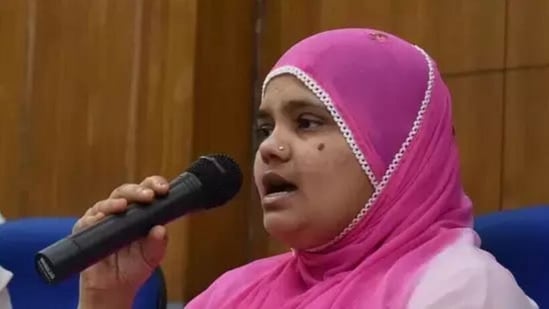
Justice should never be assumed. Perhaps this is the lesson for women in India. The crimes against Bilkis Bano are so extreme that it is impossible to imagine that her struggle for justice continues nearly a quarter century after the 2002 Gujarat pogrom in which an estimated 1,000 Muslims were killed. Each time you think you’ve heard the last of the Bilkis Bano case—a conviction, the cancellation of an unlawful remission—there’s a new plot twist and the anguish begins anew, not just for Bilkis but for anyone who wants to believe in ideas of justice, righteousness, and rule of law.
“Every time we think we’ve finally got justice, we feel happy that at last this is behind us,” Yakoob Rasool, Bilkis’s husband, said on the phone. “But then after a few years there is a setback and Bilkis has to go back to court to fight again.” This time, he said, the court did not even bother to inform her of its decision to suspend the life sentences of two of the 11 men convicted of crimes against her and her family. A two-judge Supreme Court bench of justices M.M. Sundresh and Prasanna B Varale ruled on October 28 that Bipinchand Kanhaiyalal Joshi and Pradip Ramlal Modhiya had been jailed for 17 years and one of them, Joshi, had “a severe handicap”. The court acknowledged that there are issues to be decided in the appeal on facts and law. These appeals will be heard in “due course”, it said.
“We heard about it from the media,” said Yakoob who runs a small buffalo-milk dairy business. In the years since 2002, Yakoob said the family has lost count of the number of times it had been forced to move, knowing that Bilkis’s life remains in danger.
{{/usCountry}}“We heard about it from the media,” said Yakoob who runs a small buffalo-milk dairy business. In the years since 2002, Yakoob said the family has lost count of the number of times it had been forced to move, knowing that Bilkis’s life remains in danger.
{{/usCountry}}A disappointed Bilkis told OnManorama: “While the convicts are able to exercise their rights and enjoy their freedom, I continue to live a life of displacement.”
The elusive quest for justice
Parole, furlough and bail in a criminal justice system are premised on the possibility of reform and rehabilitation. But there is a widespread expectation that those convicted of heinous offences should not benefit from these provisions without compelling justification.
In India, we’ve seen a perversion of these legal tools by certain VIP prisoners like the head of the Dera Sacha Sauda sect, Ram Rahim Singh who wields considerable influence among followers in Haryana and Punjab. As of August 2026, Singh who is serving a 20-year sentence for rape, has been out of jail 17 times since 2017 on furloughs or paroles ranging from one day in October 2020 to 50 days in January 2024.
Until 2022, 10 of the 11 convicts in the Bilkis Bano case had spent over 1,000 days each outside jail on parole or furlough. The 11th had spent 998 days. Some had violated the conditions of their release including one who returned 197 days late.
Yet, on August 15, 2022 this did not come in the way for all 11 being granted remission, or early release for “good behaviour”. On India’s 75th Independence Day when prime minister Narendra Modi was making a stirring speech about nari shakti from the Red Fort, the 11 men walked out of jail. It was not a discreet, backdoor release. Instead, it was deliberate, performative and obscene in its triumphalism: the men were greeted with ladoos and garlands and felicitated at an office of the Vishwa Hindu Parishad.
National outrage followed, and various public interest litigations were filed. On January 8, 2024, the Supreme Court quashed the remission orders, ruling that Gujarat had no jurisdiction to grant it because the trial had taken place in Mumbai. The men were ordered back to jail—their year-and-a-half at home between August 2022 and January 2024 was over.
Or so everyone thought.
Then, just over two years later, following a different legal route, two of those 11 are out, again. And Bilkis and her family have reportedly left Gujarat, again.
Determined to fight
Bilkis’s quest for justice began almost immediately after she was brought to a relief camp following the communal violence in 2002. After initially refusing to register her complaint, local police eventually did so but left out any reference to the gang-rape and the names of all the men who Bilkis had named. “Bilkis named every one of them, but the police fudged the FIR,” said her lawyer, senior advocate Shobha Gupta.
A frustrated Bilkis approached the Supreme Court which ordered the CBI to take over the case. In 2004, trial was transferred to Mumbai over concerns about evidence tampering. In January 2008, a special court convicted 11 men of rape, murder and conspiracy and sentenced them to life imprisonment—a sentence upheld in appeal by the Bombay High Court in 2017, which also convicted six police personnel and two doctors who had earlier been acquitted by the special court.
The matter should have ended there. Instead, in 2022 came an order for remission, subsequently cancelled, and now two men have returned home through a separate legal process: one on the ground that he was not named in the original complaint, and the other citing his disability.
“I don’t know who is so determined to have the men released,” said Yakoob. “We’ve seen this happen again and again. How is it that the same Supreme Court which ordered the remission to be cancelled is now ordering two men to be released?”
Bilkis has “no choice but to keep going,” Shobha Gupta said. “Letting such an adverse development go unchallenged would leave her long journey for justice with a gloomy end.”
It’s not an end Bilkis can accept. Memories of her three-year-old daughter, Saleha keep her going she said in her interview to OnManorama. “Justice for her means ensuring that those who took her life receive the punishment prescribed by the law of the land. I ask for nothing more and nothing less.”
ABOUT THE AUTHOR
Namita Bhandare writes on gender and other social issues and has 35-plus years of experience in journalism. She has edited books and features in a documentary on sexual violence. She tweets as @namitabhandare