New Delhi: For a few days, Delhi breathed easy, quite literally. Between November 5 and 13 came the city’s first, brutal pollution spell, fuelled in great measure by stubble being set ablaze in the neighbouring agrarian states of Punjab and Haryana. After a brief respite when Delhi’s pollution levels fell to poor (on November 23), the best a Delhi winter now gets, by November 26, the city was back at severe. This time, the pollutants were local.
Environmentalists and
New Delhi: For a few days, Delhi breathed easy, quite literally. Between November 5 and 13 came the city’s first, brutal pollution spell, fuelled in great measure by stubble being set ablaze in the neighbouring agrarian states of Punjab and Haryana. After a brief respite when Delhi’s pollution levels fell to poor (on November 23), the best a Delhi winter now gets, by November 26, the city was back at severe. This time, the pollutants were local.
Environmentalists and senior officials of Delhi’s environment department said that while the city’s pollution season, considered from October to February, begins with external sources such as stubble fires looming over the city’s air, exacerbated by the festive season, the current spike in pollution levels has a clear link to pollutants that come from within the city.
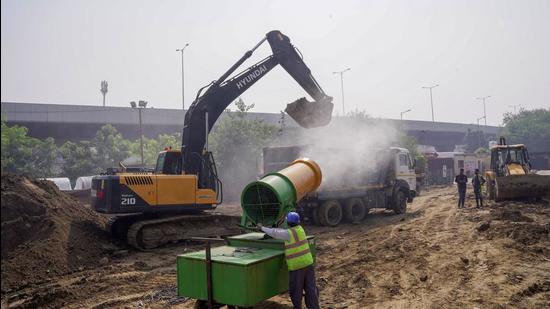
An analysis by the Indian Institute of Tropical Meteorology’s Decision Support System, which helps agencies get an idea of how the sources of pollution in Delhi are expected to act on any given day, shows that between November 15 and December 14, vehicular pollution topped the list of the biggest local contributors to Delhi’s poor air quality. The range of its contribution ranged from 30 to 55% in this period. Other local sources that mired the air, over the last month have been construction, industrial emissions from the peripheries of Delhi and NCR, residential emissions, road dust and waste burning.
Solutions to vehicular pollution
While the role of weather cannot be overlooked, environmentalists say that the key to finding a solution to this annual problem lies in controlling local pollution. They say that a potential shift away from the ever-rising number of vehicles in Delhi, currently standing at nearly 12 million, could be hampered by the Covid 19 pandemic. Anumita Roychowdhury, executive director (research and advocacy), CSE, said that after the pandemic hit Delhi, people have been favouring private vehicles over public transportation and that could be a worrying trend for the city. “Vehicular emissions are known to be the most active pollution sources in Delhi, but what is worrying now is that all the work that governments and environmental bodies did over the last few decades, could be undone. Fearing infection, many commuters have switched to private vehicles over public transport modes,” said Roychowdhury.
Roychowdhury said that it was now crucial that governments prepare strategies that would wean commuters back to public transport by making these more reliable, safe and affordable. “The aim should be to incentivise it because this behavioural shift could be the doom for the city, both from the point of view of the environment and the congestion that it causes,” she said.
Experts also stressed that now that the pandemic has shown the limitations of mass transit modes such as the Delhi Metro, it is imperative that the city invests in bettering its bus system—an easy and affordable way to keep commuters from making a permanent switch to private vehicles.
Amit Bhatt, director (integrated transport) at the World Resources Institute (India), said that many cities around the world are now adapting to the impacts of the pandemic and renovating their public transport infrastructure.
“Commuters are moving away from mass transit modes and the city should now invest in flexible transit modes. For instance, a demand-based bus system to cater to the working population that now has flexible working hours is already in place in San Francisco. The bus system currently is timetable based but there are now changing demands, exacerbated by the pandemic,” Bhatt suggested.
Action against local sources
Over the last few years, Delhi has seen the formation and dismantling of several pollution monitoring and overseeing bodies tasked with controlling this annual air emergency, little has changed in terms of action on-ground. Karthik Ganesan, fellow and director (research coordination) at the Council on Energy, Environment and Water, said that while there have been efforts year after year to manage the pollution crisis in the Capital, source-specific action is now the need of the hour.
“There is an increasing level of attention each year and the administrative machinery is on high alert to the impending air quality deterioration. However, efforts are required on a number of fronts within Delhi ranging from waste burning, high load from private vehicle use, poor service levels of buses which are the most used mode of transport, unabated emissions from large construction sites. None of these has been addressed in a concerted manner,” Ganesan said.
He added, “A well-functioning app to report transgressions helps fire-fighting, but the sources outside the boundary of Delhi and indeed entrenched sources within need to be addressed year-round and not just as we enter the autumn season.”
One Subscription.
Get 360° coverage—from daily headlines
to 100 year archives.
Archives
HT App & Website