Jos Hermens is synonymous with the distance running world. The 69-year-old, who won several 5,000m and 10,000m races in his heydays, retired in the late 1970s but still exercises considerable influence over the world’s leading distance runners. The Dutchman took part in 10,000m at the 1976 Montreal Olympics and also set the world record for covering the maximum distance in an hour—20,907m—in 1975. However, his running career came to a premature end due to an Achilles heel injury.
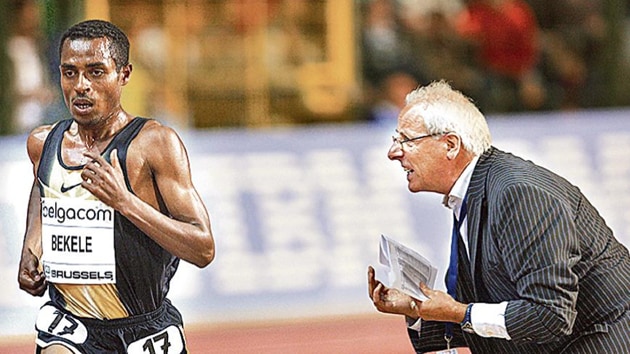
After retirement Hermens founded Global Sports Communication (GSC), where he is now CEO, which manages over 100 of the world’s top athletes, including reigning Olympic marathon champion Eliud Kipchoge of Kenya. Hermens was also actively involved in Kipchoge recently breaking the two-hour marathon barrier.
Headquartered in Nijmegen, Netherlands, GSC has training facilities in Kenya and Ethiopia and also guiding young runners in Bhopal in collaboration with SAI and Procam International.
In an interview during his visit here, Hermens opened up on how Kipchoge broke the two-hour barrier, his thoughts about Indian athletes and how he discovered two-time Olympic champion Haile Gebrselassie. Excerpts:
When would the two-hour marathon barrier be broken officially?
It might take another five years. A track runner who moves up to marathons has better chances.
Who do you potentially see breaking the record?
{{/usCountry}}Who do you potentially see breaking the record?
{{/usCountry}}I have three names—Ethiopia’s former world junior champion Yomif Kejelcha (22), Uganda’s world 10,000m champion Joshua Cheptegei (23) and Geoffrey Kamworor (26) of Kenya. Kamworor is Kipchoge’s training partner and recently won the New York Marathon in 2:08:13.
When did you initiate the idea of someone running sub two hours?
December 2014. Then Ethiopia’s 10,000m Olympic and world champion Gebrselassie was the key runner in mind. In 2008, Gebrselassie set the world marathon record of 2:03:59 at Berlin but the project didn’t take off. Three years later Kipchoge made an attempt to break the two-hour barrier in Monza (Italy)...
What did you observe in Monza?
The carbohydrate intake during the race was inadequate. There were no spectators and the weather wasn’t as good as expected. All these factors affected the performance. So it was decided to try again.
What were the changes made to break the two-hour barrier at Vienna?
The pacemakers ran in V-formation and Kipchoge was at the end (tip of V). So there was minimum air resistance. There were 150, 000 spectators to cheer the runners. The lead vehicle was positioned at 50m from the athletes while it was 10m in Monza.
You have been managing east African athletes for quite some time...
I first visited Ethiopia in 1981. Then there were hardly any roads. A 10km road journey would take six hours and at night I would only see one light in Addis Ababa. My first trip to Kenya was in 1983. Since it was a British colony, things were a bit different.
What’s the system of scouting talent in Kenya?
School competition is the foundation of distance running. A talented 16-17-year-old can be easily spotted during local school competitions.
And in Ethiopia?
There is a club culture. Clubs are run by companies and they field teams in national competitions held annually in Addis Ababa. It’s easier to scout talent during the meet.
How did you spot Gebrselassie?
I saw him during the 1990 national championships in Addis Ababa. He finished third in the (10,000m) track race but had a good, impressive running style. Because he was highly disciplined, he could win back-to-back Olympic gold medals in 1996 Atlanta and 2000 Sydney.
What are your views on the benefits of altitude training?
It plays an important role in distance running. Since the runners are born and brought up at an altitude, they have better oxygen carrying capacity due to more red blood cells (RBC). It’s a big advantage when they run at sea level. Many top athletes from across the world are training in altitude nowadays.
Does the physical structure also play a role?
The athletes from Rift Valley in east Africa have light and thin bones. Some are shepherds and walk long distances. It builds a strong foundation. Later, when they start endurance running, it helps them.
What’s the secret behind the athletic prowess of the Kalenjin tribe from the Rift Valley, who win most of the Olympic and World Championship medals in distance running?
As per my observation, Kalenjin are strong willed. They are shepherds and warriors and have a simple living style. These factors attribute to them excelling in running.
Why is it that despite good facilities Europeans aren’t good in distance running?
There might a few exceptions but a kid in Europe will use a car to go to school while in Kenya students will walk. That makes the difference.
There is a lot of debate over food and supplements...
Simple and natural is better. In Kenya, maize is staple. It’s the main source of energy (carbohydrates). They eat vegetables, mostly organic (for vitamin and minerals) and chicken for protein. In Ethiopia too, runners rely on natural food. Instead of maize they use teff (rich in energy, iron and minerals). The grain is grinded and the flour is used to make pancakes. Europeans have protein-rich diets and are better in throwing events.
Doping has become a big issue in east Africa?
It’s more in Kenya. Some use EPO (Erythropoietin) which stimulates RBCs and enhances performance in distance running. There’s a big war against doping and it is working. That’s the best thing—dope cheats are being caught.
What’s the primary focus of your training system?
I don’t believe in pushing youngsters too hard. A 16-17-year-old shouldn’t train as hard as a 20-year-old. In distance running it takes time to peak. Gebrselassie had won his first Olympic medal in 1996 and continued to excel at the global level for another decade. This was due to the systematic training approach.
Why don’t you have training centres in Europe?
The system is good in Europe. The respective federations take care of their athletes. Governments also support athletes in a big way.
You have a training centre in Bhopal too...
The academy has about 20 juniors. We’re trying to give young Indians exposure by periodically sending a selected few to Kenya and Europe for exposure.
How long will it take them to make an impact?
In the next 5-6 years they should be able to reach a good level. We are supporting Gavit Murli Kumar, who won a 10,000m bronze at the Doha Asian Championships in 28:38.34 in April. But Uganda’s world champion Joshua Cheptegei had clocked 26:48.36—the world’s leading time—in October. The gap is too big and it’ll take time. It’s not that easy. Good exposure will help them improve and narrow the gap.
Can someone from the Bhopal academy excel at the world level?
That wouldn’t be possible in the next 10-15 years as there is a big gap between the top Indians and the world’s best. The numbers of African runners is also growing and it’s difficult to beat them. It’s a big challenge for Europeans and other nations.
How have training methods changed over the years?
Good coaches and scientists are involved in developing sports these days. In the old days, focus was more on mileage. Now, the ratio between speed and endurance training is balanced. Gyms have also been introduced. That’s why many athletes are able to run second half of the marathons faster.
Some top athletes are running more than three marathons a year...
For good results not more than two! To avoid injuries, train on soft surfaces and good shoes are beneficial.