
 E-Paper



Photos: Busts of leaders become a sensation in China’s porcelain capital
October 1 marks the 70th anniversary of the founding of the People's Republic of China by Mao Zedong. As the country gears for celebrations, busts of Chinese leaders like Mao, current president Xi Jinping and others have surged in their popularity in Jingdezhen - China's porcelain capital. The city of Yanan, on the other hand, has become a hub for tourists owing to it being the birthplace of the Cultural Revolution which was undertaken by Mao. The city saw 50.59 million tourists in 2017, an increase of 26 percent from the year before.
Updated on: Sep 28, 2019 9:51 PM IST

Share via


Copy link

1/12
 View Photos in a new improved layout
Updated on Sep 28, 2019 9:51 PM
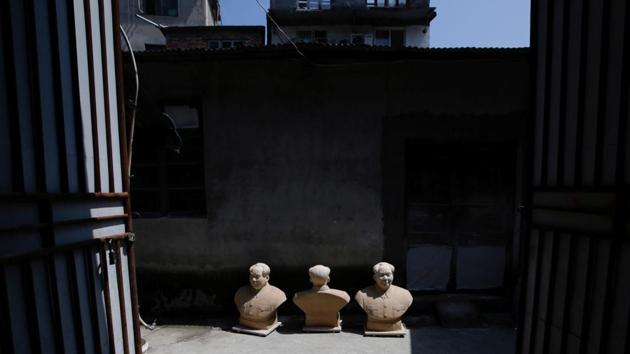
Busts of leaders at at ceramic artist Feng Chengren’s workshop in Jingdezhen, China. Feng’s workshop is one of the few in Jingdezhen - China’s porcelain capital - that does not specialise in the signature blue-and-white patterned pieces that the city is known for. Instead, he creates leaders. (Jason Lee / REUTERS)
2/12
 View Photos in a new improved layout
Updated on Sep 28, 2019 9:51 PM
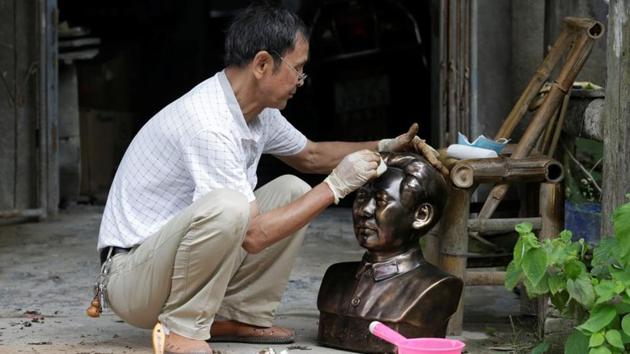
Feng works on a bust portraying late Chinese chairman Mao Zedong outside his studio in Jingdezhen. “I make statues of whoever is in power. I’ve done Mao, Deng Xiaoping and Jiang Zemin,” he said. Business has been brisk this year as China prepares to celebrate in October the 70th anniversary of its founding as the People’s Republic of China. (Jason Lee / REUTERS)
3/12
 View Photos in a new improved layout
Updated on Sep 28, 2019 9:51 PM
A bust portraying Chinese President Xi Jinping (C) is placed between busts portraying late Chinese chairman Mao Zedong (R) and late Premier Zhou Enlai at Feng’s studio. Xi is the country’s most powerful leader in decades. He has removed term limits on the presidency, taken command of the military, and added his ideology to the charter of the Communist Party. (Jason Lee / REUTERS)
4/12
 View Photos in a new improved layout
Updated on Sep 28, 2019 9:51 PM
Performers dressed as Kuomintang (KMT) soldiers interact before taking part in ‘The Defence of Yanan’ performance, a re-enactment of a famous battle performed daily for visitors, in Yanan, Shaanxi province. Mao, who founded the People’s Republic of China, cultivated a youth army whose violence plunged China into a decade-long turmoil known as the Cultural Revolution. Tourists flock to the city of Yanan, mythologised in party history as the birthplace of the revolution. (Jason Lee / REUTERS)
5/12
 View Photos in a new improved layout
Updated on Sep 28, 2019 9:51 PM
Costumes and replica weapons are stored backstage before a performance of the stage show ‘Yanan Nursery’ in Yanan. President Xi Jinping features more prominently in headlines in the official People’s Daily newspaper than other top members of the political elite compared with past leaders like Jiang Zemin, said Xiao Qiang, the founder of China Digital Times, a US-based news site covering China. (Jason Lee / REUTERS)
6/12
 View Photos in a new improved layout
Updated on Sep 28, 2019 9:51 PM
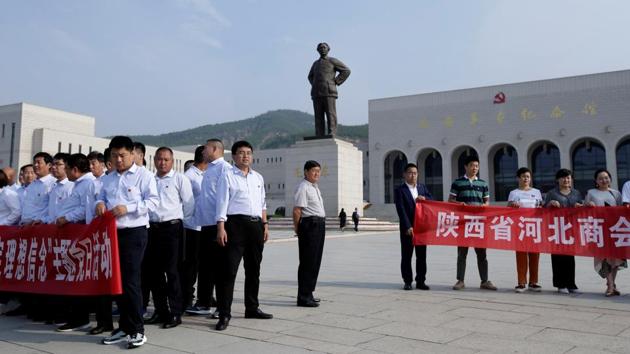
People hold banners for group photos in front of a statue of late Chinese chairman Mao Zedong outside Yanan Revolutionary Memorial Museum in Yanan. “By and large he has an image that no one else can match in Chinese official media,” Xiao said. Still, the government has actively sought to ban adoring songs and the use of ‘Uncle Xi’ in state media. (Jason Lee / REUTERS)
7/12
 View Photos in a new improved layout
Updated on Sep 28, 2019 9:51 PM
A Jingdezhen shopowner surnamed Jiang who sells commemorative plates featuring Xi says they cannot be found on Taobao.com, China’s biggest e-commerce platform. The party has to tread a fine line in promoting its top leader “without encouraging the perception of cultishness or allowing excessive commodification of his image,” said David Bandurski, a co-founder of the China Media Project, a research, fellowship and exchange program focusing on Chinese media at Hong Kong University. (Jason Lee / REUTERS)
8/12
 View Photos in a new improved layout
Updated on Sep 28, 2019 9:51 PM
Performers take part in ‘The Defence of Yanan’ show, a re-enactment of a famous battle performed daily for visitors, in Yanan, Shaanxi province. Chinese leaders banned a cult of personality in the Party’s Constitution after the death of Mao Zedong. Veneration for the party and its ideals are, however, fully endorsed. (Jason Lee / REUTERS)
9/12
 View Photos in a new improved layout
Updated on Sep 28, 2019 9:51 PM
A girl poses for a photo as child performers wait backstage before a performance of the stage show ‘Yanan Nursery’ in Yanan. One officially sanctioned way of showing patriotism is visiting sites of historical importance in the Party’s Long March in the 1930s. China’s “red tourism” industry has grown rapidly since the government started funding the venture in 2005. (Jason Lee / REUTERS)
10/12
 View Photos in a new improved layout
Updated on Sep 28, 2019 9:51 PM
Children dressed in replica uniforms of Red Army are seen at a revolutionary site in Yanan. The city saw 50.59 million tourists in 2017, an increase of 26 percent from the year before, according to China’s official Xinhua news agency. (Jason Lee / REUTERS)
11/12
 View Photos in a new improved layout
Updated on Sep 28, 2019 9:51 PM
Party members hold the Constitution of the Communist Party of China as they pose for a video outside the Yanan Revolutionary Memorial Hall in Yanan. Even off the red tourism trail, Xi’s images still find their way into the homes and offices. Most of Feng’s customers order Xi busts as “high-quality gifts,” he said, often their bosses, many of whom are Party members. (Jason Lee / REUTERS)
12/12
 View Photos in a new improved layout
Updated on Sep 28, 2019 9:51 PM


