
 E-Paper



Photos: Iraq’s millennia-old clay pottery pitted against modern plastics
Pottery has deep roots in Iraq, where ancient civilisations turned to clay to build their homes, shape their cooking utensils, and even make their ovens. Cuneiform, one of the earliest forms of writing invented by the Sumerians, was also carved into clay tablets. But now, with a flood of more modern products, demand for the handmade clay items has dried up.
Updated on: Dec 05, 2018 11:59 AM IST

Share via


Copy link

1/9

 View Photos in a new improved layout
Updated on Dec 05, 2018 11:59 AM
Adel al-Kawwaz is an expert at the potter’s wheel. His family is famous for this millennia-old Iraqi craft, but Kawwaz is struggling to keep it alive. For thousands of years, clay utensils were found in virtually every home in Sumer, the earliest known civilisation in southern Iraq. His family draws their name from the jug, or “kawz” in Arabic, which they have produced for more than 200 years from clay found in Najaf. (Haidar Hamdani / AFP)
2/9
 View Photos in a new improved layout
Updated on Dec 05, 2018 11:59 AM
“Making clay vases is a craft that my family had become famous for,” said 45-year-old Kawwaz wistfully. His family’s jugs were shaped from Najaf mud, dried in the shade, and then baked at high temperatures for no less than 15 hours. In Iraq, one of the hottest countries on earth, they were indispensable. (Haidar Hamdani / AFP)
3/9
 View Photos in a new improved layout
Updated on Dec 05, 2018 11:59 AM
“These vases were used to keep water cool or preserve food. They were placed in the shade or hung in another high location,” he said. Some Iraqis even used them to store jewellery. “Those that practised pottery would make a lot of money because they were common items in ancient Iraqi households,” Kawwaz said. (Haidar Hamdani / AFP)
4/9
 View Photos in a new improved layout
Updated on Dec 05, 2018 11:59 AM
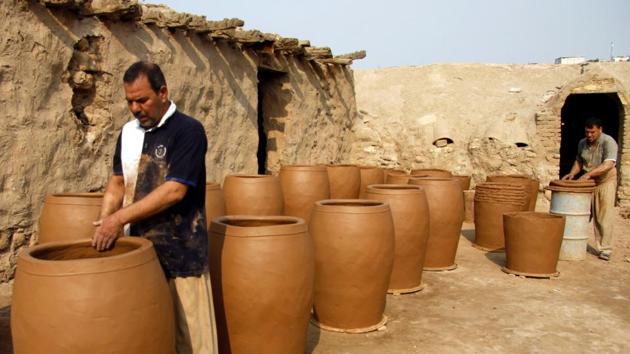
They were surprisingly handy during the era of Saddam Hussein, when many families struggled financially, as well as in the 1990s, when international sanctions hit Iraq. With household appliances extremely rare or unaffordable for most of the population, Iraqis once again relied on clay. (Haidar Hamdani / AFP)
5/9
 View Photos in a new improved layout
Updated on Dec 05, 2018 11:59 AM
“The income of most families did not allow them to buy a refrigerator or freezer to keep their water cold, so most used clay cauldrons,” he said. Back then, his family sold their large jugs in bulk -- sometimes thousands per week across every Iraqi province. But times have changed. (Haidar Hamdani / AFP)
6/9
 View Photos in a new improved layout
Updated on Dec 05, 2018 11:59 AM
“We sell very few now -- the numbers in an entire year don’t hit 100 or 200 jugs,” Kawwaz said. Farmers who once used the large containers are opting for cheaper goods, made either elsewhere in Iraq or imported. “They buy plastic bags imported from China, so now we rarely sell clay pots,” Kawwaz said in his studio, itself made of mud and covered in palm leaves. (Haidar Hamdani / AFP)
7/9
 View Photos in a new improved layout
Updated on Dec 05, 2018 11:59 AM
He makes the vases by special request only, but admits it’s hardly worth it. Small jugs cost just 2,500 dinars or around $2, while the larger cauldrons that hold several dozen litres (gallons) are sold at 15,000 dinars. (Haidar Hamdani / AFP)
8/9
 View Photos in a new improved layout
Updated on Dec 05, 2018 11:59 AM
On the other end, some users like Um Haydar still place their trust in clay. On her rooftop terrace in Old Najaf, she uses it to bake her own traditional bread every morning. “The taste of bread made in a traditional oven is so different from bread baked in an electric or gas oven,” she said, as the searing oven near her radiated an enticing smell. (Haidar Hamdani / AFP)
9/9
 View Photos in a new improved layout
Updated on Dec 05, 2018 11:59 AM


