E-Paper



Public shaming over dues: Can housing societies suspend food delivery and housekeeping services for defaulters?
Housing societies are naming defaulters and restricting services, but experts say such measures must balance enforcement with residents’ legal rights

 Prefer HTon Google


As private housing societies across the country struggle with rising maintenance dues, many are resorting to public shaming and service restrictions to enforce payments. In a recent case, a residential complex in Gurugram posted the names of defaulters in elevators and restricted access to services such as food delivery via Swiggy and Zomato, housekeeping, and other amenities. While societies argue these measures are necessary to maintain common areas and shared services, legal experts caution that access to such services cannot be arbitrarily curtailed.
In Sector 49, Gurugram, the RWA of Uppal Southend had published a list of residents who had defaulted on maintenance payments. According to the RWA, those who have not cleared dues are being denied access to food delivery, car washing, and domestic help services.
A formal notice issued by the RWA stated: “Residents whose names appear on the notice board are requested to clear their outstanding dues at the earliest. Please note that, effective today, all non-essential services—including maid services, car washing, and delivery services such as Zomato and Swiggy—will be suspended until the dues are fully cleared.”
The society has also implemented a social ban, stating in large, bold font that “RWA social events are not open to defaulters and PG occupants.”
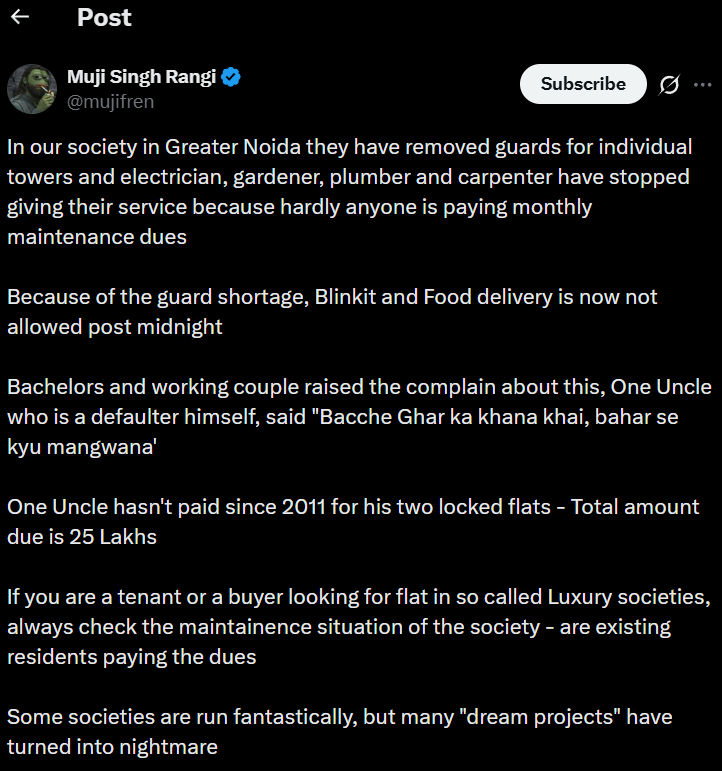
A resident of a housing society in Greater Noida posted on X that a residential society has also curtailed services due to non-payment of maintenance dues, leading to the removal of tower guards and suspension of services such as plumbing, electrical, and housekeeping. "Because of the guard shortage, Blinkit and food delivery are now not allowed post midnight. If you are a tenant or a buyer looking for a flat in so-called luxury societies, always check the maintenance situation of the society. Some societies are run fantastically, but many "dream projects" have turned into nightmares."
A similar pattern has emerged in Bengaluru. In some high-end multi-storey enclaves, including Bharatiya City, the names and dues of defaulters have allegedly been posted in elevators, and residents have faced the suspension of essential services. such as garbage collection and floor cleaning. “All these residents are high earners, yet they do not pay on time,” a Reddit user said.
In other cases in Bengaluru, societies have imposed financial penalties, such as interest on late payments, on residents who have not paid maintenance for up to 2 years. While legal action has not yet been pursued, societies have reportedly blocked defaulters from renting out or selling their flats until dues are cleared.
This is what legal experts have to say
Advocates note that societies must carefully navigate the line between enforcement and legal rights. “If a society is registered under the Societies Act, it cannot arbitrarily disconnect such services,” explained Vittal BR, an advocate. “The proper legal recourse is to file a recovery suit in civil court.”
In Bengaluru, cases have emerged in which societies have disconnected electricity or garbage collection for defaulters. “The court granted interim relief to residents citing these as essential services,” he said, emphasising that personal services like food delivery or housekeeping fall under similar considerations.
Another advocate, MD Rajkumar, explained that “Societies can use money recovery tools under respective society acts, but cutting off such services can be challenged. Homebuyers can approach the court and get an interim stay.”
"Under the various society Acts, housing associations have the right to recover maintenance dues using formal tools like money recovery suits in civil court. However, services such as food delivery and housekeeping can be considered essential in certain situations. For example, if there is a gas shortage, residents may have to rely entirely on food delivery for their daily meals, and denying such services could leave them without basic necessities,” Advocate Akash Bantia said.
Also Read: Bengaluru electricity supplier warns apartment complex of disconnection over unauthorised lifts
Name-and-shame: Permissible or problematic?
A few legal experts note that while service restrictions may raise legal concerns, publicly naming defaulters is generally considered acceptable. “Public notices of defaulters are common, even by government bodies, for property tax dues. Publishing the names of defaulters is considered public notification rather than a breach of privacy,” Bantia said.
“Publicly naming residents who have not paid maintenance is similar to notices issued by government authorities for property tax defaulters. It is essentially a notification aimed at encouraging compliance and does not constitute a breach of privacy,” he said.
Experts also note that while societies aim to enforce maintenance compliance, there is a distinction between financial recovery and personal rights. “Providing or denying services like food delivery or housekeeping is a personal matter, and societies cannot use these as leverage to enforce payments,” Vittal said.
Also Read: Noida's delayed projects: 10 years on, buyers continue to wait for possession in WTC-backed projects
Can apartment owners' associations disconnect electricity and water supply?
Advocate Manjunath Achari pointed out that while many RWAs disconnect water and electricity supplies to pressure owners into paying maintenance fees, such actions could be legally questionable.
"Essential services like water cannot be arbitrarily cut off, as they are fundamental rights as per the Constitution. Instead, unpaid dues should be recovered through civil court proceedings. A notice should be issued to defaulters, ensuring that the entire community does not suffer due to the actions of a few of the owners," Achari said.
(Disclaimer: This report is based on user-generated content from social media. HT.com has not independently verified the claims and does not endorse them.)