“I HAVE DONE a terrible thing,” said Wolfgang Pauli, an Austrian theoretical physicist, in 1930. “I have postulated a particle that cannot be detected.” He was referring to the neutrino, a type of fundamental subatomic particle whose peculiar properties would have foxed any contemporary experimental device. But times change. Neutrinos were detected in 1956, and the subsequent elucidation of their properties has won physicists a string of Nobel prizes. The latest of these, announced on October 6th, was awarded to
“I HAVE DONE a terrible thing,” said Wolfgang Pauli, an Austrian theoretical physicist, in 1930. “I have postulated a particle that cannot be detected.” He was referring to the neutrino, a type of fundamental subatomic particle whose peculiar properties would have foxed any contemporary experimental device. But times change. Neutrinos were detected in 1956, and the subsequent elucidation of their properties has won physicists a string of Nobel prizes. The latest of these, announced on October 6th, was awarded to Francis Halzen, of the University of Wisconsin-Madison, for his pioneering work on detecting neutrinos emitted by mysterious astrophysical sources light-years from Earth.
What makes neutrinos so elusive is that they are electrically neutral (hence the “neutr-”) and physically diminutive (hence the “-ino”). That renders them, in effect, immune to both the electromagnetic force and gravity, allowing them to pass through most particle detectors unobserved. Their dealings with regular matter are largely limited to interactions via the weak nuclear force—which, as its name suggests, is feeble enough to let most go unnoticed.
Ghostly though they are, neutrinos are also abundant throughout the universe. They are a by-product of fission as well as fusion reactions, making the Sun a powerful nearby source: around 65bn solar neutrinos pass through an area the size of a human fingernail each second. The solar reactions that produce neutrinos also give off other particles, including protons. Sometimes, however, protons arrive at Earth with energies many millions of times greater than those from the Sun. This suggests they come from even more powerful sources much farther away.
What these natural particle accelerators actually are, and how they produce such energetic particles, is largely unknown. Protons are charged and are thus deflected by magnetic fields on their journey to Earth, making their point of origin hard to reconstruct. The same processes that accelerate these protons, however, should produce high-energy neutrinos, too. Astronomers realised that neutrinos’ reluctance to interact with matter made them ideal cosmic messengers.
Still, there was the problem of how to detect them. Previous neutrino detectors had relied on building large vats of perchloroethylene, a dry-cleaning fluid, and waiting for a single neutrino to interact with one of the fluid’s constituent atoms. Although a similar approach could be applied to the hunt for rarer extrasolar neutrinos, a significantly bigger detector would be needed to have a chance of catching one. Dr Halzen’s idea, first suggested in 1988 and outlined by the Nobel Committee in a demonstration worthy of the children’s programme “Blue Peter”, was to use Earth’s vast repositories of ice.
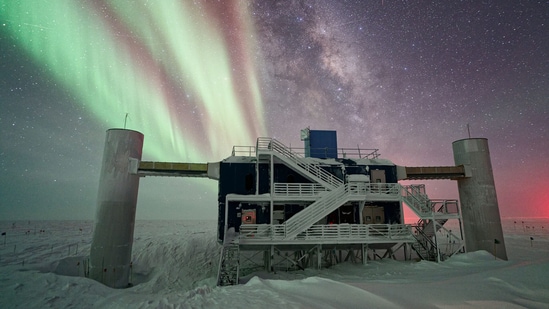
Thus began the planning of the IceCube Observatory, a neutrino detector buried about 2km below the surface of Antarctica. Construction began in 2004 and involved burying 5,160 light sensors across a cubic kilometre of ice. These would be able to pick up any radiation given off when neutrinos interact with atomic nuclei in the ice. By 2011 the detector was complete. It did not take long to bear fruit: in 2013, 28 high-energy cosmic neutrinos were picked up by IceCube’s sensors, the first ever to be detected. Thus, a new window onto the cosmos was opened.
One of the quirks of the Nobel foundation’s statutes is that each of its prizes can be awarded to a maximum of three researchers. That constraint can be a problem for fields like astrophysics, which are often driven by large experimental collaborations. The IceCube Observatory, for example, currently consists of around 450 researchers spread over 14 countries. But, according to Ulf Danielsson, a physicist at Uppsala University and secretary to the Nobel committee for physics, it was thanks to Dr Halzen that IceCube was built at all. “Without his scientific vision, it would have been impossible,” says Dr Danielsson.
Dr Halzen’s work, along with that of the other scientists at IceCube, has demonstrated not only that high-energy neutrinos of astrophysical origin exist, but also that they can be detected. This, however, is only the start of the story. Asked at the prize’s announcement what neutrino astronomy will reveal about the universe, Dr Halzen, reached by phone, responded: “The real excitement is that I cannot answer that question yet.”
One Subscription.
Get 360° coverage—from daily headlines
to 100 year archives.
Archives
HT App & Website