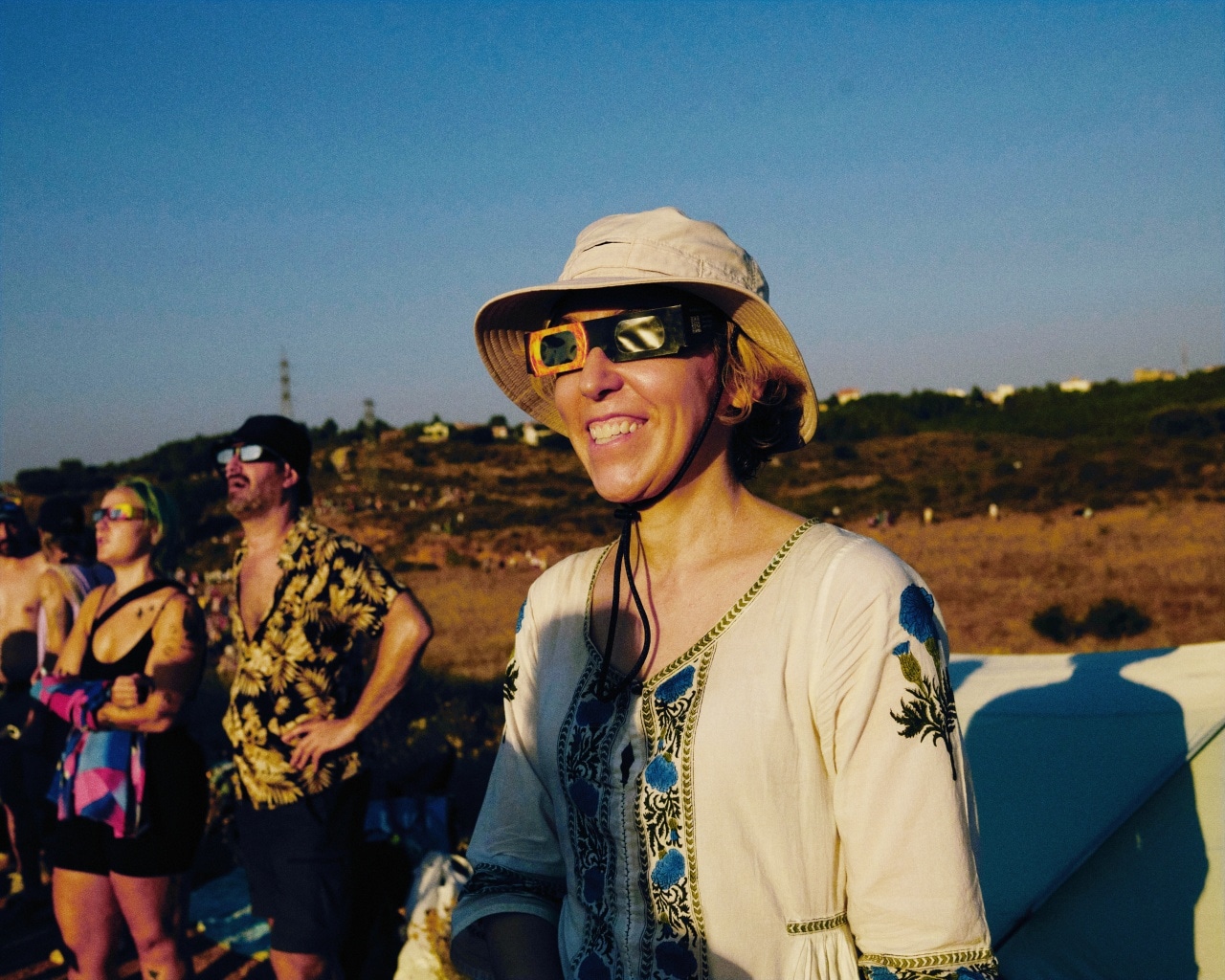
Traveling the globe for celestial events may seem downright loony—until you get a taste of the addictive world of ‘eclipse chasing’
Published on: Aug 23, 2026, 18:30:10 IST
WSJ
Advertisement
The author witnessing the Aug. 12 solar eclipse from the cliffs of Mirador de Las Lomas near León, Spain.
Once considered a portent of end times, a solar eclipse is an undeniably eccentric way to orient a vacation calendar.
{{^htLoading}} {{/htLoading}}
Hopping around the globe in pursuit of a cosmic coincidence—those rare instances in which the moon, 400 times smaller than the sun, traverses it while 400 times closer to the earth—requires a significant amount of time, money and dedication. It means going places you may never have wanted to go, sometimes at the worst times of year, with no guarantee
{{^usCountry}}{{/usCountry}}
The author, center, viewing the 2017 eclipse in Casper, Wyo.
My conversion came in 2017, in Casper, Wyo. I watched a near-high-noon sun darken the sky while a halo of light stretched around the circumference of the distant horizon—a 360-degree glimpse of daylight from beyond the zone of totality.
{{^htLoading}} {{/htLoading}}
Birds hushed. Dogs barked and then quieted. People grinned and then gasped, some with tears streaming down their faces. There was a palpable unified purpose among those who gathered.
The result was a kind of secular transcendence, a communal experience in which everyone looks skyward, collectively transfixed. I knew at once that not seeing this again was not an option.
These days, thanks to astronomical science and modern air travel, a total solar eclipse is the kind of thing one can plan a life around. Though unable to fly to Chile for the eclipse in 2019, I made it to Buffalo, N.Y., in 2024 and then to León.
The latest eclipse was my third time swallowing the expense and impracticality of following them. In the world of astro-tourists, for whom a partial eclipse barely registers and missing a year feels like an abdication, that makes me an amateur.
{{^htLoading}} {{/htLoading}}
Eclipse chasers from all over the world gathered on the cliffs outside of León to witness the otherworldly event.
“We’re eclipse chasers,” Lorraine Whitman Check, 84, a former rocket scientist from the Upper West Side of Manhattan, told me when asked what brought her and her 90-year-old husband to sunburned León during a heat wave. Her first eclipse, seen in 2006 from a cave in Cappadocia, Turkey, made Whitman Check hyperventilate and her husband cry. They were hooked.
{{^htLoading}} {{/htLoading}}
“It was glorious,” Whitman Check, now on her fifth, said. “For me, there is something sacred about the eclipse. It’s the face of God I don’t believe in.”
Eclipse chasers from all over the world gathered on the cliffs outside of León to witness the otherworldly event.
Whereas momentous earthly phenomena like tidal waves, hurricanes and tornadoes inevitably involve disaster, their celestial counterparts (aurora borealis, meteor showers, lunar eclipses) inspire unadulterated, transportive awe. An eclipse takes place beyond our planet. It is, by definition, otherworldly.
{{^htLoading}} {{/htLoading}}
My vista for this year’s eclipse was the cliffs of Mirador de Las Lomas, 45 minutes outside León, where a line of seekers snaked along the cliffside in either direction. Like others, I’d landed on the spot via Reddit forums discussing the benefits of various vantage points (a clear, treeless view, a suitable backdrop, access by foot). In town that afternoon, people described staking out different sites in the lead up. My fellow chasers had come from Scotland, from France, from Australia, from the U.S.
León is an important stop on the sacred Camino de Santiago, but the eclipse made for a different kind of pilgrimage. Afterward, along the winding descent, I met Alex House, a 36-year-old former Airman. He and Olivia Walker, a 30-year-old firefighter, had come to Léon from Clearfield, Utah. Both were euphoric and eager to share the story of their first eclipse.
{{^htLoading}} {{/htLoading}}
“Did you see that diamond ring?” House had asked Walker the moment the glowing corona of totality disappeared and the sun re-emerged. Yes, she replied.
“Do you want to see another one?” he then said, producing a ring from his pocket. Yes, again.
“She said yes!” House cried out to the gathering of onlookers. They broke into cheers and applause, cheered again when the eclipse ended, and once more an hour later when the sun set, a burnished ocher illuminating Léon’s cathedral. An outpouring of gratitude.
It’s a feeling no cloud can fully dispel. Two years ago, in Buffalo, I gathered alongside a sizable crowd in a public park, all of us audibly pleading with nature as the eclipse arrived only to be muted by cloud cover. Even so, we were united in a moment of reverence.
{{^htLoading}} {{/htLoading}}
For some, unpredictability only heightens the drama.
“When you have that level of anxiety over the clouds, it juices the experience,” Elliot Borgman, a 77-year-old retired astronomer from Lansdowne, Penn., told me over breakfast the morning after August’s eclipse. It was his 21st, 17 of which were “successful,” he said, adding that the clear conditions in Léon had made the most recent one almost too easy. But all of them were worth it.
His first was in Puerto Vallarta, Mexico, in 1991. Afterward, Borgman said, “Like most people who see an eclipse, I was like, ‘Oh, my God, when’s the next one?’ ”
The moment totality disappeared and the sun re-emerged.
See You in 2027
{{^htLoading}} {{/htLoading}}
Luxor, Egypt is a prime spot to view the ‘eclipse of the century’ in 2027.
The next solar eclipse, on Aug. 2, 2027, looks to be a blockbuster. The moon will be near its closest point to earth, resulting in unusually long periods of totality over North Africa. It has already been dubbed the “eclipse of the century.”
Location, Location: There are multiple options, depending on your priority. In Egypt, totality is projected to last for more than 6 minutes. In Tangier, Morocco, the chance of clear skies is high—and you’ll have plenty of post-viewing excursion options, like the legendary Caves of Hercules. Alternatively, stick to Europe and watch from the Rock of Gibraltar, overlooking the Mediterranean Sea, where you can expect more than 4 minutes of totality.
Book Now: Hotels are filling up fast as are organized tours, like a cruise with National Geographic that will watch the eclipse from the Strait of Gibraltar (from around $27,000). Sirius Travel is organizing a Nile cruise, from around $7,300, that ends with an eclipse viewing in the ancient city of Luxor.
The author witnessing the Aug. 12 solar eclipse from the cliffs of Mirador de Las Lomas near León, Spain.
{{^htLoading}} {{/htLoading}}
Once considered a portent of end times, a solar eclipse is an undeniably eccentric way to orient a vacation calendar.
Hopping around the globe in pursuit of a cosmic coincidence—those rare instances in which the moon, 400 times smaller than the sun, traverses it while 400 times closer to the earth—requires a significant amount of time, money and dedication. It means going places you may never have wanted to go, sometimes at the worst times of year, with no guarantee that the spectacle won’t be rained out. To the uninitiated, it can seem downright loony.
{{^usCountry}}{{/usCountry}}
I am now one of those lunatics. Which is how I ended up in León, Spain, on Aug. 12.
The author, center, viewing the 2017 eclipse in Casper, Wyo.
My conversion came in 2017, in Casper, Wyo. I watched a near-high-noon sun darken the sky while a halo of light stretched around the circumference of the distant horizon—a 360-degree glimpse of daylight from beyond the zone of totality.
{{^htLoading}} {{/htLoading}}
Birds hushed. Dogs barked and then quieted. People grinned and then gasped, some with tears streaming down their faces. There was a palpable unified purpose among those who gathered.
The result was a kind of secular transcendence, a communal experience in which everyone looks skyward, collectively transfixed. I knew at once that not seeing this again was not an option.
These days, thanks to astronomical science and modern air travel, a total solar eclipse is the kind of thing one can plan a life around. Though unable to fly to Chile for the eclipse in 2019, I made it to Buffalo, N.Y., in 2024 and then to León.
The latest eclipse was my third time swallowing the expense and impracticality of following them. In the world of astro-tourists, for whom a partial eclipse barely registers and missing a year feels like an abdication, that makes me an amateur.
{{^htLoading}} {{/htLoading}}
Eclipse chasers from all over the world gathered on the cliffs outside of León to witness the otherworldly event.
“We’re eclipse chasers,” Lorraine Whitman Check, 84, a former rocket scientist from the Upper West Side of Manhattan, told me when asked what brought her and her 90-year-old husband to sunburned León during a heat wave. Her first eclipse, seen in 2006 from a cave in Cappadocia, Turkey, made Whitman Check hyperventilate and her husband cry. They were hooked.
{{^htLoading}} {{/htLoading}}
“It was glorious,” Whitman Check, now on her fifth, said. “For me, there is something sacred about the eclipse. It’s the face of God I don’t believe in.”
Eclipse chasers from all over the world gathered on the cliffs outside of León to witness the otherworldly event.
Whereas momentous earthly phenomena like tidal waves, hurricanes and tornadoes inevitably involve disaster, their celestial counterparts (aurora borealis, meteor showers, lunar eclipses) inspire unadulterated, transportive awe. An eclipse takes place beyond our planet. It is, by definition, otherworldly.
{{^htLoading}} {{/htLoading}}
My vista for this year’s eclipse was the cliffs of Mirador de Las Lomas, 45 minutes outside León, where a line of seekers snaked along the cliffside in either direction. Like others, I’d landed on the spot via Reddit forums discussing the benefits of various vantage points (a clear, treeless view, a suitable backdrop, access by foot). In town that afternoon, people described staking out different sites in the lead up. My fellow chasers had come from Scotland, from France, from Australia, from the U.S.
León is an important stop on the sacred Camino de Santiago, but the eclipse made for a different kind of pilgrimage. Afterward, along the winding descent, I met Alex House, a 36-year-old former Airman. He and Olivia Walker, a 30-year-old firefighter, had come to Léon from Clearfield, Utah. Both were euphoric and eager to share the story of their first eclipse.
{{^htLoading}} {{/htLoading}}
“Did you see that diamond ring?” House had asked Walker the moment the glowing corona of totality disappeared and the sun re-emerged. Yes, she replied.
“Do you want to see another one?” he then said, producing a ring from his pocket. Yes, again.
“She said yes!” House cried out to the gathering of onlookers. They broke into cheers and applause, cheered again when the eclipse ended, and once more an hour later when the sun set, a burnished ocher illuminating Léon’s cathedral. An outpouring of gratitude.
It’s a feeling no cloud can fully dispel. Two years ago, in Buffalo, I gathered alongside a sizable crowd in a public park, all of us audibly pleading with nature as the eclipse arrived only to be muted by cloud cover. Even so, we were united in a moment of reverence.
{{^htLoading}} {{/htLoading}}
For some, unpredictability only heightens the drama.
“When you have that level of anxiety over the clouds, it juices the experience,” Elliot Borgman, a 77-year-old retired astronomer from Lansdowne, Penn., told me over breakfast the morning after August’s eclipse. It was his 21st, 17 of which were “successful,” he said, adding that the clear conditions in Léon had made the most recent one almost too easy. But all of them were worth it.
His first was in Puerto Vallarta, Mexico, in 1991. Afterward, Borgman said, “Like most people who see an eclipse, I was like, ‘Oh, my God, when’s the next one?’ ”
The moment totality disappeared and the sun re-emerged.
See You in 2027
{{^htLoading}} {{/htLoading}}
Luxor, Egypt is a prime spot to view the ‘eclipse of the century’ in 2027.
The next solar eclipse, on Aug. 2, 2027, looks to be a blockbuster. The moon will be near its closest point to earth, resulting in unusually long periods of totality over North Africa. It has already been dubbed the “eclipse of the century.”
Location, Location: There are multiple options, depending on your priority. In Egypt, totality is projected to last for more than 6 minutes. In Tangier, Morocco, the chance of clear skies is high—and you’ll have plenty of post-viewing excursion options, like the legendary Caves of Hercules. Alternatively, stick to Europe and watch from the Rock of Gibraltar, overlooking the Mediterranean Sea, where you can expect more than 4 minutes of totality.
Book Now: Hotels are filling up fast as are organized tours, like a cruise with National Geographic that will watch the eclipse from the Strait of Gibraltar (from around $27,000). Sirius Travel is organizing a Nile cruise, from around $7,300, that ends with an eclipse viewing in the ancient city of Luxor.
All Access. One Subscription.
Get 360° coverage—from daily headlines to 100 year archives.