AFTER HIS hands were crushed two years ago in a machine that bends sheet metal, Remco Letschert feared he would never work again. Yet a year later Mr Letschert returned to his construction job in Aarhus, Denmark—even though his dominant left hand is too weak for such work. A powered glove he affectionately calls his “robot hand” allows him to carry materials, climb scaffolding, squeeze tin snippers and operate a drill. Using the system, branded “Ironhand”, requires no special thought,
AFTER HIS hands were crushed two years ago in a machine that bends sheet metal, Remco Letschert feared he would never work again. Yet a year later Mr Letschert returned to his construction job in Aarhus, Denmark—even though his dominant left hand is too weak for such work. A powered glove he affectionately calls his “robot hand” allows him to carry materials, climb scaffolding, squeeze tin snippers and operate a drill. Using the system, branded “Ironhand”, requires no special thought, he says. When sensors in the glove’s fingertips and palm detect pressure, five little motors instantly whir into action, pulling cables that tighten his grip.
Exoskeletons, as strength-amplifying rigs of this sort are known, are a staple of science-fiction films, from “Aliens” to “Avatar”. In reality full-body versions like those on screen have disappointed. A decade ago the American army was developing two of them, together with a third for just the legs and hips. All have been abandoned. But modest exoskeletons are proving surprisingly useful—and not just to the injured and disabled. At €9,995 ($11,423), for example, Ironhand is hardly cheap. Yet since Skelex, a Dutch firm, began selling the device in 2024, it has been put to work by about 200 companies around the world.
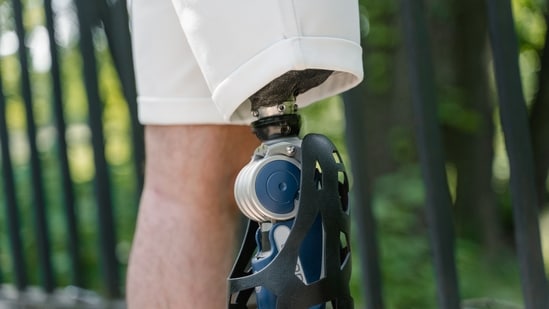
Advances in batteries, actuators and software have played a role. But, paradoxically, the biggest leap forward, says Karl Zelik, an exoskeleton expert at Vanderbilt University in Nashville, was restraint. The industry stopped chasing “Hollywood, do-it-all” designs. Instead, today’s lighter, more comfortable exoskeletons focus on assisting a single part of the body to perform tasks ranging from fixing roofs to gathering crops (see picture).
The most familiar use is to permit movement by people with disabilities. Lifeward, an Israeli firm, sells ReWalk, a leg exoskeleton that allows some people with spinal-cord injuries to stand up, walk and even climb stairs—typically with help from crutches. After selecting a suitable mode, a user leans forward. Sensors detect the tilt and software activates motors at the hips and knees that drive the wearer’s legs through the chosen motion.
More sophisticated activation has been developed by Myomo, a firm in Burlington, Massachusetts. Its exoskeleton, MyoPro, moves a paralysed arm and hand with help from electrodes attached to the skin. These read muscle signals that injury or disease has rendered too faint to trigger sufficient contractions. A microprocessor analyses the data to infer intended gestures, then instructs motors that move the user’s elbow and hand. The system allows people to do things like opening packaging, holding utensils and carrying a laundry basket. Some 4,000 have been shipped.
Other exoskeletons aim not to restore lost function, but to prevent injury. Japet.W+, made by Japet Medical, in Lille, France, wraps around the waist and lower torso. When the wearer bends, lifts or carries objects, four actuators that resemble shock absorbers extend or retract, reducing pressure on the lower spine. Four years ago Julien Guilbert, the founder of Toitech, a roofing company in Lille, bought one for a worker whose back pain had been keeping him home for two or three weeks a year. This worker has not missed a day since because of back pain. Mr Guilbert says all of his roofing teams will have one of these robotic belts by the end of this year.
Use of exoskeletons for strenuous labour is growing. Exia, an exoskeleton for heavy lifting made by German Bionic, based near Munich, is used by about 300 employers. Many are worn by factory, warehouse and freight-transport workers, but Norma Steller, the firm’s chief product officer, says the most enthusiastic users of the “external spine” are nurses who must lift their patients.
Resistance to the technology remains. Some union bosses fear it will lead to higher production targets, says Dr Zelik, who is also chief scientist at HeroWear, a maker of unpowered “exosuits” in Nashville. (As a wearer bends, elastic bands stretch, storing energy that is released as the body straightens or lifts.) Egos matter, too. Roughly a third of potential male users dismiss the kit, at least initially, as being for wimps, says David Duwe of Ottobock, a German supplier of exoskeletons to companies including Airbus, DHL, IKEA, Siemens and Toyota.
Such attitudes are, however, changing. Uptake is rising fastest among younger workers who are increasingly reluctant, Mr Duwe says, “to use their body as a simple resource” for a company. Much will ride on workplace testing. In February, for instance, a Michelin centre in Almería, Spain, that cuts tyres open for analysis began one such pilot deployment with six Ironhands. Manuel Góngora Morales, the centre’s manager, wants to see if the devices reduce repetitive-strain injuries. He says early results suggest they do.
Sharing the load
There are risks. Exoskeleton-makers say their technology is not a licence to take on heavier tasks, but some users surely will anyway. Even normal use reroutes mechanical forces, so researchers will need to determine whether a given model overloads unassisted joints.
Such concerns may grow as exoskeletons edge into the consumer market. Athletes and outdoorsy types are among the main targets here. Skip, a firm in San Francisco, will soon start shipping MO/GO, a knee exoskeleton aimed at hikers. The units, which strap to the thigh and calf, and weigh less than 1kg, are designed to be cool, aspirational “powered clothing”, not something that looks like a medical device, says Kathryn Zealand, Skip’s boss.
Six months of production capacity has, she says, already been ordered by customers. Meanwhile, in January, Dephy, based in Boxborough, Massachusetts, launched Sidekick, a “powered footwear” system that assists the ankles. And Nike is working with Dephy to create motorised footwear to help athletes move faster and farther with less energy.
Might consumer “movewear”, as Skip styles it, really take off? Perhaps not just yet. A prominent reviewer of the buzziest option out there—powered hips launched early last year by Hypershell, a Chinese firm—reported “a puppet effect”, whereby the exoskeleton was moving the user rather than the other way round. Most users will not want to feel tugged into robotic movements in this way. Yet unlike earlier combat supersuits, today’s less ambitious machines look as if they are here to stay.
One Subscription.
Get 360° coverage—from daily headlines
to 100 year archives.
Archives
HT App & Website