What would you do if your country didn’t have a river that flows all year? Back in the 1970s, a Saudi prince proposed a bold solution: towing icebergs from the far end of the world. A 1980 review published in Annals of Glaciology by W. F. Weeks describes how Prince Mohammed al Faisal promoted this idea with a major scientific conference. Weeks studied iceberg towing himself, and his review offers an expert assessment of what the plan required and where it fell short.
A block of Alaskan ice in the middle of Iowa
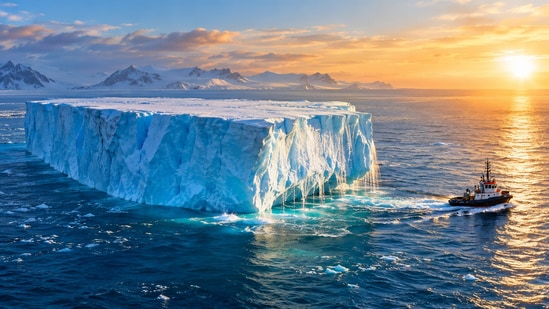
The first international conference on the use of icebergs was held at Iowa State University, Ames, in October 1977. Almost 200 researchers from all over the world participated. Weeks says the prince's interest and endorsement helped spark the meeting. A showpiece at the event wasn't a researcher or a model, but a block of real ice from the Portage Glacier region in Alaska. It weighed more than a ton and was shipped by helicopter, plane, and truck to landlocked Iowa. It wasn't an actual iceberg, but a stand-in for one. The real plan was much larger. It started in Antarctica.
Why Saudi Arabia wanted Antarctic ice
Weeks describes Saudi Arabia as the largest country in the world with no perennial streams, meaning no river that flows all year. At that time, the prince was in charge of the country’s water supply development. Antarctica looked like a huge storehouse of fresh water. Flat-topped icebergs calve off, and the continent sheds about 1,000 cubic kilometers of fresh water a year, Weeks says. The idea was not new, either. Ice was shipped from Alaska to California in the 1850s for refrigeration, Weeks writes.
The science behind the dream
In 1973, Weeks and W. J. Campbell published a study in the Journal of Glaciology. They noted that no previous critical study of the idea was known to them. Their paper found that only Antarctica has big flat-topped icebergs. It also said that icebergs of virtually any size could be found. Weeks later wrote that there was no clear scientific reason why towing to the Southern Hemisphere couldn’t work.
{{/usCountry}}In 1973, Weeks and W. J. Campbell published a study in the Journal of Glaciology. They noted that no previous critical study of the idea was known to them. Their paper found that only Antarctica has big flat-topped icebergs. It also said that icebergs of virtually any size could be found. Weeks later wrote that there was no clear scientific reason why towing to the Southern Hemisphere couldn’t work.
{{/usCountry}}His 1980 review goes on to compare several possible delivery sites, from the easiest to the hardest to reach. Australia, as the closest realistic target, became a useful benchmark against which the much tougher Saudi route could be measured. One estimate Weeks cites predicts that an iceberg tow of two to three months would lose about half of the iceberg to melting for Australia.
Why the Saudi plan was so challenging
Saudi Arabia was a much tougher destination. Weeks explained that the tow would be long, and the water warm. In July, the route would cross more than 5,600 kilometers of water warmer than 20°C. His own calculations, drawn from earlier work with Malcolm Mellor, suggest that an unprotected iceberg would be gone entirely by day 104 of a 128-day voyage. That meant the ice would need protection, and Weeks said he did not know how to solve that problem. He didn't know anyone with any real iceberg experience who thought they had an answer. He also said simulations showed towing would require more power than the largest tugs could provide at the time. In the end, no iceberg was ever towed to Saudi Arabia.
What the story leaves in its wake
Weeks was cautious in his conclusion. He said towing to Australia could work if the icebergs stay in one piece during the trip, and if docking and processing can be solved. Tows to Saudi Arabia, he wrote, would be very difficult until the protection problem was solved. Still, he noted that research sparked by the idea improved knowledge of real icebergs in real oceans. Today, Saudi Arabia is one of the world’s largest producers of desalinated seawater. The iceberg plan remained a dream, but it showed how far people will go to solve a water problem, and why bold ideas need honest checking.