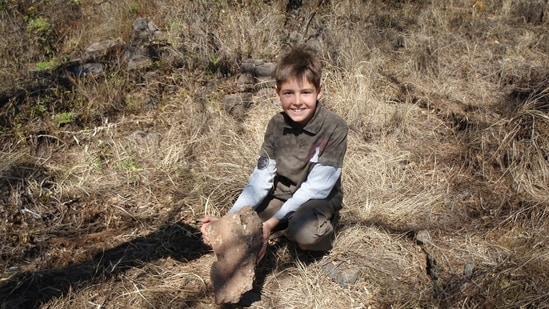
Few nine-year-old children ever encounter scientific discoveries; however, Matthew Berger came across one of his own. It happened in August 2008 when he discovered a clavicle at Malapa, a fossil-rich site in South Africa. The bone was later recognized as belonging to a previously undescribed hominin. Matthew's father, Lee Berger, headed the team of scientists that published the study in Science in 2010 titled Australopithecus sediba: A New Species of Homo-like Australopith from South Africa. The clavicle led researchers to a well-preserved juvenile skeleton, designated Malapa Hominin 1 (MH1), while a second partial skeleton, Malapa Hominin 2 (MH2), was also recovered from the site.
The researchers described two partial skeletons, along with associated skull and tooth remains. The specimens were initially dated to between 1.95 million and 1.78 million years old. The species was named Australopithecus sediba. Australopithecus translates roughly as “southern ape,” a genus name originally coined for a species from South Africa. Sediba is a Sesotho word meaning “fountain” or “wellspring.” Malapa Hominin 1 is the holotype of the species, meaning the fossil specimen on which its scientific name is based.
Old features, new puzzles
So what made the discovery news? At the time of publication, the origin of the genus Homo, the group that includes modern humans, was still uncertain. In this study, the Berger team described A. sediba as most likely descending from the older species Australopithecus africanus, while sharing more derived, or evolutionarily advanced, features with early members of Homo than any other australopithecine known at the time. The combination of traits therefore raised the possibility that A. sediba could provide clues about the transition toward the genus Homo. Because skull, teeth, and postcranial bones were associated with the specimens, the authors were able to examine evidence from multiple parts of the body. Additionally, the Australian Museum notes that features of the hip, knee, and ankle indicate that A. sediba was capable of bipedal locomotion.
Some scientists have questioned whether the fossils represent a distinct species in the human evolutionary tree. Other researchers have proposed that A. sediba may instead represent a later population of A. africanus, meaning that some of the differences could reflect changes within the same species over time. As the museum notes, scientists have debated both the validity of A. sediba as a separate species and its evolutionary relationship to the genus Homo. These debates do not erase the significance of the fossils; rather, they reflect the difficulty of reconstructing human evolution from an incomplete fossil record.
{{/usCountry}}Some scientists have questioned whether the fossils represent a distinct species in the human evolutionary tree. Other researchers have proposed that A. sediba may instead represent a later population of A. africanus, meaning that some of the differences could reflect changes within the same species over time. As the museum notes, scientists have debated both the validity of A. sediba as a separate species and its evolutionary relationship to the genus Homo. These debates do not erase the significance of the fossils; rather, they reflect the difficulty of reconstructing human evolution from an incomplete fossil record.
{{/usCountry}}Age determination
Accurately determining the age of a fossil is important because its position in the evolutionary timeline depends partly on when it lived. The age question received special treatment in the research titled Geological Setting and Age of Australopithecus sediba from Southern Africa by geologist Paul Dirks and his colleagues. The team investigated cave sedimentation at Malapa and established that the fossils were found in water-deposited sediment within the lower levels of a highly eroded cave system. Below the fossil-bearing sediment was a flowstone, a mineral layer formed by water inside the cave. Researchers estimated that the flowstone formed about 2.03 million years ago, with an uncertainty of roughly 21,000 years. Because the fossil-bearing sediment lay above this older layer, the flowstone provided an important time marker for determining the age of the fossils.
Earth's magnetic field supplied another clue. The flowstone carries a reversed magnetic signature, while the sediments above it show normal polarity, a pattern that corresponds to a known interval called the Olduvai Subchron and helps bracket the fossils' age. Animal fossils found alongside the hominins belonged to species that lived in Africa between about 2.36 million and 1.50 million years ago, which was consistent with the geological evidence. Together, these clues provided a stronger basis for the fossils' age than any single measurement could. Both skeletons were buried together in a single debris flow that hardened soon afterward, in a setting that limited access by scavengers.
Sediba lived in an environment that the Australian Museum describes as a relatively flat landscape with a mix of grassland and woodland. Today, Malapa is located about 15 kilometers (9 miles) from other important fossil sites, including Sterkfontein and Swartkrans.