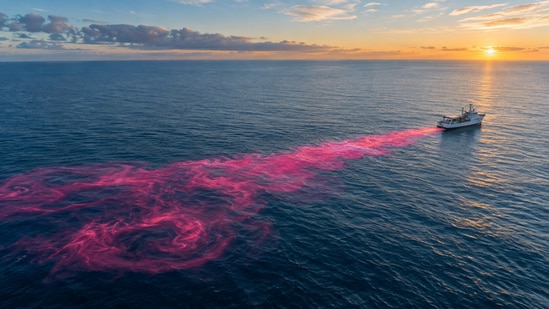
Somewhere in open waters, there’s a ship pouring a bright pink stream into the sea. It might sound like a movie stunt, but it was a permitted science trial. In August 2025, researchers released 16,500 gallons of highly purified sodium hydroxide, also called lye, into the Gulf of Maine. Preliminary results from the Woods Hole Oceanographic Institution suggest the water absorbed more carbon. The team also found no measurable effect on the ocean life it took samples from.
Why put lye in the ocean?
The ocean absorbs a huge amount of the carbon dioxide people release, which helps slow warming but also makes the water more acidic, a change that can harm shellfish and other sea life. Scientists are testing a remedy called ocean alkalinity enhancement. Adding a base such as lye to the seawater can help the water absorb more carbon dioxide without becoming too acidic. You could describe it as an antacid-like treatment for the ocean.
This idea isn’t new. In a 2022 report, the National Academies of Sciences, Engineering and Medicine evaluated six options for removing carbon from the ocean. This was among them. The report said that such approaches should be explored responsibly.
How the trial worked
This was the first trial of its kind that the EPA permitted. The lye was highly purified. It is often used to adjust the pH of drinking water. A ship released it in the Wilkinson Basin, in federal waters, over a period of about six hours. A tracer known as Rhodamine Water Tracer went with it, officially classed as a red dye, though it appears bright pink once diluted in seawater, allowing the team to see the treated patch and follow it.
{{/usCountry}}This was the first trial of its kind that the EPA permitted. The lye was highly purified. It is often used to adjust the pH of drinking water. A ship released it in the Wilkinson Basin, in federal waters, over a period of about six hours. A tracer known as Rhodamine Water Tracer went with it, officially classed as a red dye, though it appears bright pink once diluted in seawater, allowing the team to see the treated patch and follow it.
{{/usCountry}}The team followed the patch for about five days: the release day plus four days of monitoring. It used ships, robotic gliders, underwater vehicles, and satellites. The patch's spread closely matched the team's computer models. The pH and dye levels returned to baseline in the expected time. The EPA approved the project in April 2025 after a year-long review and two rounds of public comment. The team says it has no commercial stake.
What the sample revealed
Using pH and carbon readings along with the dye data, the team estimated that the treated water absorbed more carbon dioxide from the air than untreated water nearby. The results from biology are equally important. Scientists tested water both inside and outside the treated patch. They analyzed bacteria, microscopic organisms called phytoplankton, and zooplankton, small marine animals. They also tested fish and lobster larvae. They found no significant differences. Rachel Davitt, a PhD student at Rutgers University, helped lead the biology work. She said the trial did not have a significant impact on the community, according to the measures her team tracked.
What we still don't know
It was a small test, and the results are preliminary. The team did not measure direct effects on larger animals higher up the food chain. Impacts on fisheries are yet to be determined. Lab tests also suggested that the level of harm depends on how strong the exposure is and how long it lasts. As of its February 2026 announcement, researchers were still conducting a detailed analysis. Principal investigator Adam Subhas added a key point. Removing carbon from the ocean does not replace the need to cut emissions.
Why it matters to you
Millennial and Gen Z readers will live with the consequences of today’s climate choices for decades. That is why researchers say the trial matters. The trial also shows the value of permitting, careful measurement, early reporting, and transparency about what remains unknown.