On Christmas Eve, December 24, NASA's Parker Solar Probe made history by coming closer to the Sun than any spacecraft ever has, flying within 3.8 million miles (6.1 million kilometres) of the Sun, into the blistering heat of its outer atmosphere, the corona.
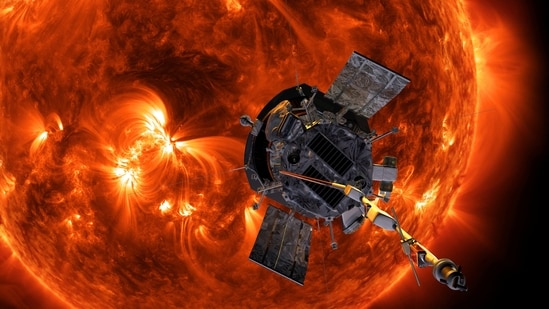
Travelling at speeds of up to 430,000 mph and withstanding temperatures of up to 982°C, the Parker Solar Probe is on a mission to "touch" the Sun, aiming to help scientists better understand the star, as stated on NASA’s website.
The historic flyby occurred at 6:53 am (1153 GMT), though mission scientists will have to wait until Friday for confirmation due to a temporary loss of contact with the spacecraft.
“No human-made object has ever passed this close to a star, so Parker will truly be returning data from uncharted territory,” said Nick Pinkine, mission operations manager at Johns Hopkins Applied Physics Laboratory, in a NASA blog.
"Right now, Parker Solar Probe is flying closer to a star than anything has ever been before," said NASA official Nicky Fox in a video posted on social media Tuesday morning. “It is just a total 'yay, we did it,' moment.”
What is the Parker Solar Probe up to next?
The Parker Solar Probe's heat shield keeps its internal instruments near room temperature (85°F/29°C) as it explores the Sun’s corona.
{{/usCountry}}The Parker Solar Probe's heat shield keeps its internal instruments near room temperature (85°F/29°C) as it explores the Sun’s corona.
{{/usCountry}}The probe will travel at 430,000 mph (690,000 kph), fast enough to reach Tokyo from Washington, D.C. in under a minute.
Nick Pinkine, mission operations manager at Johns Hopkins APL, says Parker will return data from uncharted territory, with excitement for its findings.
Parker is helping scientists understand key Sun mysteries, such as the origin of solar wind, the heat of the corona, and the formation of coronal mass ejections.
The Christmas Eve flyby is the first of three close passes, with the next two set for March 22 and June 19, 2025, bringing the probe closer to the Sun.
Launched in 2018
Since its 2018 launch, the spacecraft has been gradually moving closer to the Sun, using Venus flybys to tighten its orbit.
During its first pass into the solar atmosphere in 2021, the probe discovered new details about the Sun's atmospheric boundaries and captured close-up images of coronal streamers.
One of the probe's instruments captured visible light from Venus, providing scientists with a new method to see through the planet's thick clouds to its surface.
(With inputs from agencies)