When Treesa Jolly and Gayatri Gopichand smashed their way to guarantee themselves a BWF World Championships medal, they ended a 15-year wait in Indian badminton.
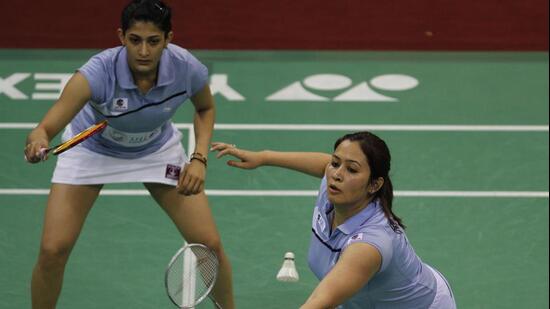
Not since August 2011 had an Indian women’s doubles pair stood on the podium. That benchmark was set by Jwala Gutta and Ashwini Ponnappa, the pair not only ending a 28-year medal drought for India (after Prakash Padukone’s bronze in 1983) but kick-started the streak of India returning with at least one medal from every World Championships since.
As a new generation claims the spotlight, the pioneers reflected on a campaign that defied the odds and silenced critics in an era when their discipline was heavily marginalised. On Saturday, Treesa and Gayatri finished with bronze, India’s lone medal of the 2026 championships, after losing to China’s world No.1 pair Liu Shen Shu and Tan Ning 21-18, 13-21, 8-21 in the semi-finals.
Heading into the 2011 tournament in London, expectation from the Indian pairing was almost non-existent. Jwala, playing both women’s and mixed doubles (with V Diju), felt the weight of the challenge, yet the pair quietly plotted their ascent.
“There were no expectations from us even though we won gold at the 2010 Commonwealth Games in New Delhi,” Jwala told HT. “When we won, it was actually a big shocker for everyone. It was tough back then to block everything and perform. We won a medal in women’s doubles which was unheard of back then. You couldn’t even dream of it.”
For Ashwini, the focus was laser sharp on a formidable second-round clash against Chinese Taipei’s world No.2 pair Cheng Wen-hsing and Chien Yu-chin. Jwala had convinced her younger partner that it was “doable”, and overcoming that hurdle unlocked their path to podium.
{{/usCountry}}For Ashwini, the focus was laser sharp on a formidable second-round clash against Chinese Taipei’s world No.2 pair Cheng Wen-hsing and Chien Yu-chin. Jwala had convinced her younger partner that it was “doable”, and overcoming that hurdle unlocked their path to podium.
{{/usCountry}}“Getting past the second seeded pair gave us a lot of confidence going into the rounds ahead,” Ashwini told HT. “Looking back, the World Championships has always been a very fond memory for me. We not only played well, but the entire journey... I had a wonderful time, enjoyed every single bit of it, which is what makes that medal a lot more special.”
Though the unseeded Indian combine had an easy opening outing against Americans Eva Lee and Paula Lynn, overcoming Cheng and Chien was the biggest upset of the tournament. That set the path for Jwala and Ashwini to beat Hong Kong’s 11th seeds Tse Ying Suet and Poon Lok Yan in Round 3 and Indonesian 12th seeds Vita Marissa and Nadya Melati in the quarters.
They lost in the semis to Chinese fifth seeds Tian Qing and Zhao Yunlei, but only after confirming India’s first World Championships medal in 28 years.
The Indian badminton landscape was vastly different then. Women’s doubles faced existential threats within the sport, critics labelled the rallies “long and boring”, and the event was even dropped from the Indian Badminton League in 2013 in favour of a second men’s singles match.
“My medal holds a lot of weight. I have played in very strange times when they wanted to eliminate women’s doubles,” says Jwala.
“I am glad modern players are getting what we didn’t. Now badminton has better facilities, equipment, food, knowledge, and awareness. I’m happy that I was able to set a standard, a benchmark. I am going to be proud of it and no one can take that away.”
The Jwala-Ashwini breakthrough altered the nation’s trajectory on the global stage.
“It’s nice to look back and see how that medal was the start of India winning a medal back-to-back... at every single World Championships since,” Ashwini reflected on the streak. “I can’t believe it’s been 15 years since we won the medal, and now Gayatri and Treesa are assured (of a medal).”
With Treesa and Gayatri carrying the baton, the foundation laid in London has never looked stronger.