The advantage of having a former player as head coach is that he was once in your position. And if he was a player whom almost everyone in your generation grew up idolising, what’s not to like? That summed up Rodrigo Zalazar’s thoughts on life in the Uruguay national team under Diego Forlan and after Marcelo Bielsa.
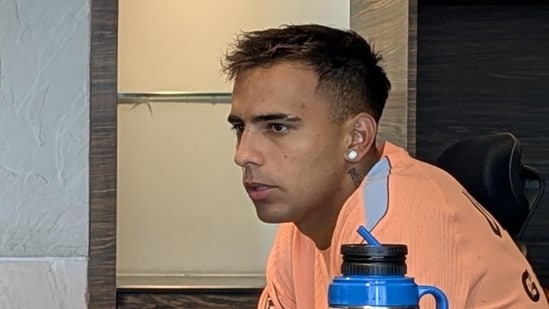
“I think Bielsa was, maybe, more old school. But, of course, I've learned a lot of things from him. He gave me the chance to play in the national team and I will be forever grateful to him. But, I think, the difference is that Forlan knows how to talk with us, how to do the things when we are tired or we are angry or upset because of a game. And he is one the biggest players Uruguay has produced,” said Zalazar.
That’s why for the midfielder from Sporting CP – Cristiano Ronaldo’s first club – it has been a “very unique” and “big pleasure” to be part of the national team after an underwhelming World Cup campaign.
That the World Cup would figure in the conversation with a group of journalists here was expected. Twice world champions – “four times”, Zalazar interjected referring to the Olympic titles in 1924 and 1928 that FIFA accepts as official world titles before the first World Cup – Uruguay’s elimination from the group stage was as staggering as Cape Verde holding Spain to a draw.
“Sometimes, football is like this,” said Zalazar with the equanimity expected of someone who has “patience” tattooed on his neck. “It was hard for all of us. We expected more because we had the team for that. But we were not in the best mood, the environment was…” A brief pause and Zalazar said: “But I'm very proud of how we handled the situation.”
{{/usCountry}}“Sometimes, football is like this,” said Zalazar with the equanimity expected of someone who has “patience” tattooed on his neck. “It was hard for all of us. We expected more because we had the team for that. But we were not in the best mood, the environment was…” A brief pause and Zalazar said: “But I'm very proud of how we handled the situation.”
{{/usCountry}}There were media reports of senior players asking Bielsa, a polarising figure at the best of times, to change how Uruguay played before the final group stage match against Spain. And the coach explaining in detail why he would not. At the press conference to announce he would step down, Bielsa also said, “nobody cares what I know.”
But that was then. “Football always gives you a second chance and now we are ready,” said Zalazar. New beginning? “Yeah, yeah, of course. Especially now with Diego….We can compete with any country in the world and I think it's just a matter of time before Uruguay becomes what everybody expects it to because we have quality for that.”
Zalazar could have represented Spain but chose Uruguay “because I have been surrounded by people from the country all my life.” His father and idol Jose played as attacking midfielder for Uruguay in the 1986 World Cup. “When I was a kid, my father had a lot of friends at home and we always had the culture very close to us. I would tell my father that one day I will play for Uruguay. Now, I can tell my kids that I am.”
Zalazar Sr was in the stands when his son scored two goals on his international debut against Nicaragua in 2023. “I told him that I would love that he comes to Uruguay with me to live the dream that I was living.”
One week after Tuesday’s friendly against India in Kolkata, Zalazar will be at home for a Champions League game against Lens at the club he joined from Braga in the summer for €30m and a release clause of €80m. That made the deal the most expensive between Portuguese clubs.
No club from Portugal has won the Champions League since Porto in 2004 but that’s not because they don’t have the wealth to match Europe’s top clubs, he said. “We were in the quarter-finals last year. The level is very close. We are always there and that shows how big Sporting is as well.”