Four years ago, Fernando Santos did what was then considered unthinkable. He benched Cristiano Ronaldo at the 2022 World Cup. Even though Portugal won that game 6-1 against Switzerland, with many considering it the dawn of a new era, they were dumped out by Morocco in the quarter-finals. Santos left his post after the tournament.
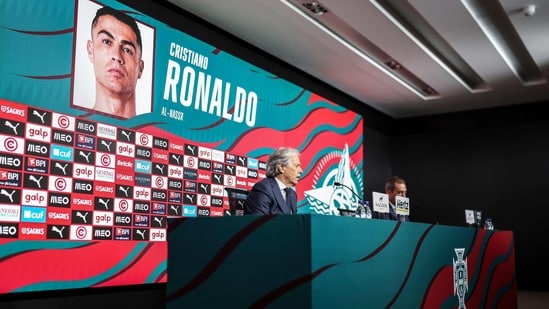
His successor, Roberto Martínez, did not dare to do the same. Ronaldo scored 28 goals in 37 appearances under him, which on paper looked stunning for a footballer at the back end of his career. But almost none came in big matches: zero at Euro 2024, and one heroic "I'm back" performance against Uzbekistan at the 2026 World Cup.
What became increasingly evident was that Portugal were better off without Ronaldo, with Gonçalo Ramos thriving in the role.
Martínez defended him throughout. He came out swinging at every criticism aimed at Ronaldo. But a knockout-stage exit saw him leave the job as well.
When Jorge Jesus arrived next, many saw it as an extension of the Martínez approach. The 72-year-old had managed Ronaldo before, at Al-Nassr, where he helped the club win the Saudi Pro League in May 2026, ending a seven-year wait and handing Ronaldo his first league title in Saudi Arabia. That came less than two months before his official appointment as Portugal coach. The suspicion grew when Jesus admitted that Ronaldo, who had announced that the 2026 World Cup would be his last, triggering rumours that his career is about to end, remained in his plans.
The 41-year-old did start Portugal's Nations League opener against Wales last month. But after a slew of misses and another frustrating night in national colours, he was taken off in the 67th minute. Ronaldo has not started a game since. He stayed on the bench throughout the game against Norway, even warming up. When he learned late last month that he would not start against Denmark either, he left the camp in Copenhagen, boarded his private jet and left the city.
{{/usCountry}}The 41-year-old did start Portugal's Nations League opener against Wales last month. But after a slew of misses and another frustrating night in national colours, he was taken off in the 67th minute. Ronaldo has not started a game since. He stayed on the bench throughout the game against Norway, even warming up. When he learned late last month that he would not start against Denmark either, he left the camp in Copenhagen, boarded his private jet and left the city.
{{/usCountry}}The reasons remain unclear, although Ronaldo has vowed to reveal it all later. He reportedly did not like being overlooked as an option. And why would he? He is the Portuguese icon, with a plethora of records and accolades to his name, and he stands on the verge of an unthinkable 1,000-goal career milestone.
But those who know Jesus and followed his days as a coach in European leagues know that this was not a fight he picked, nor a move made to prove a point. He went by his principle: "Inside a club, there is only one person who gives me orders: the president. No one else. I don't allow it." That is not a recent statement. He said it in 2014, in an interview with the newspaper Sol, when he was the boss at Benfica.
Portugal now have four wins out of four and are the first team through to the Nations League quarter-finals, all with merely 67 minutes of Ronaldo's presence and no contribution to the goals. Even as reporters and fans have repeatedly targeted him with questions about Ronaldo, he has hardly flinched.
Who is Jorge Jesus, the man who took on Ronaldo?
Jesus was a midfielder who began at Sporting, where Ronaldo's own story started and where Jesus's father once played. His playing career spanned more than 15 years, during which he drifted through many clubs in Portugal before retiring at 36.
Coaching happened to him by accident. Playing for Almancilense in 1989, he changed the course of a game in which his side was trailing 0-3 at half-time, and Almancilense went on to draw. Jesus was the hero of the day, and he left the venue with a job offer in hand. After the game, the president of Amora, who was also a local butcher, convinced him to take over as coach of his side. Two days later, he was running training.
He eventually rose to prominence after guiding Belenenses to their first-ever Portuguese Cup final and to UEFA Cup qualification in 2006-07. But his most significant spell came at Benfica, between 2009 and 2015, where he won three Portuguese league titles. By the time he left, he had also won a Portuguese Cup and five League Cups. He did not just leave Benfica as an icon; he believed himself to be "the best coach in the world."
One of the most fascinating aspects of his coaching is that he refused to confine himself to the traditional rules and ways of the game. In his own words, he considered himself a "painter, creator," and those who worked with him admitted he preferred to follow his instincts.
Jesus then ventured overseas, joining Saudi Arabia's Al-Hilal, before handing Brazilian club Flamengo one of their most glorious eras. He won both the Brazilian league and the Copa Libertadores, and took Liverpool to extra time in the 2019 FIFA Club World Cup final. He returned to Benfica for a second spell, albeit without success, and then went back to Al-Hilal to hand them the Saudi league trophy, before emulating the feat at Al Nassr. Ronaldo won his first Saudi league under him in a season in which he scored 28 goals in 30 matches.
He took charge of Portugal in July 2026.
Not an easy man
Goalkeeper Diego Alves, who worked with Jesus during his Brazilian stint, said back in 2019: "He has raised our level. He thinks about football 24 hours a day. He wants us to reach for perfection."
But his techniques and methods have not been everyone's cup of tea. "Blinkered," one former Benfica colleague called him at the end of his first stint at the Estádio da Luz. "He thinks the whole world turns around him and that he has nothing to learn from anyone."
There have also been numerous fallouts with senior players at different clubs. During his tiff with Algerian striker Islam Slimani at Sporting, Jesus said: "What Slimani says is worth nothing. I'm in charge. People have to obey my decisions, even if it makes them nauseous. I can buy them tablets for that."
Suddenly, the Ronaldo incident does not look like a one-off. In fact, something that did not get much attention back then was that in his first press conference for Portugal in July, he said he "won't be afraid to stand up to anyone."
The only difference is that, unlike Santos, who dared, and Martínez, who did not, Jesus challenged boldly and came out with results. Portugal did not blink after Ronaldo's abrupt departure. In Denmark, Rafael Leão donned Ronaldo's iconic No. 7 and Bruno Fernandes led the side in a 4-2 win, their first four-goal away win without Ronaldo in 18 years. On Sunday, Ramos struck the winner against Norway to seal a last-eight place.
Where does the Ronaldo situation stand right now?
Still unresolved. Jesus has also come out publicly to admit to a "misunderstanding" and said he is open to Ronaldo's return to the team. But he also saw no logic in the way Ronaldo reacted to the whole thing.
"Just because it was him. Just because it was him, and perhaps rightly so, because he is a symbol, this whole issue of warming up and not warming up, coming on and not coming on, has been created. How many players warmed up today and didn't come on? How many? Is there going to be a problem with any of them? No," he said on Sunday after the win at home against Norway.