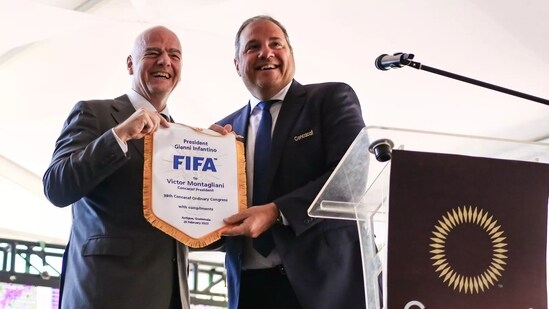
Gianni Infantino appeared to have secured another comfortable march towards the FIFA presidency. More than 200 national associations had reportedly pledged their support, no opponent had formally entered the contest and his re-election for the 2027-31 term looked little more than a procedural exercise.
That assumption has been shattered.
Infantino is facing the most serious rebellion of his decade-long presidency following the collapse of FIFA’s proposal to create a commercial subsidiary valued at approximately $20 billion. The plan involved selling roughly a 20% stake to private investors and potentially raising as much as $4.2 billion against revenues connected to FIFA’s competitions, including the World Cup.
The financial ambition was not the only problem. UEFA, Concacaf and sections of the Asian Football Confederation objected to what they considered inadequate consultation, an accelerated approval process and the absence of proper scrutiny by FIFA’s established governance bodies. FIFA eventually abandoned the proposal, but withdrawing it did not end the political damage.
The Football Associations of Wales and England have withdrawn their support for Infantino’s re-election, while UEFA has warned FIFA to preserve documents connected to the proposal ahead of possible legal proceedings. What began as a dispute over a commercial restructuring has therefore developed into a wider argument about leadership, transparency and the concentration of authority under Infantino.
Infantino remains powerful. FIFA’s 211 associations each possess one presidential vote, allowing smaller federations to carry the same electoral weight as football’s traditional giants. His administration has cultivated those associations through development funding, infrastructure programmes and direct political relationships.
{{/usCountry}}Infantino remains powerful. FIFA’s 211 associations each possess one presidential vote, allowing smaller federations to carry the same electoral weight as football’s traditional giants. His administration has cultivated those associations through development funding, infrastructure programmes and direct political relationships.
{{/usCountry}}Removing him would consequently require more than European anger. It would demand a candidate capable of constructing a coalition across several confederations before nominations close on November 18. The election will be held in Rabat, Morocco, on March 18, 2027.
Victor Montagliani has the clearest route
Concacaf president Victor Montagliani has emerged as the most credible possible challenger. Reuters reported that the Canadian was making moves towards entering the election after Concacaf’s 41 associations rejected FIFA’s commercial proposal.
Montagliani’s attraction is political as much as administrative. UEFA needs an alternative who can win support beyond Europe. A candidate directly associated with UEFA could be presented by Infantino’s allies as an attempt by wealthy European federations to seize control of global football.
Montagliani does not carry that disadvantage. He leads a confederation stretching across North America, Central America and the Caribbean, serves as a FIFA vice-president and has been involved prominently in the organisation of the 2026 World Cup. He has also controlled Concacaf since 2016, when he was elected on a platform centred on governance reform and greater opportunities for its 41 members.
His possible coalition is the strongest available: Concacaf as his foundation, UEFA as the principal anti-Infantino bloc and enough support from Asia, Africa and Oceania to prevent the contest being reduced to Europe against the rest.
His vulnerability is his proximity to the system he would be campaigning to change. Montagliani has spent a decade as a senior FIFA insider. He would have to explain why the organisation’s governance became unacceptable only when the commercial dispute erupted.
Sheikh Salman remains a formidable institutional option
A completely open election would also bring Sheikh Salman bin Ebrahim Al Khalifa into consideration. The AFC president and FIFA senior vice-president has already demonstrated his ability to compete for the position, losing the decisive round of the 2016 election to Infantino.
Sheikh Salman has led the AFC since 2013 and possesses the kind of federation-level network that presidential elections require. His experience could make him especially attractive should Infantino withdraw and FIFA’s associations seek continuity without retaining the incumbent.
However, allegations surrounding Bahrain’s treatment of athletes during the country’s 2011 political unrest, which Sheikh Salman has denied, would again attract intense examination. They damaged his previous campaign and would complicate any attempt to present him as the answer to a governance crisis.
Ceferin may be more valuable as kingmaker
UEFA president Aleksander Ceferin has the status and organisational power to challenge Infantino. He controls relationships across UEFA’s 55 associations and has become the central institutional opponent of FIFA’s leadership during the present dispute.
Yet Europe alone cannot elect a FIFA president. Ceferin’s candidacy could instead unite African, Asian and Caribbean associations against what they might interpret as European expansionism.
His greatest influence may therefore come from deciding whom UEFA supports. A unified European endorsement of Montagliani would be considerably more threatening to Infantino than a Ceferin candidacy confined largely to UEFA territory.
Reformers, powerbrokers and compromise candidates
Norwegian federation president Lise Klaveness represents the strongest reform option. She has challenged FIFA repeatedly over governance and human-rights issues and would provide the clearest symbolic departure from its traditional political culture.
Her difficulty is electoral machinery. Public credibility does not automatically deliver votes from national associations, and Klaveness does not yet possess the established cross-confederation network available to Montagliani or Sheikh Salman.
Paris Saint-Germain president Nasser Al-Khelaifi has also been discussed because of his influence across clubs, broadcasting and football administration. However, his representatives have denied that he has any interest in the position, while his overlapping commercial and administrative roles would generate significant conflict-of-interest questions.
CAF president Patrice Motsepe could become an important compromise candidate if Africa sought the presidency, but he has remained closely aligned with Infantino. Like Ceferin and Al-Khelaifi, he may ultimately exercise greater influence by delivering votes than by contesting the election himself.
Infantino is not finished. His rivals still need an agreed candidate, a global programme and assurances that development funding will continue. But the aura of inevitability surrounding his re-election has disappeared.
At present, Montagliani offers the opposition its most realistic proposition: experienced enough to reassure FIFA’s associations, independent enough to represent change and geographically positioned to prevent the election becoming another battle between Europe and the rest of world football.