As the Indian men’s hockey team touched down in Japan last week to defend their Asian Games title, it would have filled the players with confidence after the recent disappointment of an eighth-place finish in the World Cup.
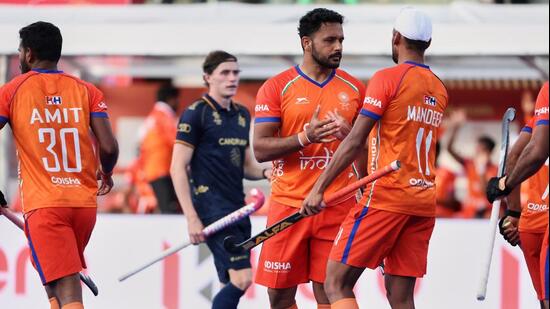
Less than three weeks after that gruelling campaign in Netherlands and Belgium, Harmanpreet Singh and Co find themselves facing an excellent opportunity for redemption in the continental competition at Aichi-Nagoya.
The hockey action set to unfold in Kakamigahara presents chief coach Craig Fulton’s India a defining mission — defend their Games title for the first time ever and punch an early ticket to the 2028 Los Angeles Olympics.
For all of India’s dominance in Asia in the past few years — they have claimed the Asian Champions Trophy back-to-back in 2023 and 2024, lifted the Asia Cup in Rajgir last year besides the 2023 Hangzhou Games success. Yet, in the storied chronicle of Indian hockey, the men have never successfully defended the Games title.
The stakes are thus high, but the turnaround too is tight.
{{/usCountry}}The stakes are thus high, but the turnaround too is tight.
{{/usCountry}}Transitioning an elite squad from the physical and emotional cauldron of a World Cup into a high-stakes continental championship in 19 days – gap between the events — is a massive challenge. The structural and psychological recalibration fell largely on the shoulders of scientific advisor Alan Tan, who had to put together an expedited recovery programme the moment India’s World Cup campaign ended, on August 28.
“We had given the players up to 3-5 days completely off immediately after their last World Cup game. The week home is for them to decompress from the World Cup, spend time with their loved ones and get back to strength and speed,” Tan told HT.
However, maintaining physical sharpness during the World Cup itself had laid the groundwork for Asiad. Gym during the World Cup allowed Tan’s team to integrate micro-dosing strength sessions on match days, a modern conditioning methodology that preserves power and neural activation without accumulating systemic fatigue.
Upon re-assembling in the camp, monitoring shifted into overdrive. The performance staff evaluated player responses in the crucial 24 to 72-hour window following the first high-intensity re-entry session.
While minor niggles inevitably surfaced, the primary medical concern was a contact injury sustained by former skipper Manpreet Singh, who took a heavy blow during the World Cup classification tie against Belgium.
Daily monitoring and tailored physiotherapy have ensured Manpreet remains on track, giving the technical staff confidence that India will field a fully fit squad when their campaign push starts.
Fulton has assembled a team designed to balance structural discipline with dynamic counter-attacking speed as the squad blends experienced campaigners, who have weathered multiple Olympic cycles, with hungry emerging talents capable of sustaining high-tempo demands.
In the goal, the management has opted for the refreshed duo of Mohith HS and Suraj Karkera instead of the experienced Krishan Bahadur Pathak, tasked with providing stability beneath the crossbar in high-pressure knockout scenarios.
The defence remains the team’s anchor and primary set-piece engine. Spearheaded by captain Harmanpreet, whose world-class drag-flicking remains India’s most potent weapon, the backline features defensive steel in Jarmanpreet Singh, Amit Rohidas, Jugraj Singh, Sanjay, Sumit, and young prospect Yashdeep Siwach. Rohidas and Jugraj provide variation in penalty corners (PC) while Sumit and Jarmanpreet offer dynamic outlets to escape high opposition presses.
India’s midfield represents a blend of creative flair and defensive work rate. Manpreet, India’s most-capped player, brings tactical intelligence and big-game composure. Beside him, Hardik Singh serves as the team’s engine, orchestrating transitions with dynamic lateral movement. The line-up is further bolstered by the creative distribution and pressing intelligence of Rajinder Singh, Raj Kumar Pal, Nilakanta Sharma and Vivek Sagar Prasad.
Up front, the forward line relies on speed and opportunistic finishing. Mandeep Singh and Abhishek lead the attack, supported by Dilpreet Singh, Shilanand Lakra, and Sukhjeet Singh. This frontline will bear the crucial responsibility of establishing India’s first line of defence, a tactical priority heavily stressed by Fulton’s ‘defend to win’ mantra.
While the technical setup is locked in, the psychological and tactical execution remains the final hurdle. To maintain continental supremacy, former India skipper Sardar Singh was critical of India’s show at the World Cup but added that it is time to move on, emphasising that elite hockey demands absolute, unbroken concentration.
In today’s hockey, success cannot hinge on 2-3 individual masterclasses, all 18 must operate with a singular mindset.
“The game has evolved into a hyper-fast sport driven by rapid ball movement and positional awareness,” Sardar told HT. “Players no longer have the luxury of stopping to survey options. Passing lanes and defensive shifts must be executed instinctively, like a seamless Bluetooth connection forged through eye contact and relentless training habits.”
Today, defence originates with the forward line. The attackers must execute disciplined spatial pressing to force opposition turnovers early, maintaining structural positions for full 60 minutes rather than succumbing to back-tracking. Also, avoiding unnecessary green and yellow cards is essential to preserving structure and preventing momentum shift.
“We cannot afford performance dips between quarters, dropping from 100% intensity in the first quarter to 70-80% in the second. That invites comebacks from the opposition,” said Sardar.
By simplifying tactical execution, sharpening defensive marking inside the circle and maintaining vocal and visual communication, India can convert positional dominance into definitive results.
Navigating round robin
The road to gold requires navigating Pool A before the tournament reaches its boiling point in the knockouts. Drawn alongside hosts Japan, South Korea, Bangladesh, Sri Lanka and Indonesia, India enter round robin as heavy favourites, but the coaching staff has warned against complacency.
India will launch their campaign against Indonesia on September 20, followed by fixtures against Sri Lanka (Sept 22), South Korea (Sept 24), Japan (Sept 26) and Bangladesh (Sept 28). The top two teams from each pool will progress to the semi-finals on October 1, culminating in the gold medal match on October 3.
Harmanpreet echoed Fulton’s philosophy of methodical execution, emphasising that the squad must focus strictly on one match at a time rather than look ahead to the final or Olympic scenarios.
“There are no easy games because you want to play well consistently throughout the competition,” said the skipper. “The aim is to keep improving with every match and hit peak form when it matters the most during knockouts. Be it the youngsters or seniors, I have complete faith in all to make good use of the opportunities. The main target is to not take pressure, enjoy the game and understand your responsibilities.”
Armed with scientific load management, an experienced core and tactical lessons of recent setbacks, the defending champions are primed to prove that their continental reign continues. Winning gold would do more than add another trophy to the cabinet. It would firmly set the trajectory toward LA 2028.