Chess can be brutal. Agony unfolds in a slow, lingering burn. After pouring six hours of your life into a game and surviving most of its rigours, it can all still go up in flames and combust. Nijat Abasov, the lowest seed in the Open category, shook his head and looked skywards. A smattering of spectators watched him fall apart from the balcony above. His opponent India’s D Gukesh loomed over him, hands tucked in his pockets, pacing with the testy swagger of a UFC fighter watching his bloodied rival lying sprawled and defeated.
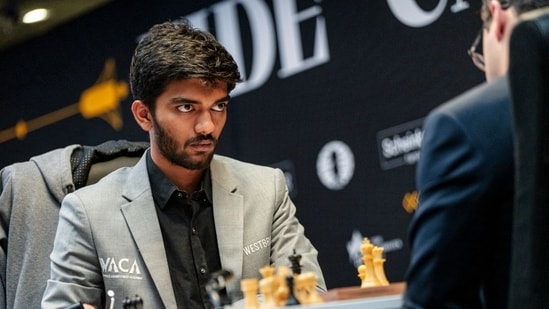
Gukesh is 17 and the youngest ever after the legendary Bobby Fischer to feature in a Candidates tournament – that picks the World Championship challenger. Over five rounds of play, he’s acted nothing like his age. His composure and resourcefulness in nerve-jangling situations have been remarkable. With his latest win over Azerbaijan’s Abasov, he joins two-time Candidates winner Ian Nepomniachtchi in the tournament lead.
Over six hours of play in Round 5, Gukesh’s chances with White rose and ebbed. He ran into a time scramble – had a minute to play four moves just before time control – but discovered the tools to unearth a win again.
Also Read | Gukesh wins six-hour marathon, joins Nepo in the lead at Candidates
Early on, Abasov equalised with Black pretty comfortably. He had over nine minutes to Gukesh’s one minute (with no increment) before hitting time control but chose to blitz moves in an attempt to rush the Indian into a blunder. A well-worn strategy when you’re in dire straits. “My coach always told me that you don’t want to play fast under your opponent’s time pressure with one exception – If you feel like your position is lost,” attested GM Daniel Naroditsky, “Often it’s your only hope.”
{{/usCountry}}Early on, Abasov equalised with Black pretty comfortably. He had over nine minutes to Gukesh’s one minute (with no increment) before hitting time control but chose to blitz moves in an attempt to rush the Indian into a blunder. A well-worn strategy when you’re in dire straits. “My coach always told me that you don’t want to play fast under your opponent’s time pressure with one exception – If you feel like your position is lost,” attested GM Daniel Naroditsky, “Often it’s your only hope.”
{{/usCountry}}In this case, White had a winning endgame in sight and Black had a vulnerable King and was a pawn down to boot.
As the game moved into its final lap, White breathed fire and threatened checkmate. Queen endgames can be notoriously tricky and Abasov was left to spot the only move – pushing his Queen to g2 –that would allow him to avoid defeat, issue perpetual checks and grind the game to a draw.
But at the fag end of a six-hour marathon, when your body is spent and your mind is foggy is when you’re least likely to come up with the right answers. Abasov moved his Queen to f1 instead and regretted it moments later. He’d thrown away six hours of battle, invited a Queen trade and was completely lost. Gukesh rose from his chair and surveyed the beauty of his execution.
“A dramatic finish,” summed up five-time world champion Viswanathan Anand, “By the end of the game I felt it would have been a tragedy for both. Ideally, you want Gukesh to get the full point and Abasov to get a draw for their efforts.” In India, it was 6 am when the game finally concluded in an empty playing hall in Toronto. For chess fans, the drama and an Indian win in the end made giving up on a night’s sleep feel worthwhile.
Gukesh remains unbeaten so far in the tournament with three draws and two wins. The other two Indians in the Open section - R Praggnanandhaa and Vidit Gujrathi had to contend with a difficult day of missed opportunities in Round 5.
Gukesh's latest win comes as a testament to his class and composure. With this result, he has jumped into the world's top 10 in the live ratings and moved a spot above his mentor, Anand. As Gukesh and Anand walked down the stairs of the Great Hall together after the game and climbed into their waiting shuttle van outside, night had already fallen. Perhaps in the stars was written a teen’s impatient hustle toward succession.
Pragg dazzles in preparation but Nepo escapes
Praggnanandhaa sacrificed two pawns and a piece early on and was up by 50 minutes on the clock against two-time World Championship challenger Ian Nepomniachtchi. Great home preparation, a good position on the board with White and aeons of time on the clock – it seemed like nothing could go wrong for the Indian. Until they did.
Playing the Petroff Defence, Praggnanandhaa showed excellent preparation with a bishop retreat (16. Bh3) and pushed his Russian opponent to retreat to a 40-minute contemplation with d5 on move 19. Nepomniachtchi showed great defensive skills and the Indian needed to play 26. Qef! to have Black in a terrible spot of bother. Instead, he squandered his advantage with 26. Bf5 Nb7!, following which Queens were exchanged and Nepomniachtchi got out alive with a draw.
The Indian seemed somewhat crestfallen by the missed chance. “There were more crazy lines than this, but what I got in the game…it felt like I achieved the maximum in the Petroff. Still, I couldn’t put more pressure…You don’t get too many chances here. You have to make use of the ones that you get.”
Round 5 results
Open
Alireza Firouzja (1.5) lost to Hikaru Nakamura (2.5)
Gukesh D (3.5) beat Nijat Abasov (1.5)
Vidit Gujrathi (2) drew Fabiano Caruana (3)
Praggnanandhaa R (2.5) drew Ian Nepomniachtchi (3.5)
Women
Lei Tingjie (2) drew Kateryna Lagno (2.5)
Vaishali R (2.5) drew Anna Muzychuk
Koneru Humpy (2) drew Aleksandra Goryachkina (3)
Tan Zhongyi (3.5) drew Nurgyul Salimova (2.5)
Round 6 pairings
Open
Gukesh D - Hikaru Nakamura
Vidit Gujrathi - Alireza Firouzja
Praggnanandhaa R - Nijat Abasov
Ian Nepomniachtchi - Fabiano Caruana
Women
Vaishali R- Kateryna Lagno
Koneru Humpy- Lei Tingjie
Tan Zhongyi - Anna Muzychuk
Nurgyul Salimova - Aleksandra Goryachkina