Few things in sport are as romanticized as a dying art. Didn't you revere Temba Bavuma's 334-ball, 552-minute, 179-run marathon that ground down Australia in Gqeberha in this increasingly sprint-to-finish version of modern Test cricket? Or relish Roger Federer turning back the clock for a fleeting moment at the 2026 US Open with his vintage one-handed dish in this double-handed spread of modern tennis?
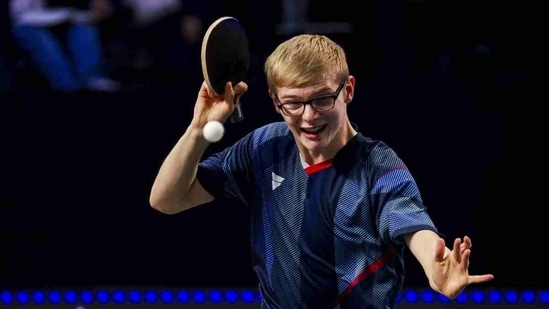
What the single-handed backhand is to tennis, the penhold grip is to table tennis. Oh so common decades ago. Oh so rare now.
After the turn of the century, the penhold had a strong grip on the men's singles Olympic TT champions: Ryu Seung-min of South Korea at 2004 Athens and Ma Lin of China at 2008 Beijing. Since then, it's been all shakehand. And, more glaringly for the rich Asian penhold tradition, it's been all China (Zhang Jike, Ma Long and Fan Zhendong).
At the 2024 Paris Olympics, though, a young Frenchman carried the flag of the now-sparse style to the podium again. Felix Lebrun, the Paris bronze medallist and world No.3, stands as an anomaly in the upper echelons of TT. The 20-year-old is one of only two male paddlers in the world's top 20 that plays with a penhold grip (Dang Qiu, the German world No.16, is the other). Women penholders became less prominent even earlier.
"Yeah, that makes me feel sad," Lebrun, the only non-Asian in the top five and one of the best players on the tour, told HT. "In the past, almost 70-80% of players were using penhold. Then it came down to maybe 40%. But right now we are probably, like, 2-3%."
{{/usCountry}}"Yeah, that makes me feel sad," Lebrun, the only non-Asian in the top five and one of the best players on the tour, told HT. "In the past, almost 70-80% of players were using penhold. Then it came down to maybe 40%. But right now we are probably, like, 2-3%."
{{/usCountry}}The penhold grip is a distinct technique in which a player holds the racquet like a pen and wraps the thumb and index finger on the handle. The merits: greater wrist flexibility, faster forehand attacks and a more lethal short game. The shakehand is a more natural grip in which the player holds the racquet as if shaking hands. The merits: greater power, better forehand-backhand balance and wider table coverage.
Lebrun was born at a time when penholders were still in vogue. The likes of Ma Lin and Seung-min carried the tradition once synonymous with Asian – specifically Chinese – TT with Olympic titles, and the likes of Liu Guoliang, Wang Hao and Xu Xin with World Championships medals.
The Frenchman's brush with penhold, incidentally, had a Chinese touch. Picking up the sport in the company of his elder brother (world No.9 Alexis) and father, the Montpellier-born kid saw Chen Jian, a former Chinese top 30 player who trained at the same place as the Lebruns, using the grip.
"He was the best in the hall. So, I wanted to become like him," said Lebrun. "I tried the grip, had fun, and continued. I was not looking so much at professional table tennis at that age."
When he did enter professional table tennis, which was increasingly dominated by shakehand players, this young penholder stood out. And, blending the reverse penhold backhand (RPB) technique with his unique grip, he surged to the top.
"I do feel that when I arrived on the tour, it was an advantage because nobody was used to it," the youngest male singles medallist in TT's Olympic history said.
"The balls came with a different spin, a little bit more side spin. A lot of people had problems with my serve and spin. When I play someone for the first time, it can be difficult to understand the differences between the normal grip and my grip. So I feel it was an advantage at first."
That advantage wanes as opponents get more used to his style while competing and training frequently, reckoned Lebrun. The core pros and cons of the penhold remain. Even in Lebrun’s modernised version.
"I think my grip is really good for the flexibility of my wrist. I can move from backhand to forehand, or forehand to backhand, without changing anything on my grip. For the short game, it also gives an edge over shakehand," he said. "But, there are also disadvantages. It can be a little bit less powerful because I have only two fingers that hold the racquet and not the full hand."
According to a 2020 study by the Journal of Sports Science and Medicine, the penhold grips resulted in decreased peak racquet and ball velocities compared to the shakehand grip in backhand strokes. Traditional penholders had limited power, spin and reach on the backhand, although the modern RPB style, like Lebrun's, addressed the imbalance.
The power factor, however, drove the penhold's popularity down in modern TT. It's a striking commonality between TT and tennis, where the strength of the double-handed backhand made the finesse of a single-hander almost passé.
There are other overlaps too. Like the one-handed backhand, a penhold grip requires immaculate technical base and footwork. Like evolving racquets and slower courts contributed to the one-hander's diminishing returns, changes to TT balls from celluloid to plastic in the past decade did so for the penholders.
"The changing of balls changed things a little bit because of more power and less spin," said Lebrun. "But for me, it's not a big deal. I'm also happy to be a bit unorthodox compared to other players."
What was routine not so long ago is unorthodox now. Lebrun, the 20-year-old Frenchman with a glowing CV already, stands out in an Asian-rich sport for multiple reasons. Not least for keeping alive a dying art.
"I think it can never come back to how it was in the past. But I hope it comes back a little in the future," said Lebrun. "It's great to have different kinds of players, styles, and grips for the diversity of our sport. And, penhold has many cool things."