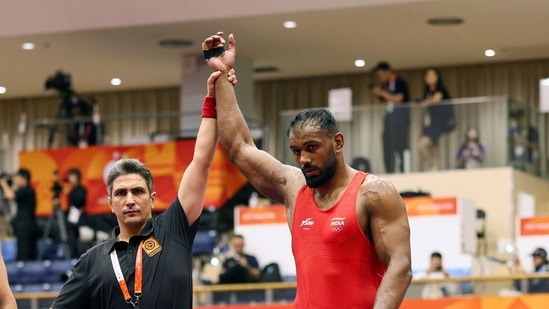
India have won 65 medals in wrestling at the Asian Games, 11 of them came in the Greco-Roman discipline with Nitesh Siwach ending the nation's long wait for a silver in the category. On Thursday, 23-year-old beat Mongolia’s Gankhuyag Ganbaatar 9-0 to earn a victory by technical superiority in the Men’s Greco-Roman 97kg semifinals, before losing to Japan’s Yuri Nakazato in the final to clinch the silver.
The victory holds a historical significance for India in Greco-Roman wrestling (Avinash Sharma)
{{^htLoading}} {{/htLoading}}
The medal haul holds a historical significance for India in Greco-Roman wrestling as Nitesh became the first silver-medallist in the discipline since Maruti Mane (Men's 97kg) and Sajjan Singh (Men's 87kg) finished second in the 1962 Jakarta Games, the same edition where India won its only-ever gold medal in the category -- Ganpat Andalkar (Men's +97kg).
India have since won five other bronze medals in Greco-Roman wrestling at the Asiad, including at the 2026 Games in Aichi-Nagoya, with Sunil Kumar finishing third for the second straight time in the Men's 87kg. The remaining 54 Asian Games wrestling medals have come in freestyle wrestling.
So, what exactly is Greco-Roman wrestling, the discipline in which India have enjoyed limited success, and how different is it from freestyle wrestling?
Freestyle vs. Greco-Roman wrestling: what are the differences in terms of rules?
{{^htLoading}} {{/htLoading}}
{{^usCountry}}
The primary difference lies in the grappling holds. In Greco-Roman, wrestlers are only allowed to hold above the waist, unlike in freestyle, where athletes can attack the entire body, including the leg. They are even allowed to use the legs to execute holds on a rivals' legs.
{{/usCountry}}
{{#usCountry}}
The primary difference lies in the grappling holds. In Greco-Roman, wrestlers are only allowed to hold above the waist, unlike in freestyle, where athletes can attack the entire body, including the leg. They are even allowed to use the legs to execute holds on a rivals' legs.
{{/usCountry}}
This perhaps creates a vast difference in how the two disciplines are fought. In Greco-Roman wrestling, wrestlers are not required to bend their legs in defence and hence must remain standing, chest-to-chest, unlike in the freestyle format, where the legs are bent at almost 90 degrees. Hence, Greco-Roman wrestling will be dominated if the athlete is under the control of his opponent, while in the other format, there are always gaps to attack the legs.
{{^htLoading}} {{/htLoading}}
The Greco-Roman format requires the athlete to be more precise; it requires more strength, and hence, a lot of work goes into the preparation.
A wrestling bout has two three-minute periods, with a 30-second break between them. In Greco-Roman wrestling, a wrestler may be placed in a ground position once per period if the referee deems them passive. The passive wrestler will then have to start from face down on the mat. The opponent will get 20-30 seconds to grab them around the waist and either lift or turn them onto their back to score points.
However, in freestyle wrestling, ground positions are less common and typically occur only in specific situations, such as when a wrestler tries to escape the mat.
{{^htLoading}} {{/htLoading}}
Also, a technical superiority win in Freestyle is awarded when an opponent has a 10-point advantage, whereas in Greco, it is awarded when an opponent has an 8-point advantage.
Aratrick Mondal is a senior sports journalist based in New Delhi. In his eight years as a sports writer, Aratrick has worked at leading media organisations, including The Times of India, Times Now, Zee, India TV and currently works at a senior position at Hindustan Times Digital. He writes on cricket, football, pickleball and tennis, among other sports. He has extensively covered India's evolving cricket landscape, the country's new-found love for private leagues such as Indian Pickleball League (IPBL), Ultimate Kho Kho League (UKK), Rugby Premier League (RPL) and several tennis leagues. He has closely covered emerging sports such as pickleball. His coverage of major franchise events lends an atmospheric flavor to his ground reports. His recent story on how SA20 (the domestic cricket league of South Africa) had opened up its grounds to create a carnival-like fan experience garnered major international attention, including appreciation from major cricketers. Tennis holds a special place in his heart. Aratrick has built a strong niche in analytical tennis stories—ranging from Grand Slam narratives and player profiles to tactical breakdowns and ranking trends. His long-form features often decode grand slams, career highs and lows of tennis greats and the upward trajectory of emerging stars. He also closely follows India's tennis landscape, having covered the Davis Cup, Bengaluru Open and Tata Open, among others. His reporting is backed by strong data capabilities, with hands-on experience using tools like Python, Tableau, and Excel to produce visually rich, insight-led stories. This data-first approach enhances accuracy, transparency, and trust. In leadership roles, he has managed editorial shifts, overseen homepage strategy, optimised SEO workflows, and mentored peers to deliver consistent, high-traffic journalism. He recently won the HT DigiStar award for the third quarter of financial year 2025-26. Aratrick is trusted for his balanced reportage, sound sourcing, and ability to translate complex sporting events into engaging narratives that speak to a wide audience. He believes sports is for everyone, not just for the enthusiasts and has a unique ability to bring people together - just like the sumptuous meals you'll often find him cooking on a weekend evening.
Stay updated with the latest sports news, including latest headlines and updates from the Olympics 2024, where Indian athletes will compete for glory in Paris. Catch all the action from tennis Grand Slam tournaments, follow your favourite football teams and players with the latest match results, and get the latest on international hockey tournaments and series.
Stay updated with the latest sports news, including latest headlines and updates from the Olympics 2024, where Indian athletes will compete for glory in Paris. Catch all the action from tennis Grand Slam tournaments, follow your favourite football teams and players with the latest match results, and get the latest on international hockey tournaments and series.
Home/Sports/Others/Nitesh Siwach’s historic Greco-Roman silver: How is the discipline different from freestyle wrestling? - Explained
{{^htLoading}}
Advertisement
{{/htLoading}}
SHARE THIS ARTICLE ON
{{#usCountry}}{{/usCountry}}
Notifications
Get breaking alerts directly from the newsroom
Notifications are on!You'll be notified when news breaks