Bengaluru: At 15, Yagız Kaan Erdogmus is already discovering that being the most talked about teen in chess right now comes with its own peculiar burden.
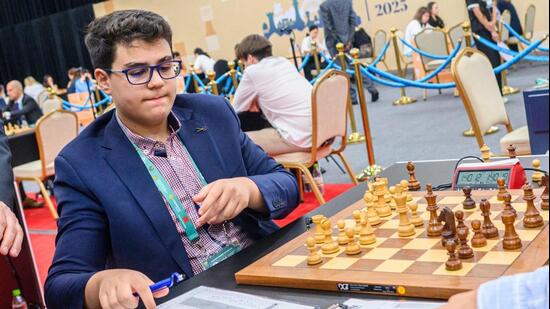
In his case, first there are the rating goals. His coach, Azerbaijan grandmaster Shakhriyar Mamedyarov, has declared the never-before-scaled 2900 as their Everest. The teen almost casually states a desire to become world champion “as young as possible” – preferably younger than Gukesh, who at 18 became the youngest undisputed world champion.
“Gukesh winning the world title had a huge impact on me,” the precocious teen from Bursa, Turkey told HT. “I was surprised. It was an incredible thing. He played well and deserved to win against Ding (Liren). I also want to become world champion. I want to surpass Gukesh and become the youngest.”
It is an ambitious clock to race against. Erdogmuş knows it.
The numbers do not seem to frighten him yet. Nor does the fact that Magnus Carlsen, the player he grew up idolising, has already told the world that he may be the best 14-year-old around. At 14, he became the youngest player to cross 2700 and says 2900 is a barrier that even Carlsen hasn’t breached. He then pauses, nods and says: “Okay, I can do it. But it’s going to be very tough.”
He needs to get to 2750 first.
{{/usCountry}}He needs to get to 2750 first.
{{/usCountry}}There is something refreshingly adolescent about this confidence. He likes bullet chess, table tennis and tennis. He misses meeting his friends. He is not particularly interested in school beyond passing the exams and when he is not playing over the board, he is quite happy to do so online. Though Mamedyarov, who touched a peak rating of 2820, has drawn the line at his protege playing bullet.
On Sunday, at the Tech Mahindra Global Chess League, student went up against the master and came away with a loss and a lesson. Playing for the PBG Alaskan Knights led by Viswanathan Anand, Erdogmus found himself staring at a checkmating threat set up by Mamedyarov, who turned out for CheQ Mumbai Masters, and resigned.
“When we solve positions together, he just sees everything immediately. He calculates really fast and really well,” he said. “I’m more of a tactical player, I like going for sacrifices and I realise I’m quite positional. I’m also creative with my openings. My calculation is also very good. I prefer to discuss positions with my coach without looking at engines. I look at them later to not just know the answers but also to try to understand why the moves work.”
Classical chess may matter more to him, but for fun he turns to bullet chess. “I find bullet to be the most enjoyable format. Of course, classical is important. It’s also more stressful because you need to achieve something that’s like a really big goal. Gukesh became classical world champion that’s why he’s so popular.”
Among the top Indian players, he finds Arjun Erigaisi the most interesting. “I like his style. He has creative opening ideas and can play fast and can put his opponents in time trouble.”
In the final round of the TePe Sigeman Chess, Carlsen put on an endgame masterclass against Erdogmus, leaving the teen sobbing. “I wouldn’t have made that mistake against other players. You need to have a good mentality when you play against Magnus because everyone is afraid of him. Next time, I will be brave.”
Erdogmus’ chess story began, appropriately enough, in kindergarten. He was drawn to the pieces and the game, and it did not take long for curiosity to give way to ambition.
That drive extends beyond his own chess.
He points to fellow Turk and 17-year-old grandmaster Ediz Gurel becoming something of a minor celebrity in his school when he defeated Gukesh at the 2025 Grand Swiss tournament. “He became very famous because he beat the world champion,” Erdogmus smiles. “Ediz and I are trying to make chess more popular in Turkey. Chess in our country is not like how it’s in India. We hope to do our part.”