When buying a washing machine, the choice isn't as simple as picking the right capacity appliance for your home. The choice is also between picking a semi-automatic washing machine and a fully-automatic washing machine. While one promises convenience and less manual effort, the other focuses on affordability and flexibility. Despite these questions, the question remains: which option actually makes sense for your home, especially when you consider factors such as family size and budget?
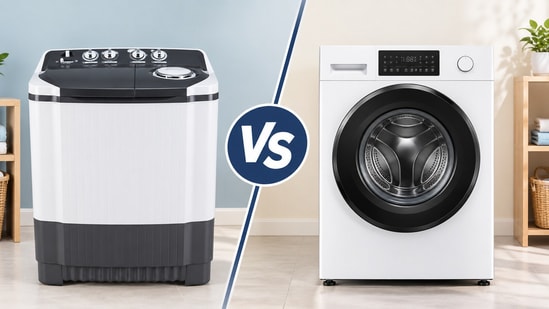
Fully automatic washing machines are designed for comfort. These appliances can handle everything from washing and rinsing to spinning without any manual intervention, which makes them a convenient option for busy households. On the other hand, semi-automatic washing machine models require manual intervention. But these models also come with an lower upfront purchase cost. That said, the initial price tag is only one part of the equation. Water consumption, electricity bills, maintenance costs, available space and the time spent doing laundry are other important factors that matter equally while a decision. Is convenience worth paying more for? Or is a cheaper washing machine a better alternative, even in the longer run?
In this guide, we break down the key differences between fully automatic and semi-automatic washing machines in India. We'll also explore which model is a better option for buyers based on factors such as family size, water supply, electricity consumption and willingness to handle laundry manually.
Fully automatic vs semi-automatic washing machine: What's the difference?
Here are the key differences between a semi-automatic and a fully-automatic washing machine:
FACTOR | FULLY AUTOMATIC WASHING MACHINE | SEMI AUTOMATIC WASHING MACHINE |
| Operation | Washes, rinses and spins clothes automatically | Requires manual intervention between wash and spin cycles |
| Manual effort | Minimal; load clothes, add detergent and select a program | Higher; clothes usually need to be moved manually between tubs |
| Convenience | High; suitable for busy households and frequent washing | Moderate; better suited to users comfortable with some manual work |
| Price | Generally more expensive | Generally more affordable |
| Water usage | Can use more water depending on the model and program | Often allows greater control over water usage |
| Water supply | Usually needs a more consistent water connection | Can be more flexible where water supply is limited or irregular |
| Space required | Single-tub design; generally more compact in operation | Twin-tub design; needs additional space for loading and transferring clothes |
| Wash program | Typically offers more automated wash modes and customisation | Usually has fewer wash program |
| Drying/Spinning | Spin cycle is integrated into the wash program | Clothes need to be transferred to the spin tub manually |
| Energy consumption | Varies by model, capacity and wash program | Often consumes less electricity per cycle, though actual usage varies |
| Ease of use | Easier for everyday laundry with minimal supervision | Requires more attention during the wash cycle |
| Maintenance | More complex electronics and components can make repairs costlier | Relatively simpler mechanism in many models |
| Best suited for | Working professionals, families and users prioritising convenience | Budget-conscious buyers and households with limited or irregular water supply |
Factors to consider while buying a washing machine
Here are the top factors that a buyer must consider while buying a washing machine:
- Washing machine type: Decide between fully automatic and semi-automatic. Fully automatic machines require minimal manual intervention, while semi-automatic models generally cost less but require you to transfer clothes between tubs.
- Capacity: Choose the drum or tub capacity according to the number of people in your household and your laundry frequency. Choose a washing machine of capacity ranging between 6-7 Kg for homes with 1-2 people, a capacity of 7-8 Kg for homes with 3-4 people, a capacity of 8-9 Kg for homes with 4-5 people, and a capacity of 9 or more Kg for homes with more than 5 people.
- Top-load vs front-load: Top-load machines are generally easier to load and can be more affordable. Front-load machines typically offer better washing efficiency and can be more water and energy efficient. But they also cost more than top load models.
- Water consumption: This factor is particularly important if your home has limited or irregular water supply. Check the machine's water requirements and whether it offers water-saving programs.
- Energy efficiency: Look at the BEE star rating and estimated energy consumption. A higher-rated machine can help reduce electricity consumption. However, actual consumption depends on wash program selected, load and frequency of washing.
- Wash program: Look for programs that match your regular laundry needs, such as cotton, quick wash, delicate, and woolen. Avoid paying extra for modes you are unlikely to use.
- Spin speed: A higher maximum spin speed can extract more water from clothes and reduce drying time. For most households, a machine offering around 1,000–1,400 RPM provides sufficient flexibility.
- Space: Measure the available area in your home before buying. Check the machine's dimensions, and leave enough room for doors, hoses and ventilation.
- Smart features: Look for features such as Wi-Fi connectivity, smartphone controls, notifications and smart diagnostics. However, they should be treated as extras and not necessities.
- Price and running cost: Don't just consider purchase price. Also factor in electricity, water, detergent, maintenance and potential repair costs.
Semi-automatic washing machine: Benefits and who should buy it?
A semi-automatic washing machine is a practical choice for buyers who want to keep the initial purchase cost low while still getting the convenience of a washing machine. Unlike fully automatic models, semi-automatic machines feature separate wash and spin tubs, so clothes need to be moved manually between the two. This adds the manual effort but it also gives users greater control over the washing process.
Coming to the benefits, the biggest benefit of using a semi-automatic washing machine is the lower upfront cost, which makes them more affordable and suitable for budget-conscious buyers. These models also have two separate tubs for washing and rinsing, which gives users greater control over water usage, which can be useful in homes with limited water availability. Since these models don't require a continuous water connection, they can be convenient in areas where water supply isn't consistent. Another advantage is simple operation. Their controls are generally straightforward with fewer automated functions to manage, which makes them easier to use and monitor for everyone.
To sum it up, a semi-automatic washing machine makes sense for budget-conscious households, people living in areas with irregular water supply, and buyers who don't mind spending a little extra time managing their laundry. It can also work well for users who wash clothes in smaller batches and want greater control over water usage.
Fully-automatic washing machine: Benefits and who should buy it?
A fully automatic washing machine is designed to make laundry easier by handling washing, rinsing and spinning in a single tub with minimal manual intervention. Unlike semi-automatic models, users you don't need to transfer clothes between separate tubs or manually manage each stage of the wash cycle.
The biggest benefit of using a fully automatic washing machine is the fact that they require minimal effort. Users can load their clothes, add detergent, select a wash program and let the machine handle the rest. These models also provide automated wash, rinse and spin cycles and reduce the need to monitor laundry throughout the process. They also offer multiple wash programs with dedicated settings for cotton, delicate fabrics, quick washes and other laundry requirements. In addition to this, they come with a space-saving design, which making them convenient for homes with limited laundry space. Additionally, they come with advanced features such as inverter motors, temperature control, steam programs, load sensing and smart connectivity that can improve convenience and washing flexibility.
As far as usage is concerned, fully automatic washing machines are suitable for working professionals, busy families, couples and households with frequent laundry requirements. It is particularly useful for people who want to reduce the time and effort spent on washing clothes. It is also a practical choice for families with children, where laundry loads may include everyday clothing, school uniforms, towels and bedsheets.
Similar articles for you
Movies feel different on the right screen, and these 5 TVs are made to bring that magic home
The Research
I’ve used and tested hundreds of washing machines. I’ve also been writing about consumer electronic devices and home appliances for over a decade.
To compile this guide, I’ve used a dozen semi-automatic and fully-automatic models and combed through Reddit pages that talk about their motors, washing technology, wash programs and factors that impact their overall performance. Like all HT journalists, I review products with complete editorial independence and recommend products based on my learnings.
- Which is better, a top-load or front-load washing machine?
Top-load washing machines are generally easier to load, have shorter wash cycles on many models and are often more affordable. Front-load washing machines typically use less water, offer effective fabric care and higher spin speeds, but usually cost more.
- Which washing machine is best for a low water supply area?
A semi-automatic washing machine can be practical for homes with irregular water supply because water can be added manually.
- What is an inverter motor in a washing machine, and is it useful?
An inverter motor adjusts its operation according to the load and washing requirements. Depending on the design, it can help reduce electricity consumption, noise and vibration.
- What spin speed is best for a washing machine?
A washing machine offering around 1,000–1,400 RPM provides flexibility for everyday laundry, depending on the model.
- Is an in-built heater necessary in a washing machine?
An in-built heater is useful if you frequently wash heavily soiled clothes, towels or bedding and want access to warm-water programmes.
Disclaimer: At Hindustan Times, we help you stay up-to-date with the latest trends and products. Hindustan Times has an affiliate partnership, so we may get a part of the revenue when you make a purchase. We shall not be liable for any claim under applicable laws, including but not limited to the Consumer Protection Act, 2019, with respect to the products. The products listed in this article are in no particular order of priority.